Yes, you can busk legally in New York City in 2026: the MTA's own rules allow "artistic performances, including the acceptance of donations" in subway stations, and NYC parks let you play acoustic without a permit. The catches are amplifiers, a few places with marked spots, and PATH stations, where music is banned. Jersey City and Hoboken are harder: we couldn't confirm their street performer rules online, so this guide gives you the offices to call. Everything here comes from the written rules, linked below. Last checked: November 9, 2026. This is general information, not legal advice.
TL;DR
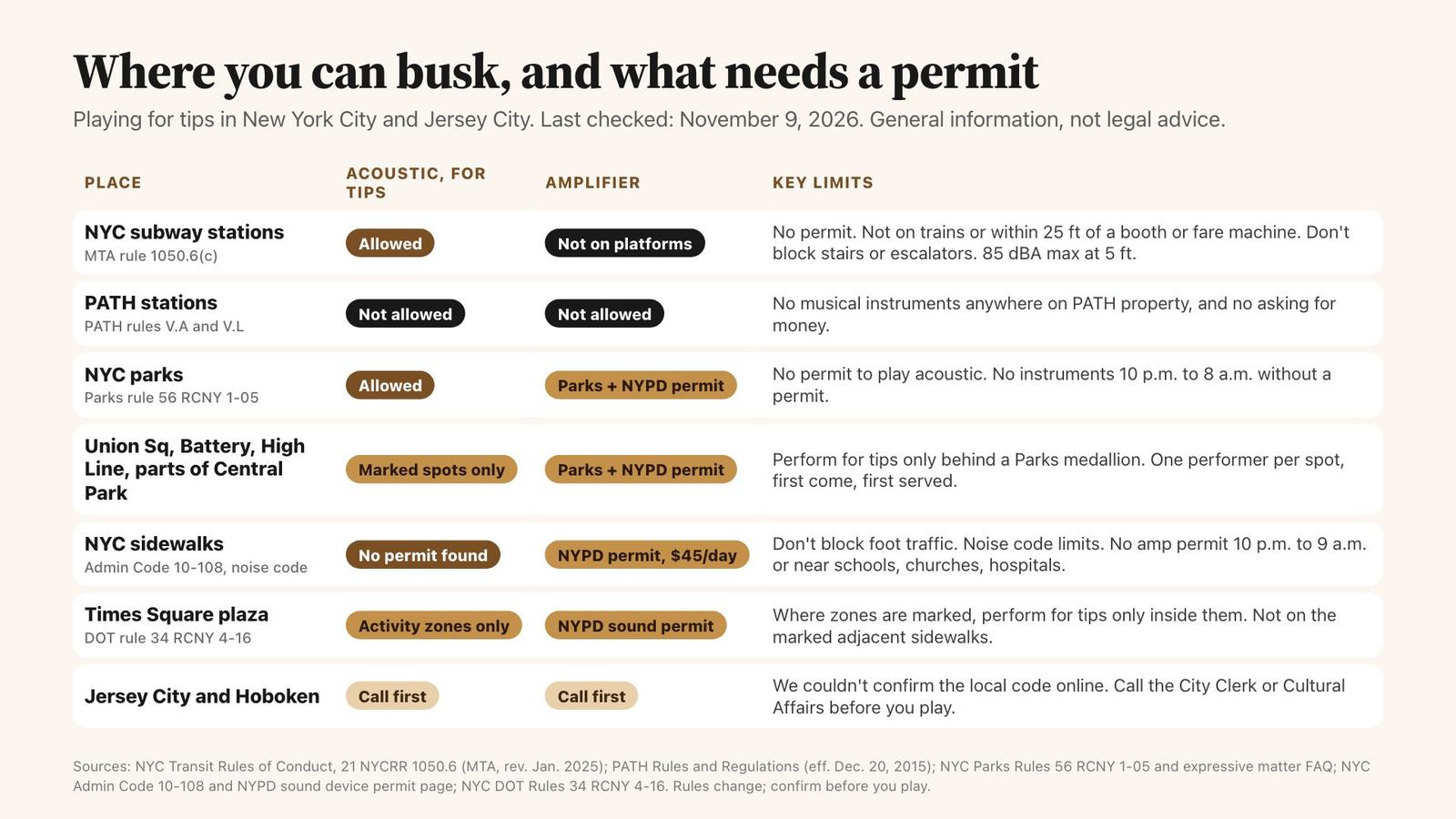
- NYC subway: allowed, no permit. No playing on trains, within 25 feet of a booth or fare machine, or where you block stairs, escalators or riders. No amplifiers on platforms. Over 85 dBA at five feet is too loud.
- PATH: not allowed. No musical instruments anywhere on PATH property, and no asking for money.
- NYC parks: acoustic is fine. In Union Square, Battery Park, the High Line and parts of Central Park, you must play from a marked spot. Amps need a Parks permit plus an NYPD sound permit. No instruments 10 p.m. to 8 a.m. without a permit.
- Sidewalks and amps: the NYPD sound device permit costs $45 a day. File it at the local precinct at least five days ahead.
- Times Square: where zones are marked, you can only perform for tips inside a Designated Activity Zone.
- Jersey City and Hoboken: we couldn't confirm the rules online. Call the city before you play.
Table of contents
- Busking in the NYC subway
- PATH stations: no music
- NYC parks
- Sidewalks, amps and the NYPD sound permit
- Times Square
- Jersey City and Hoboken
- Tips, courtesy and gear
- If police ask you to move
- FAQ
Busking in the NYC subway
The subway is the clearest case, because the rule is written down. Section 1050.6(c) of the NYC Transit Rules of Conduct (21 NYCRR Part 1050) lists the "nontransit uses" the MTA allows, and one of them is "artistic performances, including the acceptance of donations." The MTA's subway performance rules page says it plainly: any musician may perform as long as they follow the Rules of Conduct. No permit, no audition.
The same section sets the limits:
| Rule | What it says |
|---|---|
| 1050.6(c)(1)(i) | Not "on or within: a subway car; an omnibus; or, any area not generally open to the public" |
| 1050.6(c)(1)(ii) | Not within 25 feet of a station booth or a fare media sales device, like a vending machine |
| 1050.6(c)(1)(iii) | Not within 50 feet of the marked entrance to an authority office or tower |
| 1050.6(c)(2) | Nothing that interferes with "access onto or off of an escalator, stairway or elevator," or with the movement of passengers |
| 1050.6(c)(3) | Not on a platform with construction, renovation or maintenance work on or near it, or near the stairs, escalators or elevators leading to it |
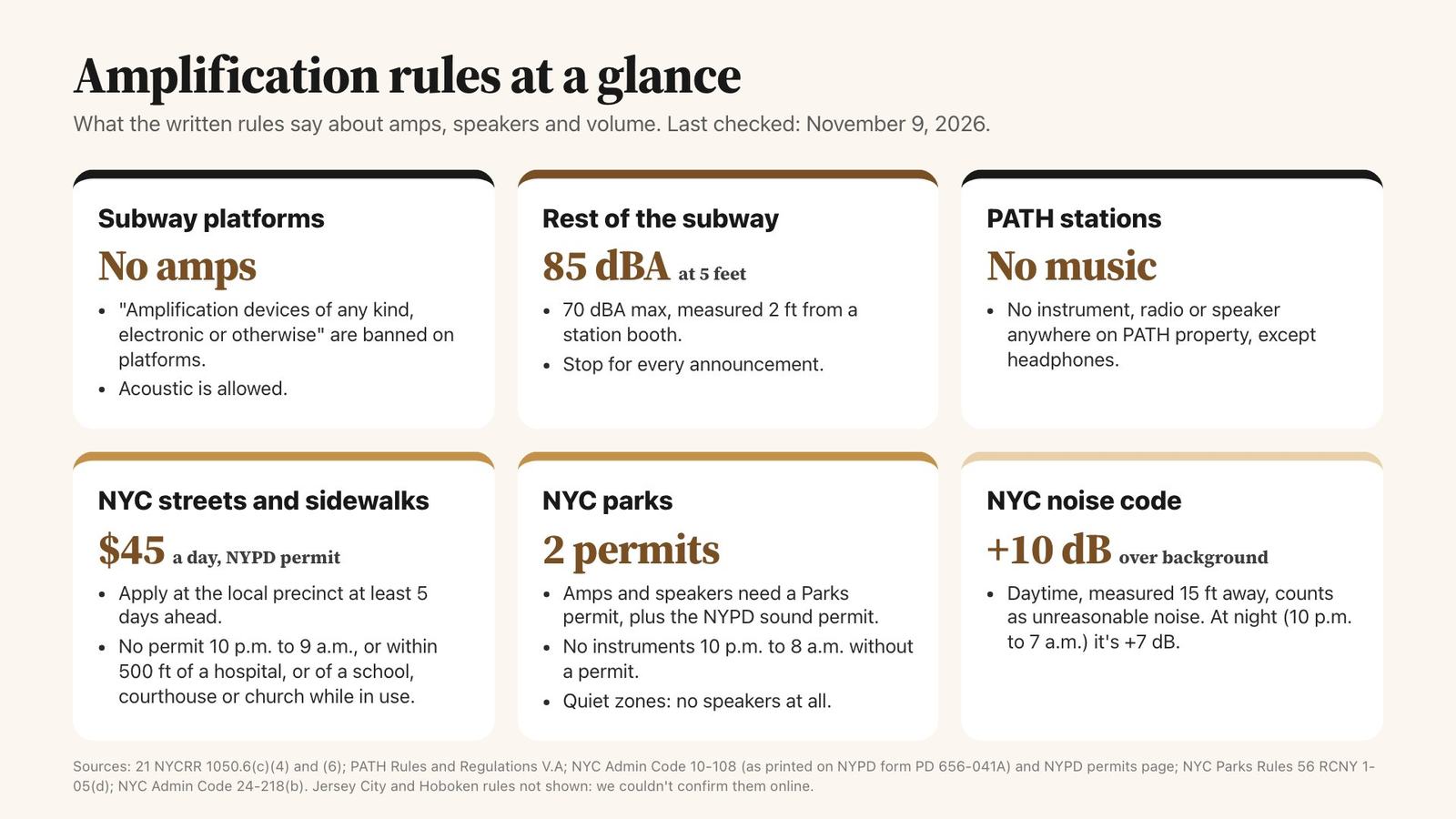
| 1050.6(c)(4) | Sound over 85 dBA measured five feet from the source, or 70 dBA two feet from a station booth, is excessive. "The use on subway platforms of amplification devices of any kind, electronic or otherwise, is prohibited." |
| 1050.6(c)(6) | Stop your sound device during any public address announcement, or one by a police officer or MTA employee |
| 1050.6(c)(7) | Don't claim to be part of an MTA program, like Music Under New York, if you're not |
Put together: acoustic playing on a platform is allowed. A small amp is allowed only off the platforms, like in a mezzanine or passageway, and still under 85 dBA at five feet. The rule only allows donations. Selling things, like CDs or merch, falls under "commercial activity" in 1050.6(b), which needs MTA authorization. The MTA's fine schedule (revised January 2025) lists $25 for each 1050.6(c) violation, such as excessive noise, $50 for unauthorized commercial activity, and $100 for obstructing operations or traffic.
MTA Music and Music Under New York
The MTA also runs its own program, long known as Music Under New York and listed on the MTA's site as MTA Music. The MTA says more than 150 performers and ensembles put on more than 8,500 performances across the transit system. Performers get in by audition, and as of November 9, 2026, the page says: "There are currently no auditions scheduled for MTA Music." For news, email music@mtahq.org or follow MTA Arts & Design. You don't need to be in the program to play legally. You just can't pretend you are.
PATH stations: no music
PATH is run by the Port Authority, not the MTA, and its rules go the other way. Section V.A of the PATH Rules and Regulations (effective December 20, 2015) says no one may "play or operate any musical instrument or device" anywhere on PATH property except through personal headphones. Section V.L bans panhandling, begging or soliciting "the immediate contribution of money." So you can't busk in Journal Square, Grove Street, Exchange Place, Newport, Hoboken or any other PATH station, even quietly.
PATH does allow some "expressive activity," like speech or handing out literature, by permit in designated areas, but its rules bar soliciting funds in any interior space during it. That doesn't open a door for music.
NYC parks
NYC Parks treats performing for tips as vending "expressive matter," which its rules define to include "entertainment." Its expressive matter FAQ confirms that since May 8, 2013, the rules apply to "performers who provide entertainment, such as musical performances, dance, juggling, or other performance arts in exchange for a fee or donation." You don't need a permit to vend expressive matter, but you have to follow the rules in 56 RCNY § 1-05.
Parks with marked spots
In four places, you can only perform for tips from a spot Parks has marked with a medallion on the ground:
- Union Square Park, including its perimeter sidewalks
- Battery Park, including its perimeter sidewalks
- The elevated High Line
- Parts of Central Park: the perimeter from East 60th to East 85th and West 60th to West 86th, Central Park South, Wien Walk and Wallach Walk, the paths along East Drive between Grand Army Plaza and Center Drive, Grand Army Plaza, Pulitzer Plaza and Columbus Circle
Spots are first come, first served, one performer per medallion, and you can't reserve one. In Union Square, the FAQ says green medallions are open every day, and gray ones also on Tuesdays, Thursdays and Sundays. If all the spots are taken, Parks' advice is to go to another park. If two people claim a spot and no one can tell who came first, the rule says both are in violation, so don't argue over a spot. Move on.
Outside those areas, the table-size and distance rules (12 feet of clear path, 50 feet from monuments, 5 feet from benches) apply only if you use a display table. The FAQ says they "should not impact the majority of performers and buskers."
Sound in parks
Section 1-05(d) covers noise. "Sound reproduction device" includes an "amplified musical instrument, portable speaker" and "any sound amplifier," and playing one in a park needs a permit from Parks and any other city agency involved. There's an exception for "regular and customary use" that doesn't unreasonably disturb others, but not in posted quiet zones. A busking amp aimed at a crowd is not something to gamble on, so ask Parks or get the permit. Also, no instruments in any park between 10 p.m. and 8 a.m. without a permit, unless signs set other hours.
Sidewalks, amps and the NYPD sound permit
We found no general city license for playing acoustic on an ordinary NYC sidewalk. What applies is the noise code, the sound permit if you plug in, and the basic rule against blocking people. New York's disorderly conduct law, Penal Law § 240.20, includes obstructing "vehicular or pedestrian traffic" and making "unreasonable noise." Keep your crowd off the crosswalk and out of doorways.
The NYPD sound device permit
The NYPD says "a sound permit is issued for events that require amplified sound by a device." The basics:
- Cost: $45, paid by certified check or money order. NYC's 311 page says the fee starts at $45 and varies with the number of days, and the NYPD form says $45 for the first day.
- Where: the precinct where you'll play. The Sound Device Application (PD 656-041A) is online.
- When: at least five days before the date. If approved, you usually pick it up on the day.
The form reprints the limits in Administrative Code § 10-108. The police commissioner won't issue a permit within 500 feet of a school, courthouse or church during school, court or worship hours, or within 500 feet of a hospital. No permits between 10 p.m. and 9 a.m. And within 50 feet of a home, none from 8 p.m. or sunset, whichever is later, until 9 a.m. on weekdays or 10 a.m. on weekends and holidays. The form lists civil penalties of $250 for a first violation, $500 for a second and $750 for a third. That form is dated 2007, so confirm current amounts with the precinct.
The noise code
NYC's noise code starts with a simple line in Administrative Code § 24-218(a): "No person shall make, continue or cause or permit to be made or continued any unreasonable noise." For sound from a device, like an amp, § 24-218(b) counts as unreasonable anything 10 dB(A) or more over the background level from 7 a.m. to 10 p.m., and 7 dB(A) or more from 10 p.m. to 7 a.m., measured at least 15 feet away on a public street or inside a nearby home. On a busy corner the background is already loud. On a quiet block at night it isn't. The city's noise code guide notes that complaints go to 311.
Times Square
Times Square has its own rule. The NYC DOT pedestrian plaza rules (34 RCNY § 4-16) define "Designated Activities" as "entertainment or performances by individuals or groups," among other things, "where any form of compensation, donation, or gratuity is requested or accepted." The Times Square Pedestrian Plaza covers Broadway from 41st Street to 53rd Street.
Where DOT has marked Designated Activity Zones on a block, you can't perform for tips anywhere else on that block, unless you have a DOT concession agreement or an event permit from the Mayor's Office of Citywide Event Coordination and Management. On the listed sidewalks next to those blocks, you can't perform for tips at all, except at the days and times licensed street vendors may vend there. The plaza rules also ban unreasonable noise under the noise code, and using or blocking plaza chairs, tables or benches while performing for donations. Look for the markings and stay inside them.
Jersey City and Hoboken
Here's what we could and couldn't confirm on November 9, 2026.
- The code: Jersey City's municipal code page points to Municode, and Hoboken's City Clerk page points to eCode360. Neither would load for us, so we can't tell you whether either city requires a permit for street performers, limits amplification, or treats tips as peddling. We won't guess.
- Special event permits: Jersey City's Office of Cultural Affairs handles permits for events on public property, like park gatherings, festivals and block parties. Apply 60 to 120 days ahead. The organizer must be a nonprofit or partner with one, and carry at least $1 million in general liability insurance. That's built for events, not a solo set on a corner.
- PATH stations: no music, as covered above.
Before you play in either city, call:
| Office | Phone | Ask about |
|---|---|---|
| Jersey City Office of the City Clerk, 280 Grove St. (by appointment) | (201) 547-5150 | Which ordinance covers street performers, peddling and noise |
| Jersey City Office of Cultural Affairs | (201) 547-6921 | Performing in public spaces and plazas; event permits |
| Jersey City Division of Commerce | (201) 547-5578 | Whether tips or selling CDs needs a vendor license |
| Hoboken City Clerk, 94 Washington St. | (201) 420-2000 ext. 1030 | Street performer, vendor license and noise rules |
Ask three things: Do I need a permit or license to perform for tips? Can I use a small amplifier, and when? Are there places I can't play? Write down the name of the person you spoke to, the date and the ordinance number. If they email it, save it to your phone.
Tips, courtesy and gear
Taking tips
- Cash: an open case or a jar. Empty it now and then so it doesn't fill up in front of you.
- QR codes and apps: a printed sign with a QR code for your payment app helps people who don't carry cash. On Venmo, personal payments cost $0, payments marked as goods and services cost the receiver 2.99%, and a business profile costs 1.9% plus $0.10 per payment.
- Taxes: the IRS says gig income must be reported even when it's paid in cash and even without a 1099. Keep a simple log of what you make each day.
- Subway only: donations are allowed, but selling CDs or merch is "commercial activity" without MTA authorization. A QR code to your music is fine.
Being a good neighbor
- Leave a clear path. Your case and your crowd shouldn't block a door, stairs or a crosswalk.
- Stop for announcements in the subway. It's a rule, and riders notice.
- Don't set up right next to another performer. Ask when they're finishing.
- Rotate your spot and keep sets short where people live.
- If a shop owner asks you to move, move. Tomorrow you might want to play inside.
Gear checklist
- A sound level meter. The NIOSH Sound Level Meter app is free on iOS. Check yourself at five feet to stay under the subway's 85 dBA.
- A battery amp only where amps are allowed, and a copy of your sound permit if you need one.
- A small sign with your name, socials and a QR code.
- A compact stool, a case or bag you can close fast, and layers for cold stations.
- Screenshots of the rules in this guide, so you can show what you're following.
If police ask you to move
Even when you're following the rules, you may be asked to move. Some rules expect that: NYC Parks' vending rule says that in "exigent circumstances," like heavy crowds, a parade, construction or an emergency, a vendor told to move temporarily must do so. Here's a calm way to handle it.
- Know your rule before you set up. Have the section number ready, like 1050.6(c) in the subway.
- Stay polite and ask what the problem is. Maybe you're too close to a booth or a stairway. Fixing that may be all it takes.
- Comply, then sort it out later. Refusing a lawful order can turn a $25 issue into something worse. Penal Law § 240.20 includes refusing a lawful order to disperse.
- Document it. Write down the officer's name, badge number, the time and the place. New York's Civil Rights Law § 79-p gives you the right to record police activity, as long as you don't physically interfere.
- Follow up. If you think an NYPD officer acted improperly, you can file a complaint with the Civilian Complaint Review Board. If you got a ticket, read it carefully and talk to a lawyer or legal aid group before your hearing.
Our perspective
Busking is one of the oldest ways to find an audience, and New York still makes room for it in writing. The rules can feel picky, but most of them come down to the same thing: don't block people, don't drown out safety announcements, and don't blast a neighborhood.
What bothers us is how hard it is to find the rules. We went through the official sites and still couldn't read Jersey City's or Hoboken's code. Musicians shouldn't need a law degree to play a song on a corner. If you call those offices and get a clear answer, write it down and share it with other players.
Busking and GigNBizz
A good busking spot finds you listeners. A café or bar that books you every month finds you a paycheck. GigNBizz is a free community for both sides of that second part. You can:
- Make a free artist page with your songs, so the person who stopped to listen can find you later.
- Use Discover to connect with local businesses that host live music, and message them directly. You settle the date, set and pay between yourselves.
- Answer requests from the Booking Agent on Discover, where a business or person asks for an act and nearby verified musicians respond.
- List your shows so they can appear under Shows on Home, after admin approval.
GigNBizz doesn't handle gig pay or take a cut, and it can't promise you gigs. See how it works for musicians, read the FAQ, or sign up free.
FAQ
Is busking legal in the NYC subway?
Yes. MTA rule 21 NYCRR 1050.6(c) allows artistic performances, including accepting donations, without a permit. You can't play on trains, within 25 feet of a station booth or fare machine, or where you block stairs, escalators or passengers. Amplifiers are banned on platforms, and sound over 85 dBA at five feet counts as excessive noise.
Do I need a permit to busk in New York City?
Not to play acoustic in subway stations or most parks, and we found no general busking license for ordinary sidewalks. Amplified sound is different: the NYPD sound device permit costs $45 a day and is filed at the local precinct at least five days ahead, and parks also need a Parks permit. In Union Square, Battery Park, the High Line and parts of Central Park, you must perform from a marked spot.
Can I busk in PATH stations?
No. PATH's rules ban playing any musical instrument anywhere on PATH property, except through personal headphones, and ban asking for money.
Do I need a permit to busk in Jersey City?
We couldn't confirm it online. The city's web pages don't mention street performers, and we couldn't read its municipal code reliably. Call the Office of the City Clerk at (201) 547-5150 or the Office of Cultural Affairs at (201) 547-6921 before you play.
How do I join Music Under New York?
The MTA's music program, listed as MTA Music on the MTA's site, chooses performers by audition. As of November 9, 2026, its page says no auditions are scheduled. Email music@mtahq.org or follow MTA Arts & Design for news. You don't need to be in it to play legally in stations.
What should I do if police tell me to move?
Stay calm and move if you're asked to. Ask which rule applies, then write down the officer's name, badge number, the time and the place. In New York, state law protects your right to record police as long as you don't physically interfere. Raise a complaint later instead of arguing on the spot.
Sources
- MTA: NYCTA Rules of Conduct & Fines, 21 NYCRR Part 1050 (revised January 2025)
- 21 NYCRR § 1050.6: Use of the transit system (Cornell Legal Information Institute)
- MTA: Subway Performance Rules
- MTA Arts & Design: MTA Music
- Port Authority: Rules and Regulations of the PATH Rail System (effective December 20, 2015)
- NYC Parks: Rules, 56 RCNY § 1-05 Regulated Uses
- NYC Parks: Expressive Matter Vending FAQ (effective May 8, 2013)
- NYPD: Permits (Sound Device Permits)
- NYPD: Sound Device Application, PD 656-041A, with Admin Code § 10-108 excerpt
- NYC 311: Sound Device Permit
- NYC Admin Code § 24-218, unreasonable noise (public-domain copy)
- NYC DEP: A Guide to New York City's Noise Code
- NYC DOT Rules, 34 RCNY Chapter 4, including § 4-16 Pedestrian Plazas
- NYC DOT: NYC Plaza Program
- NY Penal Law § 240.20: Disorderly conduct
- NY Civil Rights Law § 79-p: Recording certain activities
- NYC Civilian Complaint Review Board
- Jersey City: Office of the City Clerk
- Jersey City: Office of Cultural Affairs
- Jersey City Office of Cultural Affairs: Special Event Permit Applications
- Jersey City: Division of Commerce
- Hoboken: City Clerk
- Venmo: Our fees
- IRS: Gig Economy Tax Center
- CDC NIOSH: Sound Level Meter App
Photos: Martin David via Wikimedia Commons (CC0); rawpixel.com via rawpixel (CC0). Charts: GigNBizz.