
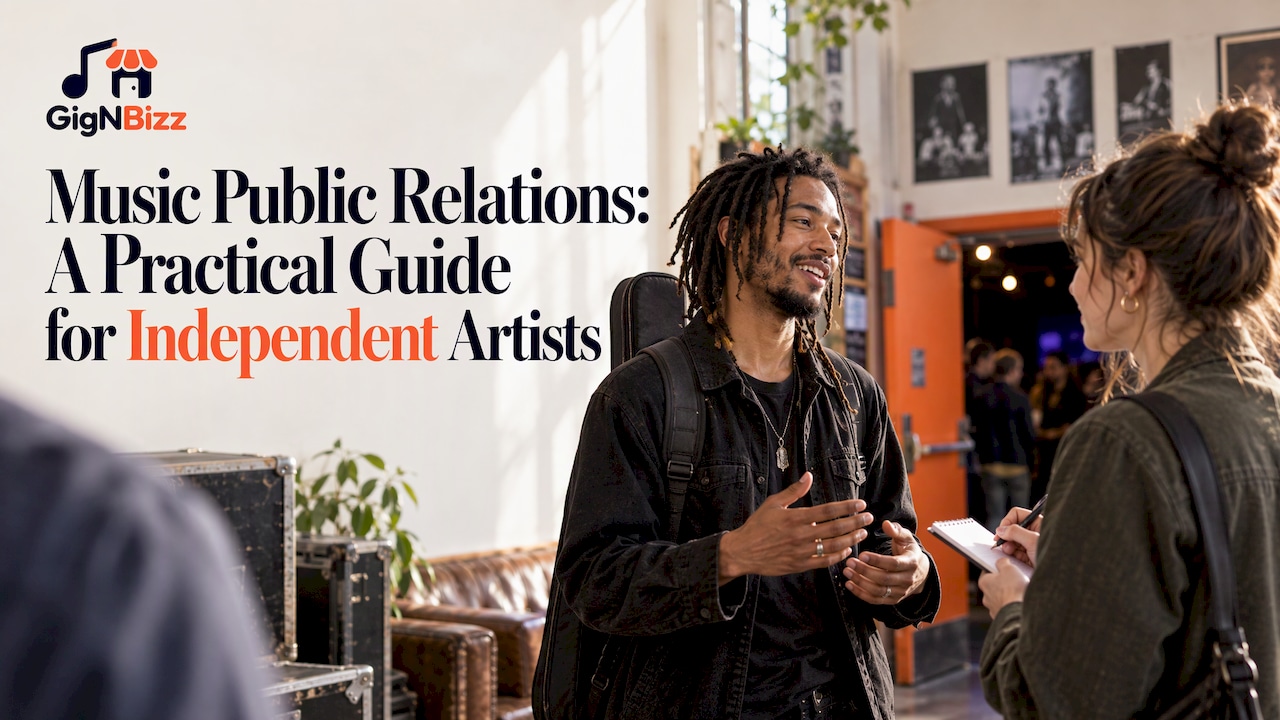
Music public relations is the work of earning press attention for an artist and shaping the story that attention tells. For an independent musician, the most effective path is usually to start locally: build a clear story, a tight press kit and real live dates, then take that proof to writers. Gigs give a publicist or a blogger something to write about, and they give you an audience that can actually show up. On GigNBizz, you can create a musician profile, find gigs with local venues and build the track record that press coverage depends on, with no booking fees for musicians or businesses.
TL;DR
- Music PR is mostly media relations: pitching writers, editors and broadcasters for reviews, interviews and features, and managing how an artist is perceived.
- You can run a campaign yourself with an EPK, a targeted media list, short personalized pitches and a few well-timed follow-ups.
- US publicists commonly charge thousands of dollars per campaign, and most advice says to wait until you have a release, real dates and a story.
- Live shows are some of the strongest publicity you can generate, and they are the best way to build local momentum first.
- Measure results against one goal, such as streams from a given source, gig invitations or ticket sales, not against press mentions alone.
Table of Contents
- What music PR actually does
- What you need before you pitch anyone
- Running your own campaign, step by step
- Local PR and live gigs reinforce each other
- When a publicist makes sense
- How to tell whether it worked
- Where GigNBizz fits
- Start with the gigs that give press something to cover
- FAQ
- Sources
What music PR actually does
Public relations for musicians has two jobs. Berklee describes a publicist’s core goals as soliciting attention from media, tastemakers and customers, and managing situations when that attention turns negative. Campaigns commonly come before an album release or a tour.
In practice, MusicRadar’s explainer on music PR frames it as media relations: pitching editors and writers for reviews, profiles and interviews, while helping manage how an artist is seen and building an audience.
That last part is the one most artists miss. The same explainer quotes publicists who argue that good PR is interpretation. A campaign has to find the thematic angle of a record and translate it for the audience of one specific publication. Sending a generic release to a long list is distribution, not PR.
PR versus marketing
The two get confused constantly. Hypebot separates them: PR deals in brand image, messaging and press relationships, while marketing leans on advertising, social strategy, launch materials and sales-oriented promotion. They feed each other. CelebrityAccess notes that press coverage can become material for marketing, strengthening your messaging and social engagement.
So a feature in a local paper is not only a clipping. It is a quote for your bio, a post for your socials and a line in your next pitch.
What you need before you pitch anyone
Writers get a flood of emails. The artists who get answers make it easy to say yes. That starts with a story and a press kit.
Find your angle
CD Baby’s Ryan DiLello makes the case in a 2025 guide to pitching the press that for emerging artists, news of a new single is not enough. Journalists need a theme, an experience, a statement or a central idea to explore. Ask yourself:
- What is the record about, in one sentence a stranger would repeat?
- What is unusual about your background, your town, your collaborators or the way you made it?
- What is happening in the real world around it: a residency, a tour, a benefit show, a local scene?
That last question matters more than it looks. The publicists interviewed by Vortex Music Magazine describe touring as especially valuable publicity because it shows media that you are active and accomplishing things.
Build the EPK
An electronic press kit is the central asset of DIY PR. Soundcharts describes it as a page holding photos, a biography, featured music, social links and related details, so media can pull accurate information about you without asking. Other guides agree on the contents. Bridge.audio’s 2026 guide lists a short bio of one to two paragraphs, a high-resolution press photo or artwork, a stream or download link, key dates for releases, tours and events, and quotes or endorsements if you have them. Prowly adds an attention-grabbing headline.
A workable checklist:
- A one-to-two paragraph bio, plus a shorter version for quick use.
- Two or three press photos and your cover art in high resolution.
- Private streaming links that open without a login.
- Upcoming dates: release, shows, festival slots.
- Social and website links.
- Any quotes from venues, fellow musicians or early listeners.
In an interview with a veteran publicist, Music Consultant suggests holding back some photos and assets for exclusives instead of sending everything to every outlet. Giving one site a first look at a video is a stronger offer than giving ten sites the same thing.
Your profile can carry some of this load. A GigNBizz musician profile shows your talent and your available gigs in one place, and the platform’s Discoverability Score is built to help you see how to strengthen your online presence. It does not replace an EPK, but it gives venues and fans a living page to land on.
Running your own campaign, step by step
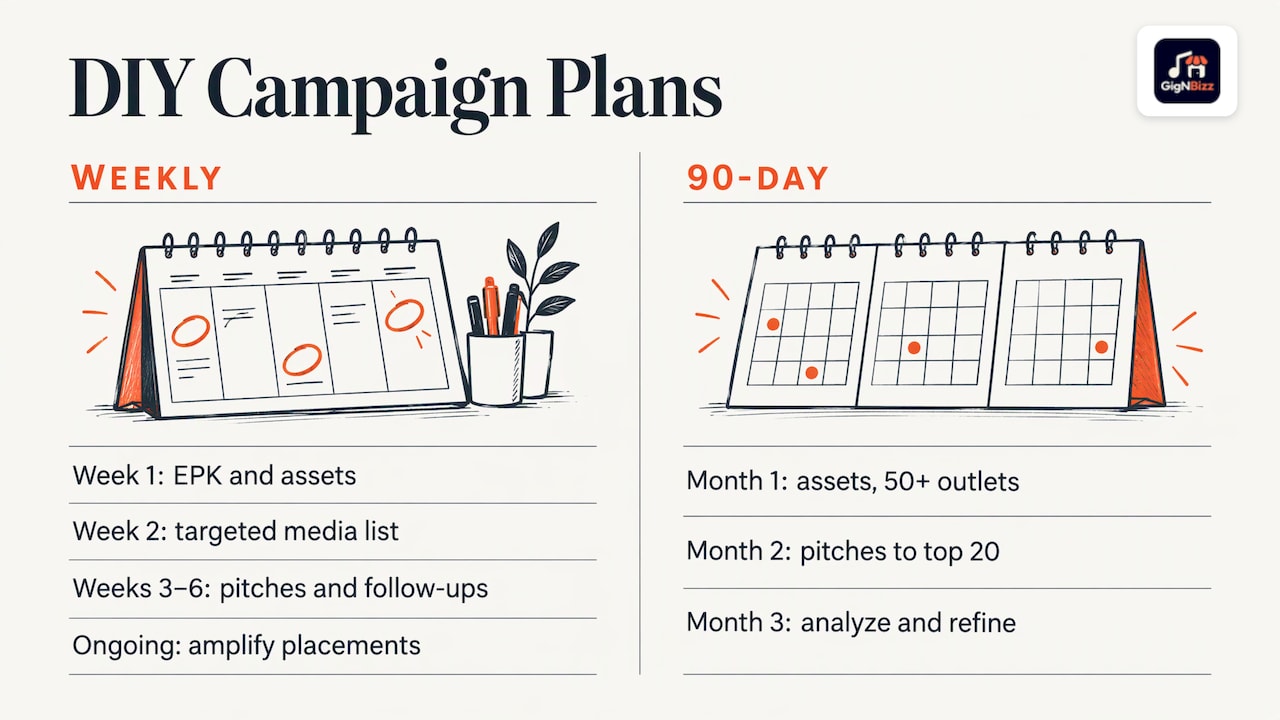
Here is a timeline assembled from several current guides. Indiefy’s DIY workflow runs Week 1 on the EPK and assets, Week 2 on building a targeted media list, Weeks 3 to 6 on pitches and follow-ups, and then ongoing work to amplify placements and nurture relationships. Music Supremacy’s 90-day plan stretches the same logic over three months: build assets and a media list of 50 or more outlets in the first month, personalize pitches for your top 20 targets in the second, and analyze and refine in the third.
Step 1: Pick the goal
Name one outcome. It might be ten local bookings, a feature in a regional music blog, or radio spins before a release show. A goal decides which outlets matter and how you judge the result.
Step 2: Build a short, real media list
Research before you send. AndR.'s 2026 DIY guide recommends reading each contact’s recent coverage, following submission guidelines, finding the correct writer and checking that the outlet is still active. For a local act, your list will probably include:
- the music or arts writer at your city paper or alt-weekly
- local music blogs and podcasts
- college and community radio shows
- event listings editors
- hosts of local showcase nights and festival organizers
The Music Connection article on how publicists work indie acts points to indie radio, festivals, websites and publications, plus online song or video premieres, as the routes that built buzz and opened bigger doors.
Step 3: Warm up the top contacts
DiLello recommends picking five to ten priority journalists and building rapport over social media before you pitch: mention a recent article they wrote, introduce yourself and let them know you will be in touch. It takes a few minutes per person and changes how your email is received.
Step 4: Write the pitch
Keep it short. Both AndR. and Bridge.audio recommend staying under 200 words. AndR. says to cover who you are, what you are releasing, why it matters now, a specific story angle and direct links to music, photos and the EPK. Promoly suggests a three-paragraph structure and a single follow-up after three to five days.
A simple frame:
- Subject line: specific and plain, such as the town, the genre and the news.
- Paragraph one: who you are and why this writer in particular.
- Paragraph two: the release or show and the story behind it.
- Paragraph three: links, dates, thanks.
Step 5: Time it right
According to the CD Baby guide, give at least three weeks’ notice. Local press can handle one to two week turnarounds, while large national publications need a month or more. It recommends sending pitches Tuesday through Thursday morning. For a release campaign, the Music Connection piece suggests allowing at least three months, ideally four.
Step 6: Follow up, then stop
Indiefy’s cadence is a first follow-up three to five business days after the pitch, a second seven to ten business days later, and a polite wrap-up seven to ten days after that. CD Baby is blunter: keep follow-ups brief and friendly, and treat the third as the point where the journalist is probably not interested.
Step 7: Use what you get
Thank the writer. Share the piece. Put the quote in your bio. Pitch the next outlet with the previous coverage attached. That is the domino effect Music Consultant describes: publicity coordinated with marketing, sales and promotion, with outreach tailored to each publication.
Local PR and live gigs reinforce each other
Most press lists for independent musicians should start close to home. Local outlets turn pitches around faster, they care about hometown acts, and their readers can walk into a venue on Friday night.
That is where gigs enter the strategy. Real dates give a writer a time-bound reason to cover you. They give you photos, video, reactions and quotes. And playing for a local business or venue builds the relationships that lead to more bookings. If you are working on this side of your career, our posts on promoting your music without a record label, building a personal brand as a musician and why networking matters cover the groundwork that makes outreach land.
If you are writing pitches but nobody is listening yet, start with why nobody is listening to your music. Press helps most when there is something worth amplifying.
When a publicist makes sense
A publicist can open doors and save time, but timing matters. Spotify for Artists advises that a relatively new band without an album, meaningful touring beyond its hometown or the financial capacity should generally wait. It suggests considering one when local coverage has begun and broader attention is a realistic next step. It also notes that nobody can guarantee coverage.
Orphiq’s guide to finding a publicist lists signs you are ready: something newsworthy such as a strong single, a debut album or a notable collaboration; competitive music quality; momentum in streams or social engagement; a release timeline with at least six to eight weeks of lead time; and the budget. It lists the opposite signs too: no clear news hook, unrealistic expectations and no budget for a proper campaign.
What it costs in the US
AMW’s 2026 pricing guide puts US music PR at roughly $2,000 to $8,000 for a single or EP campaign and $5,000 to $25,000 for a full album push when priced by project. Retainers for developing and mid-level artists run $2,000 to $10,000 per month. It says a self-funded independent releasing a debut single often spends $2,000 to $5,000 on a boutique campaign. Orphiq’s job title guide gives a lower range, with publicist compensation typically $500 to $5,000 or more per month depending on experience and scope.
Those figures are a snapshot, and quotes vary by publicist and campaign. Use them for budgeting, not as a price list.
What to check before you sign
- Fit: does the publicist work with artists who sound and look like you?
- Evidence: ask for campaign examples or referrals.
- Trust: do you believe they will pitch you honestly to writers?
- Expectations: a good publicist promises effort and access, never guaranteed coverage.
- Wish list: the Music Connection piece says publicists ask clients for a 10-to-15-item wish list and map a personalized media plan. Have yours ready.
How to tell whether it worked
Press mentions are easy to count and easy to misread. Tie your review to the goal from step one. The Velveteen Records guide to the weeks after release recommends checking links, profiles and tracking in the first 48 hours, then comparing listener, content, outreach and paid-media signals over consistent reporting windows. Keep notes on your sources and definitions, separate what you observed from what you concluded, and pick a next action from the evidence.
ArtistRack’s list of metrics includes press mentions and outlet quality, audience reach, social engagement, streaming and sales uplift, website traffic, search volume, playlist placements and sentiment. You do not need all eight. Choose three that match your goal.
A local artist might track:
| Goal | Signal to watch |
|---|---|
| More bookings | Number of venue invitations and confirmed dates |
| Bigger crowds | Attendance and ticket or door numbers at shows |
| More streams | Listener sources in your streaming dashboard |
| Press credibility | Number and quality of outlets that replied or published |
MusicTeam’s release strategy guide adds post-release steps worth copying: repurpose coverage, find new story angles, thank your contacts, use analytics, keep performing live and plan the next release.
Where GigNBizz fits
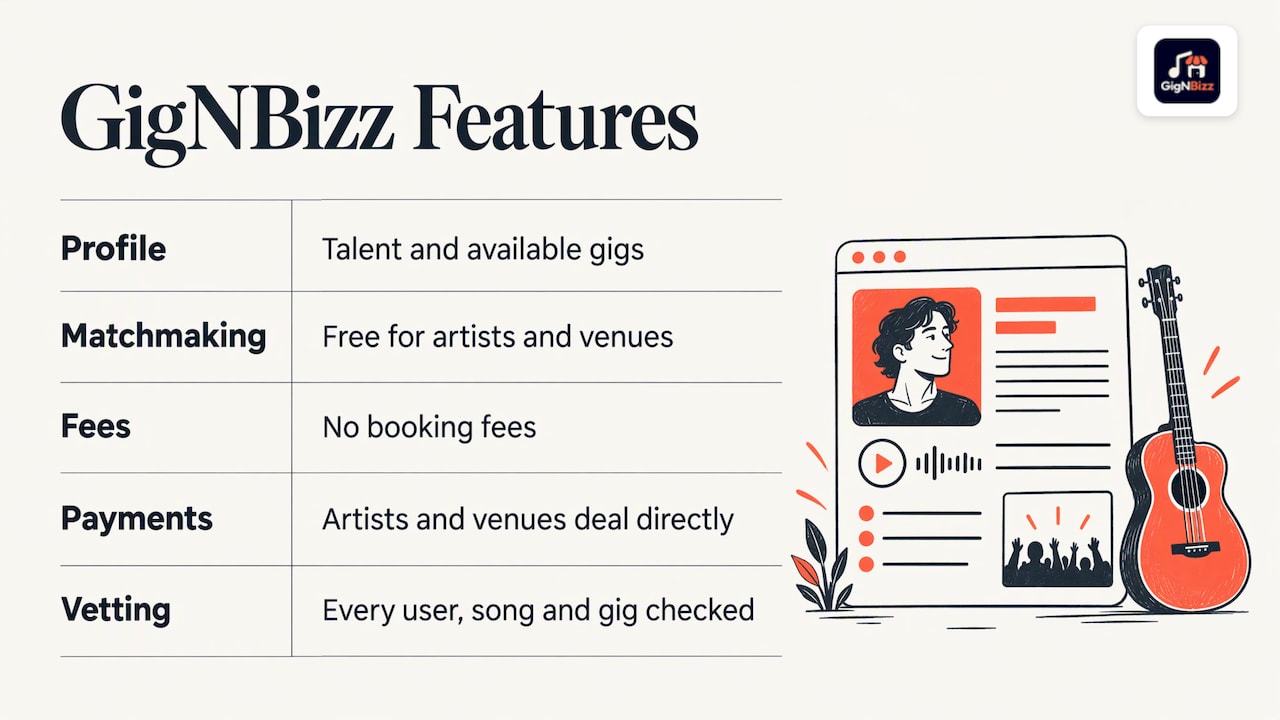
On GigNBizz, a musician profile shows your talent and your available gigs. Venues and local businesses can find and book emerging artists, and gig matchmaking and bookings are free for both sides. The platform takes no booking fees and never handles payments, so you and the venue deal directly. Every user, song and gig is vetted by a real person, which means a venue looking at your profile is looking at a page that has been checked.
Other features help you build the visible track record that PR relies on. You can record and share song covers, share your releases, work on your Discoverability Score and climb community charts through upvotes.
Our perspective
We built GigNBizz around a simple idea: the music that matters to a town starts in that town. Before a national writer covers an artist, a local venue books them, a neighbor upvotes the song and someone tells a friend about the show. Most publicity guidance for independents says the same thing in different words: get real dates, build traction, then pitch.
That is why we put connection ahead of noise. Every musician and song on GigNBizz is vetted by a real person, and bookings run directly between artists and venues with no booking fees. A profile with live gigs, shared releases and community support is exactly the kind of story a local writer can pick up.
Our advice to independent artists is to treat the first year of PR as relationship building. Play for the people who can book you, share your work where they can see it and let the results give you something worth pitching.
the author
Start with the gigs that give press something to cover
If you want both bookings and a story to pitch, create your profile on GigNBizz and start connecting with local venues. Core features are free. The optional memberships add profile features and promotion perks: Plus is $4.99 per month and Premium is $8.99 per month, as listed on the membership page.
Venues and local businesses looking for emerging talent can use the gig booking page. Our post on what changed on Spotify for independent artists is worth reading alongside your release plan.
FAQ
What does a music publicist do?
A publicist pitches editors, writers and broadcasters for reviews, interviews and features, and helps shape how an artist is perceived. Berklee describes two core goals: attracting attention from media and tastemakers, and managing situations when attention turns negative. Campaigns often build toward an album or a tour.
How much does music PR cost in the US?
AMW’s 2026 pricing guide gives $2,000 to $8,000 for a single or EP campaign and $5,000 to $25,000 for an album, or $2,000 to $10,000 per month on a retainer for developing and mid-level artists. Other sources quote lower monthly publicist rates. Confirm current pricing directly with any publicist.
Can I do music PR myself?
Yes. Build an EPK, make a targeted list of outlets that cover your genre and region, send short personalized pitches under about 200 words, and follow up a limited number of times. Starting locally and using live shows as your news hook makes it more manageable.
How far ahead should I pitch the press?
CD Baby’s guide recommends at least three weeks’ notice. Local press can turn things around in one to two weeks, and large national publications may need a month or more. For a full release campaign, plan three to four months.
What is the difference between music PR and music marketing?
PR focuses on press relationships, messaging and brand image. Marketing focuses on advertising, social strategy, launch materials and sales. Good coverage from PR becomes material for your marketing.
Sources
- Publicist | Berklee
- Explainers: What are music PRs? And what can they do for me? | MusicRadar
- Music PR vs. Music Marketing: What’s the difference? | Hypebot
- Music PR vs. Music Marketing | CelebrityAccess
- How to pitch the press for coverage on your next release | CD Baby DIY Musician
- How to Get Press | Vortex Music Magazine
- How to Handle Your Own Music PR + Finding a Music PR Firm | Soundcharts
- Music PR 101 | Bridge.audio
- Music PR: How to Get Publicity for Your Music | Prowly
- Building a Public Relations Strategy | Music Consultant
- Music PR and Media Relations for Independent Artists | Indiefy
- Music PR for Independent Artists: Success Guide | Music Supremacy
- DIY PR and Press Outreach for Independent Musicians | AndR.
- Press Outreach for Artists | Promoly
- How 4 Publicists Work Their Indie Acts | Music Connection
- The Do’s and Don’ts of Hiring a Publicist | Spotify for Artists
- Finding a Music Publicist: When and How | Orphiq
- How Much Does Music PR Cost? | AMW
- Music Industry Job Titles Explained | Orphiq
- What Happens After Release Day? | Velveteen Records
- How to Measure the Success of Your Music PR Campaign | ArtistRack
- How to build an effective music release strategy | MusicTeam