
Yes, you can still fill your December, but start pitching this week. The most requested acts start filling December dates as early as July and August, and by November there are fewer open dates and higher prices. But smaller venues, restaurants, senior living communities and private hosts keep booking into December, and they need someone local who can say yes fast. Here's where the gigs are, how to pitch, and what to charge.
TL;DR
- Holiday gigs come from parties, restaurants, hotels, town events, senior living, churches and New Year's Eve.
- Big rooms book months ahead, but smaller venues often book only 1 to 3 months out. In November, pitch local and flexible.
- Keep the pitch short: who you are, a 60-second holiday clip, your open dates and your price.
- Peak nights earn more. Published guides put December and holiday-weekend premiums at about 10 to 50%, and New Year's Eve at up to double or more.
- When you play at a business, the public performance license is the business's job, according to ASCAP. Purely private parties don't need one.
- Get a contract and a deposit for every date, and ask happy hosts to rebook.
Table of contents
- Where holiday gigs come from
- When to start booking
- How to pitch a holiday gig
- What to charge on peak dates
- Worked example: a December of gigs
- Building a holiday setlist
- Logistics: cold, sound and contracts
- Turning holiday gigs into repeat bookings
- FAQ
Where holiday gigs come from
Some holiday gigs pay well, some pay in visibility. The Female Entrepreneur Musician podcast, hosted by Bree Noble, suggests pairing low-paying community gigs that build your name with higher-paying private and corporate ones.
| Gig type | Who books it | What to pitch |
|---|---|---|
| Office and company parties | Office managers, HR, owners of small businesses | Background music for dinner, then a livelier set |
| Restaurants and bars | Owners and managers | A holiday night, or a weekly December slot |
| Hotel and brunch residencies | Food and beverage or events managers | Weekend holiday brunches, every weekend in December |
| House parties | Friends, past clients, neighbors | A short, cozy acoustic set or a sing-along |
| Tree lightings and town events | Town recreation departments, business districts | A family-friendly set of carols and standards |
| Senior living communities | Activities directors | Afternoon sets of classic standards |
| Churches | Music directors, event committees | Candlelight services, concerts and parties |
| Malls and holiday markets | Marketing and events staff | Short sets, on a stage or roaming |
| Hanukkah events | Synagogues, community centers, families | A warm, all-ages set |
| New Year's Eve | Bars, restaurants, private hosts | A full night that counts down to midnight |
Two dates to know: Hanukkah runs from the evening of Friday, December 4 to Saturday, December 12, according to the Farmers' Almanac. And the event-space site Peerspace estimates that about 75% of holiday parties fall on the first two weekends of December.
When to start booking
Ideally, in July. The Female Entrepreneur Musician podcast advises planning holiday gigs then, because most venues and organizations book holiday entertainment months in advance.
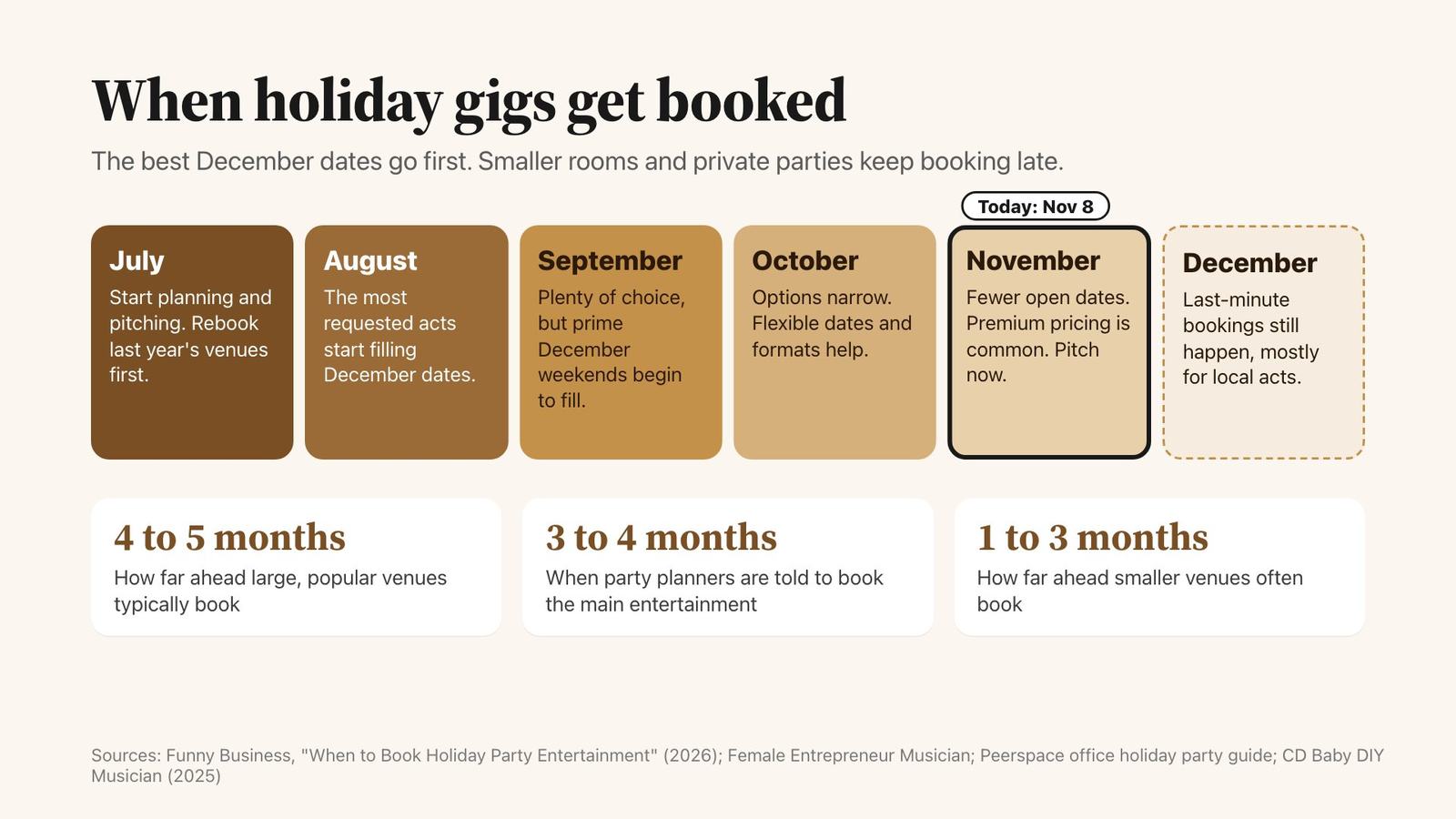
But CD Baby's DIY Musician notes that large, popular venues typically book 4 to 5 months out, while smaller venues may work on a 1 to 3 month basis. So in mid-November, aim at:
- Venues you've played before. They already trust you.
- Small, local rooms. Restaurants, cafes, breweries and bars that book week to week.
- Weeknights and daytime. Senior living afternoons, weekday lunches and Sunday brunches are often still open.
- Late planners. Small businesses and private hosts running behind.
How to pitch a holiday gig
Holiday bookers are busy. Keep it short, professional and friendly, as CD Baby puts it, and give them everything they need to say yes in one message.
A short pitch template
Subject: Live holiday music for your December event
Hi [name], I'm [your name], a [solo acoustic singer / jazz duo / band] based in [town]. I play holiday standards plus a few of my own songs, and I'm booking December dates now.
Here's a 60-second clip of my holiday set: [link]
Open dates: [Fri Dec 4 evening, Sun Dec 6, weekday lunches Dec 7 to 18].
A 2-hour set with my own sound system is $[usual rate]. December Fridays and Saturdays are $[peak rate].
Want me to hold a date? I can send a short agreement today.
[Name] · [phone] · [profile link]
What makes a pitch work
- A holiday demo. Film two or three songs on your phone. The Female Entrepreneur Musician podcast recommends a holiday highlight reel for every pitch.
- Real dates. A short list of open dates is easier to answer than "I'm flexible."
- Your price up front. Have prices ready for each set length and group size.
- A follow-up. If you don't hear back, CD Baby suggests waiting at least a week before following up.
What to charge on peak dates
Published guides agree that December weekends and New Year's Eve cost more. They disagree on how much, partly because some are American and some British.
| Source | Market | What it says |
|---|---|---|
| Green Light Booking (2026) | US booking agency | Summer Saturdays and holiday weekends carry a 25 to 50% premium. New Year's Eve can cost double. |
| Encore (2025) | UK booking platform | December runs 10 to 30% above other months. New Year's Eve is 1.8 to 3 times a standard December date. |
| Last Minute Musicians reader poll | 402 UK musicians | 48% charge double for Christmas and New Year gigs, 19% triple or more, 16% a slight increase and 16% their usual rate. |
| Thumbtack | US marketplace | The national average cost of hiring a band is about $407 to $854. Not holiday-specific. |
The poll is self-selected, so treat it as a sign of what musicians do, not a rule. A simple way to price: keep your usual rate for weekdays and daytime gigs, add 25% or so for December Fridays and Saturdays, and charge up to double for New Year's Eve. Whatever you choose, put the holiday rate in writing before the client agrees.
Worked example: a December of gigs
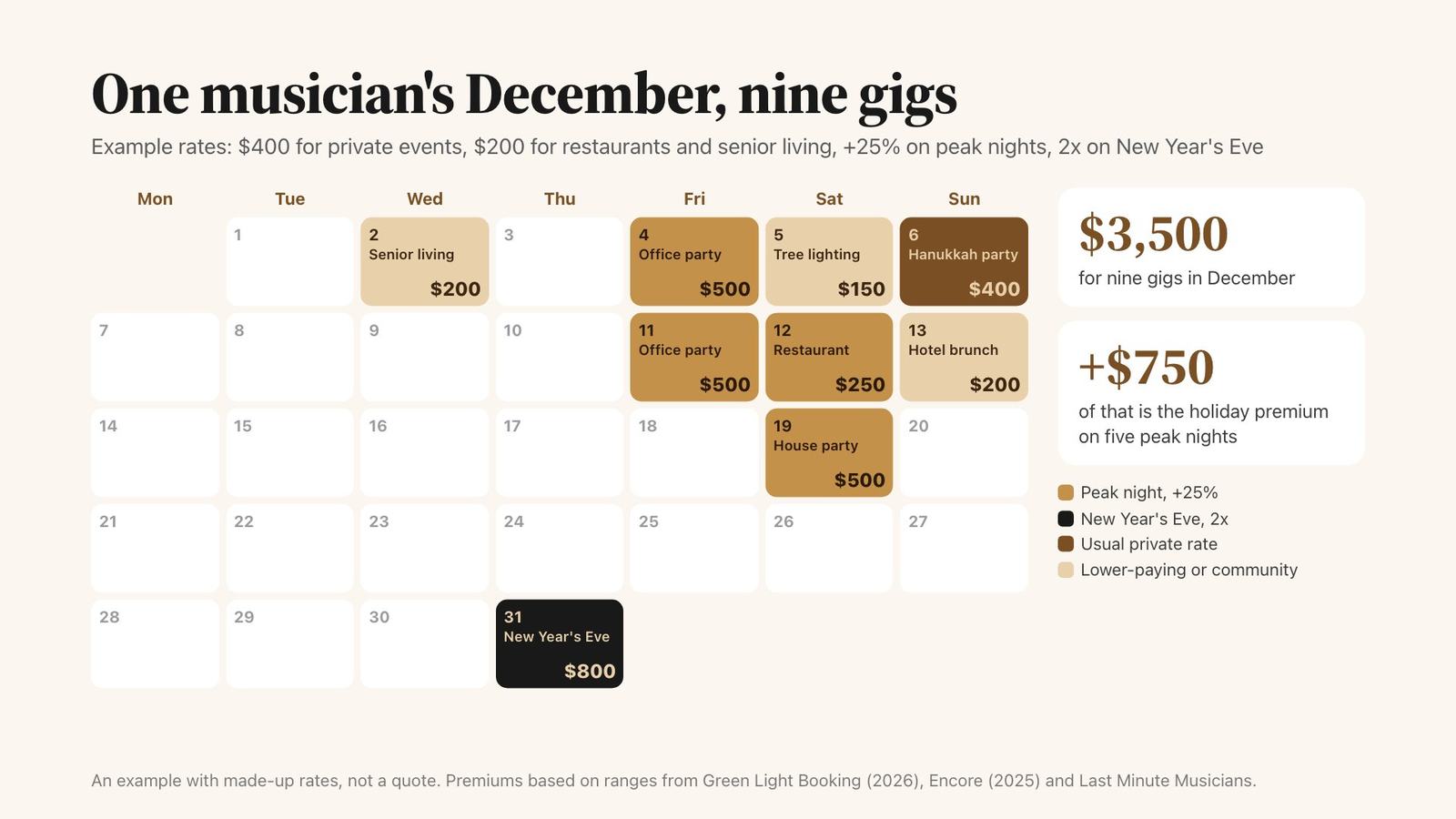
Say you're a solo singer-guitarist with your own small sound system. Your usual rate is $400 for a private event and $200 for restaurants and senior living. You add 25% on December Fridays and Saturdays and double your private rate on New Year's Eve. These rates are made up for the example, not a quote.
| Date | Gig | Rate |
|---|---|---|
| Wed, Dec 2 | Senior living afternoon | $200 |
| Fri, Dec 4 | Office party (peak night) | $500 |
| Sat, Dec 5 | Town tree lighting (community gig) | $150 |
| Sun, Dec 6 | Hanukkah house party | $400 |
| Fri, Dec 11 | Office party (peak night) | $500 |
| Sat, Dec 12 | Restaurant holiday night (peak night) | $250 |
| Sun, Dec 13 | Hotel holiday brunch | $200 |
| Sat, Dec 19 | House party (peak night) | $500 |
| Thu, Dec 31 | New Year's Eve private party | $800 |
| Total, nine gigs | $3,500 | |
Without the holiday premiums, the same nine gigs would pay $2,750. The extra $750 comes from just five nights. The low-paying tree lighting still earns its spot: it puts you in front of local families.
Building a holiday setlist
Holiday crowds want songs they can hum along to, so build around standards and slip your own songs in between. ASCAP's list of the most played holiday songs of 2025 was led by "Sleigh Ride," followed by "Let It Snow! Let It Snow! Let It Snow!," "It's Beginning to Look a Lot Like Christmas," "Jingle Bell Rock" and "A Holly Jolly Christmas."
- Read the room. An office dinner wants quiet background music first. A New Year's Eve crowd wants energy by 11 p.m.
- Cover more than Christmas. Have a few Hanukkah songs and winter songs that aren't about any holiday.
- Play your originals. One or two per set is how a holiday crowd finds out who you are.
Who handles music licensing?
In the US, playing copyrighted songs in public needs a public performance license. When you play at a business, that license is generally the business's job, not yours. ASCAP says that since the business owner benefits from the performance, "the business owner is legally responsible to obtain the license." Venues usually need a license from each organization whose songs get played: ASCAP, BMI, SESAC and GMR.
A few exceptions: ASCAP says purely private events, like personal gatherings of family and friends, don't need a license. US copyright law also exempts music performed in the course of religious services, though not a church's social or fundraising events. Rules differ outside the US, and this isn't legal advice.
One more thing: if you write your own songs and belong to ASCAP or BMI, report your setlists through ASCAP OnStage or BMI Live. Both pay royalties for live performances of your songs.
Logistics: cold, sound and contracts
Outdoor gigs in the cold

Tree lightings and holiday markets are often outside, after dark, in December. The instrument retailer Thomann advises keeping instruments cased while traveling, warming them up gradually, and not playing while the instrument still feels cold to the touch. Bring fingerless gloves, and ask the organizer about power, cover from snow, and a warm place to wait.
Sound
Ask before you quote: is there a sound system, or do you bring one? How big is the room? Office parties and brunches want music at talking volume, so a small speaker is often enough. Say in your quote whether sound is included.
Contracts and deposits
December dates are valuable, so protect them. A short agreement should cover the date, times, set length, fee, deposit, when the balance is due, sound, and what happens if either side cancels. The Texas Music Office's sample booking agreement uses a 50% non-refundable deposit, with the balance due before the performance. The Female Entrepreneur Musician podcast also recommends locking in weekend dates with a signed contract, a non-refundable deposit and clear cancellation deadlines. Deposit rules vary by place, so check yours.
Turning holiday gigs into repeat bookings
A holiday gig is an audition for next year, and maybe for a regular spot in January:
- Ask to rebook. Before you pack up, ask: "Should I pencil you in for next December?" The Female Entrepreneur Musician podcast suggests starting each season with venues you've already played.
- Pitch a regular slot. A restaurant that liked your holiday brunch may want you once a month. Quiet months need music too.
- Collect contacts. Guests throw parties too. Leave a card or a QR code to your profile, and ask happy hosts for a one-line review.
- Follow up in January. A short thank-you with a photo from the night keeps you top of mind.
Our perspective
Holiday gigs are where a lot of local musicians first meet the businesses that end up booking them all year.
That's what we built GigNBizz around: local musicians and local businesses finding each other directly. Being late to the holiday rush isn't a dead end if you're the act who's easy to find, quick to answer and ready to play.
Book holiday gigs with GigNBizz
GigNBizz is a free community for independent musicians. On it, you can:
- Build a profile with your songs, including your holiday set, so businesses can hear you before they book.
- Use the Booking Agent on Discover to find gigs, and answer local businesses asking for an act.
- Post your December shows under Shows on Home, so nearby fans can tap "Going".
Read more about finding local gigs as a musician, see how businesses book local musicians, or check the GigNBizz FAQ.
FAQ
Is it too late to book holiday gigs in November?
No, but the best dates go first. Large venues typically book 4 to 5 months out, while smaller venues often book 1 to 3 months ahead. In November, pitch past venues, small local rooms, daytime events and late-planning hosts.
How much should I charge for a holiday party gig?
Start from your usual rate and add a premium for peak nights. US booking agency Green Light Booking puts holiday-weekend premiums at 25 to 50%, and says New Year's Eve can cost double. In a UK poll of 402 musicians, 67% said they charge at least double for Christmas and New Year gigs.
Do I need a license to play Christmas songs at a gig?
When you play at a business in the US, the public performance license is generally the business's responsibility, not yours, according to ASCAP. Purely private gatherings of family and friends don't need one. Rules can vary, so ask the venue if you're unsure.
What holiday songs should I learn?
Start with the standards people know. ASCAP's most played holiday songs of 2025 were led by "Sleigh Ride," "Let It Snow! Let It Snow! Let It Snow!," "It's Beginning to Look a Lot Like Christmas," "Jingle Bell Rock" and "A Holly Jolly Christmas." Add a few Hanukkah and winter songs, plus one or two of your own.
Should I ask for a deposit for a holiday gig?
Yes. December dates are hard to refill if a client cancels. A signed agreement with a deposit (50% is common), and clear cancellation terms protects both of you.
Sources
- Funny Business: When to Book Holiday Party Entertainment
- Female Entrepreneur Musician: It's Time To Start Booking Holiday Gigs
- Peerspace: The Ultimate Office Holiday Party Planning Guide
- CD Baby DIY Musician: Top Tips for Booking Gigs as an Indie Artist
- Farmers' Almanac: When Is Hanukkah?
- Green Light Booking: How Much Does a Band for a Private Party Cost in 2026?
- Encore: How Much Does a Christmas Party Band Cost?
- Last Minute Musicians: What to Charge at Christmas and New Year
- Thumbtack: How Much Does Hiring a Band Cost?
- Music Connection: ASCAP Holiday Songs (2025)
- ASCAP: Licensing FAQ for Businesses
- 17 U.S. Code § 110: Limitations on Exclusive Rights
- Hypebot: How to Report Setlists to PROs After Performing Live
- Thomann: How to Protect Your Instrument in Autumn and Winter
- Texas Music Office: Performance Booking Agreement
Photos: Kim Siever via Flickr (public domain), rawpixel (CC0). Charts: GigNBizz.