
Charge at least your floor: every hour the gig really takes, times the hourly pay you need, plus your costs. For a 3-hour solo gig 20 miles from home, that's often 7 or more hours of work and about $40 in costs, so a fair minimum is around $260 at $30 an hour. Then check the market. Thumbtack's national average for a solo musician is $328 to $655 per event, and on The Bash a live band averages about $1,083 in Jersey City and $1,317 in New York City. Here's how to do the math for a solo act, a duo and a band, and how to quote, negotiate and handle the tax side.
TL;DR
- Your minimum fee = (all your hours × your hourly target) + your costs. Count rehearsal, travel, setup, playing, teardown and promotion, not just stage time.
- For an hourly target, MIT's 2026 living wage for one adult with no kids is $38.21 an hour in Manhattan, $30.53 in Hudson County, NJ, and $26.24 in Dutchess County, NY, before tax.
- For driving, the IRS business mileage rate is 76 cents a mile from July 1, 2026 (72.5 cents before that). It's a fair benchmark for what your car really costs.
- Published averages: solo musician $328 to $655, band $407 to $854 (Thumbtack). Live band averages on The Bash: $1,083 Jersey City, $1,317 New York City, $1,650 Poughkeepsie.
- Quote per event, with a minimum, an overtime rate, a travel fee past a set distance, and a deposit. Put it in writing.
- Set aside money for taxes. Self-employment tax alone is 15.3%. You owe tax on gig money with or without a 1099, and cash counts.
Table of contents
- Work out your minimum fee
- Worked examples: solo, duo and a 4-piece band
- What the market pays
- Rates by gig type
- How to quote a gig
- Negotiating and when to say no
- Taxes: set money aside
- FAQ
Work out your minimum fee
Most musicians price a gig by asking what the room usually pays. That's useful later. Start instead with what the gig costs you, so you know the number below which you're paying to play.
Step 1: count every hour
A "3-hour gig" is never 3 hours. Write down your real time for each part:
- Rehearsal and prep: building the setlist, learning requests, band rehearsal. Thumbtack's solo musician guide quotes one musician who says learning obscure requested songs can add 5 to 10 hours of work.
- Travel: both ways, plus time to park and load in.
- Setup and soundcheck.
- Playing, including breaks you're required to stay for.
- Teardown and packing the car.
- Booking and promotion: the emails, the contract, the posts telling people to come.
Step 2: pick an hourly target
This is what one hour of your working time has to earn. If you have no idea, a living wage is a fair starting point. MIT's Living Wage Calculator (data updated Feb. 15, 2026) puts it, for one adult with no children, at:
| Area | Living wage, 1 adult, no kids |
|---|---|
| New York County (Manhattan), NY | $38.21 an hour |
| Hudson County (Jersey City, Hoboken), NJ | $30.53 an hour |
| Dutchess County (Poughkeepsie, Beacon), NY | $26.24 an hour |
Treat that as a floor, not a goal. Those figures are before tax and assume steady full-time work. A gigging musician has no paid time off, buys their own gear, and pays both halves of Social Security and Medicare (more in the taxes section). Experienced players and in-demand acts charge well above it.
Step 3: add your costs
- Mileage. The IRS business standard mileage rate is 76 cents a mile for July 1 to Dec. 31, 2026, up from 72.5 cents for the first half of the year. It covers gas, wear and insurance, so it's a better guide than the price of gas alone.
- Tolls and parking. In New York City and North Jersey, these can be real money. Count them.
- Consumables and wear: strings, sticks, batteries, cables, and a share of what you'll spend replacing a PA or amp.
- Shared costs for a band: rehearsal room time, a sound person, a rental.
Step 4: split it fairly
For a duo or band, do the hours for each player, add them up, and add shared costs once. Pay back whoever drove or paid for the room, then split the rest by hours worked. The leader who books, emails and handles the contract does more hours, and it's fair for that to show up in their share. Thumbtack's band guide notes that some bands charge a per-musician hourly fee so each artist is paid for their time.
Worked examples: solo, duo and a 4-piece band
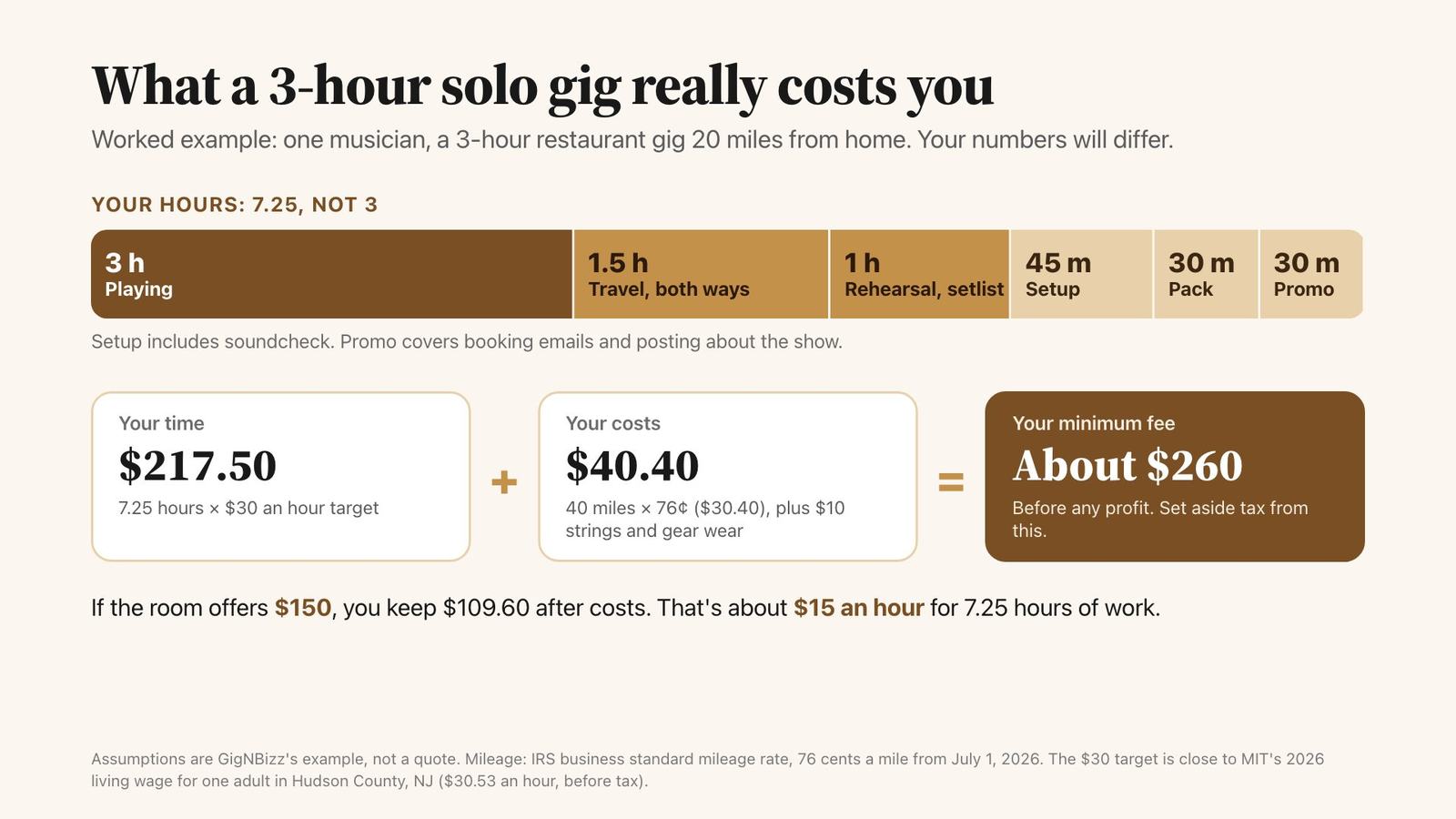
These are GigNBizz examples, not quotes. The times and costs are assumptions you should replace with your own. Both use a $30 hourly target, close to the Hudson County living wage, and the IRS rate of 76 cents a mile.
Solo act: 3-hour restaurant gig, 20 miles away
| Item | Hours or cost |
|---|---|
| Playing | 3 hours |
| Travel, both ways | 1.5 hours |
| Rehearsal and setlist | 1 hour |
| Setup and soundcheck | 45 minutes |
| Teardown and packing | 30 minutes |
| Booking and promotion | 30 minutes |
| Total time | 7.25 hours × $30 = $217.50 |
| Mileage, 40 miles × $0.76 | $30.40 |
| Strings and gear wear | $10 |
| Minimum fee | $257.90, so quote about $260 or more |
Now say the restaurant offers $150. After $40.40 in costs you keep $109.60, which is about $15 an hour for 7.25 hours. That's less than the $17 New York County minimum wage shown in MIT's calculator. You can still take it for a good reason (more on that below), but now you know what you're giving up.
Duo: same gig
Two players each put in 7.25 hours, so 14.5 hours × $30 = $435. Add one car's mileage ($30.40) and $20 in strings and wear, and the minimum is about $485, or roughly $243 a person after costs are paid back.
Four-piece band: 3-hour private party, 30 miles away
| Item | Hours or cost |
|---|---|
| Each player: playing 3, travel 2, band rehearsal 2, setup 1, teardown 0.75 | 8.75 hours × 4 players = 35 hours |
| Leader: booking, calls and contract | 2 more hours |
| Total time | 37 hours × $30 = $1,110 |
| Mileage: 2 cars × 60 miles × $0.76 | $91.20 |
| Rehearsal room | $60 |
| PA upkeep, strings, sticks | $90 |
| Minimum fee | $1,351.20, so quote about $1,350 or more |
The split: each player gets $262.50 for 8.75 hours, the leader gets $322.50 for 10.75 hours, each driver gets $45.60 back for mileage, and whoever paid for the room and gear gets that back. That minimum lands close to The Bash's average live band cost of $1,317 in New York City, so the math and the market agree here. For a band, a gig paying $400 means each player is working a long day for well under minimum wage.
What the market pays
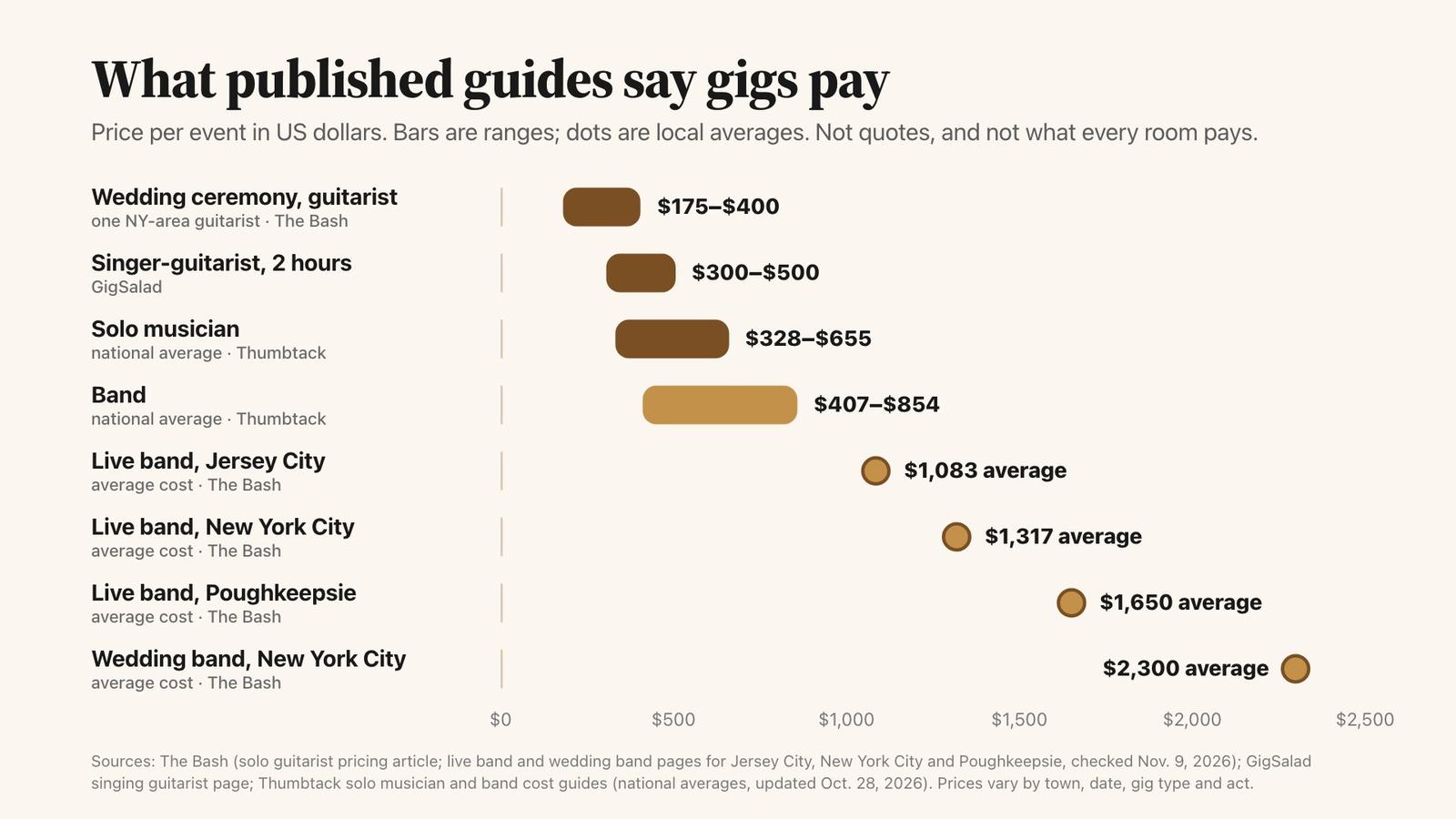
Your floor tells you what you need. The market tells you what clients expect. Published cost guides are a useful check, with two warnings: most of these numbers come from private events booked through hiring sites, and bars and restaurants may pay less.
| Act | Published price | Source |
|---|---|---|
| Solo musician | $328 to $655 national average; $201 low end, $1,114 high end | Thumbtack, updated Oct. 28, 2026 |
| Singer-guitarist | About $300 to $500 for two hours | GigSalad |
| Band | $407 to $854 national average; $243 low end, $1,602 high end | Thumbtack, updated Oct. 28, 2026 |
| Live band, Jersey City | $1,083 average cost | The Bash |
| Live band, New York City | $1,317 average cost | The Bash |
| Live band, Poughkeepsie | $1,650 average cost; $3,075 average quote | The Bash |
| Wedding band, New York City | $2,300 average cost | The Bash |
The Bash pages were checked on November 9, 2026, and don't say what period their averages cover. Notice the Poughkeepsie gap: the average quote ($3,075) is far above the average cost ($1,650). Asking prices can run well above what clients end up paying, a reminder that a quote is an opening, not a final price.
What about union scale?
Members of the American Federation of Musicians have set minimum rates, Thumbtack notes, and they can cost more than nonunion players. In New York City, that's Local 802. We couldn't find Local 802's current club date scale posted publicly, so we're not quoting one. Union agreements are still worth a look for the things freelancers forget to charge for. Local 802's 2018 club date agreement, for example, included cartage (pay for hauling heavy instruments), an overnight rate for late out-of-town jobs, and paid wait time.
Rates by gig type
The same act can fairly charge very different amounts for different rooms. Here's what we found, and where we couldn't find good published numbers, we say so.
| Gig type | What we found | How to think about it |
|---|---|---|
| Bar or restaurant | One Georgia musician quoted by Thumbtack charges $50 an hour for restaurants and $100 an hour for private parties and weddings. | Often the lowest pay, but repeatable. Ask about tips, a meal and a residency. |
| Brewery or winery | No reliable published average found. | Price it like a restaurant gig, then adjust for longer daytime sets, outdoor sound and travel. |
| Private party | Thumbtack's solo average is $328 to $655 per event; the band average is $407 to $854. | One-off, so price in all your prep and travel. No future dates to discount against. |
| Corporate event | Thumbtack says weddings and corporate events usually cost more because they run longer and need more preparation. On The Bash, DJs average $920 for a corporate event and $683 for a private party. | Expect more paperwork (insurance, invoices, payment terms). Charge for it. |
| Wedding ceremony | A top New York-area guitarist told The Bash a ceremony typically costs $175 to $400. | Short playing time, long prep: learning the processional, a rehearsal, planning calls. |
| Wedding reception | The Bash's average wedding band cost in New York City is $2,300, against $1,317 for a live band in general. | Long day, high stakes, special songs. Price well above your regular gig. |
| Residency | A Chicago guitarist on The Bash dropped a 2-hour rate from $250 to $200 for five Sundays in a row. A Thumbtack example: three wedding events booked together for $1,300, a $300 discount. | A discount for guaranteed dates is fair, since you save booking time. Keep it above your floor. |
For the other side of the table, our guide to paying musicians at restaurants and bars in NYC and NJ covers what venues budget, and the holiday party cost guide covers December and New Year's Eve, when many musicians charge more.
How to quote a gig
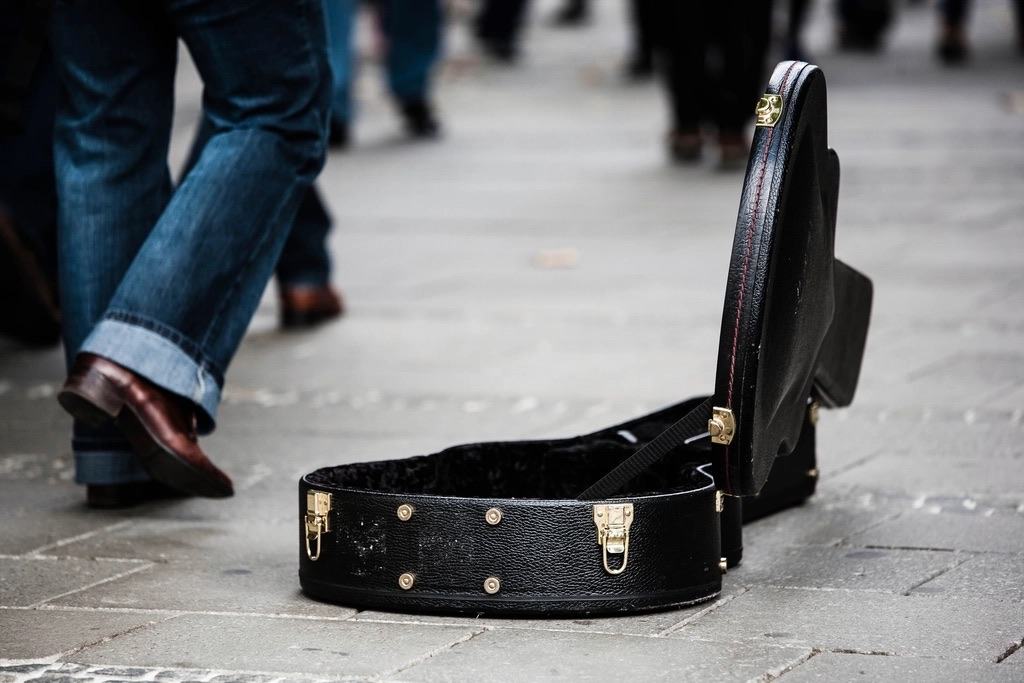
Per event, with a minimum and overtime
Setup, travel and soundcheck take the same time whether you play one hour or four. So price the first block high and extra hours lower. Two examples from published guides:
- A Redondo Beach, California, musician on Thumbtack charges $200 for up to two hours and $50 an hour after that.
- A Chicago classical guitarist on The Bash charges $150 for the first hour and $100 for each hour after, with a 5-minute break at the top of each hour.
Put your overtime rate in the agreement, so nobody has to negotiate at 11:45 p.m.
Travel fee
Include a set radius in your normal price and charge past it. The Chicago guitarist adds a travel fee for drives over 25 miles. A string group on Thumbtack charges $1 a mile beyond 20 miles from its home base. Using the IRS rate of 76 cents a mile is easy to explain to a client: it's the government's own number for what driving costs. Add tolls and parking at cost.
Deposit
A deposit holds the date and protects you from late cancellations. One string group on Thumbtack requires 25 percent up front. For weddings and big private events, ask for a deposit when the contract is signed and the balance by the day of the gig. For a regular bar night, a simple written confirmation may be enough.
Put it in writing
A short contract or even a clear email both sides reply "agreed" to should cover:
- Date, venue address, load-in time and set times, with breaks
- The fee, the deposit, when the balance is due and how it's paid
- Overtime rate and travel fee
- Who provides the sound system, and what power and space you need
- Number of players and any special songs
- Cancellation terms for both sides, including weather for outdoor gigs
- Extras: a meal, parking, a merch table, whether you can put out a tip jar
This is general information, not legal advice. For big contracts, ask a lawyer.
Negotiating and when to say no
Know your floor and your asking price before the conversation starts. Then, when a client pushes back, change the gig instead of only cutting the price:
- Fewer hours: two sets instead of three.
- Fewer players: a duo instead of the full band.
- Less gear: use the venue's sound system.
- More dates: a lower per-night rate in exchange for a run of nights.
- Non-cash extras: a meal, drinks, tips, a merch table, a mention on the venue's social posts and mailing list.
When to take less
Below-floor gigs aren't always wrong. A new room that could turn into a residency, a showcase where bookers will be in the crowd, a cause you care about: those can be worth it. The point is to choose them on purpose, a few times a year, not by default.
When to say no
- The pay is "exposure" from a business that charges its customers.
- You're asked to pay to play, or to guarantee ticket sales.
- A big date with no written agreement and no deposit.
- Anything that, after costs, pays less than your gas and time are worth, with nothing else in it for you.
Say no politely and leave the door open: "That's below what I can do for a 3-hour night. If a 90-minute set or a weeknight works, I can do that for less."
Raising your rates
Review your rates once a year. Your costs go up even if your fee doesn't: the IRS business mileage rate went from 70 cents in 2025 to 72.5 cents in January 2026 and to 76 cents in July. Signs it's time to raise: your weekends book up early, people rebook you, and you're turning down more dates than you take. Raise for new clients first, and give regulars a heads-up a few months ahead.
Taxes: set money aside
Most gig pay arrives with no tax taken out. Set part of every fee aside the day you get paid. Thumbtack's solo musician guide puts the share that goes to taxes at roughly 25 percent. Your number depends on your income and state, so ask a tax professional. The basic rules, from the IRS:
- Self-employment tax is 15.3% (12.4% Social Security, 2.9% Medicare) if your net earnings from self-employment are $400 or more, on top of income tax. You can deduct the employer-equivalent part of it when figuring your adjusted gross income (IRS).
- The 1099-NEC threshold went up. A business generally has to file a 1099-NEC for someone who isn't its employee once it pays them $2,000 or more in a year, for payments made after Dec. 31, 2025. It used to be $600. So a bar paying you $1,500 in 2026 may not send you a form at all.
- You owe tax anyway. The IRS Gig Economy Tax Center says gig income must be reported even if it's not on a 1099, and whether it's paid in cash, property, goods or virtual currency.
- Estimated payments. If you expect to owe $1,000 or more when you file, you generally need to make estimated tax payments during the year.
- Keep records. Log every gig, fee, mile and receipt. Business mileage and gear can lower your taxable income.
This is general information, not tax advice.
Our perspective
Most local businesses that host music aren't trying to underpay anyone. Margins are thin, and many owners have never seen what a 3-hour gig costs the person playing it. Musicians who can explain their number calmly, with the hours and the miles, tend to get it, or at least get a better offer.
Every musician who plays below their floor also makes it harder for the next one to ask for fair pay. You don't have to be rigid. Just know your number, say it plainly, and walk away sometimes.
Find gigs with GigNBizz
GigNBizz is a free community where independent musicians find gigs at local businesses that host live music, and those businesses book them. It started around the Hudson Valley, New York City and Jersey City. You can:
- Make a free artist page with your songs, so a business can hear you before they ask your rate.
- Use Discover to find local cafés, bars, breweries, wineries and venues, connect and message them.
- Answer open dates businesses post, and requests through the Booking Agent, where a business asks for an act and nearby verified musicians answer.
You and the business settle the date, set and pay directly between yourselves. GigNBizz doesn't handle gig pay or take a cut. See how it works for musicians, read the FAQ, or join free.
FAQ
How much should I charge for a gig as a solo musician?
Work out your floor first: count every hour the gig takes, multiply by the hourly pay you need, and add travel and gear costs. For market context, Thumbtack's national average for a solo musician is $328 to $655 per event, and GigSalad puts a singer-guitarist at about $300 to $500 for two hours. Restaurants can pay less: one musician quoted by Thumbtack charges $50 an hour for restaurants and $100 for private parties and weddings.
How much should a band charge for a gig?
Multiply each player's hours by your hourly target, add shared costs like mileage and rehearsal space, and quote the total. Thumbtack's national average for a band is $407 to $854. On The Bash, the average cost of a live band is $1,083 in Jersey City, $1,317 in New York City and $1,650 in Poughkeepsie.
Should I charge per hour or per event?
Quote per event, with a minimum that covers your setup, travel and first block of playing, then add an overtime rate per extra hour. Setup and travel take the same time whether you play one hour or three, so the first block should cost the most.
How much should I charge for travel?
Many musicians include a set distance and charge for miles past it. The IRS business standard mileage rate is 76 cents a mile from July 1, 2026, which is a fair benchmark for what driving really costs. Add tolls and parking, and add travel time to your hours.
Do I have to pay taxes on gig money if I don't get a 1099?
Yes. The IRS says gig income must be reported even when no 1099 is issued, and that includes cash. Starting with payments made in 2026, a business generally only has to send a 1099-NEC once it pays you $2,000 or more in a year, so expect fewer forms, not less tax. This is general information, not tax advice.
Sources
- Thumbtack: How much does it cost to hire a solo musician? (updated Oct. 28, 2026)
- Thumbtack: How much does hiring a band cost? (updated Oct. 28, 2026)
- GigSalad: Singing Guitarists for hire
- The Bash: How to Book a Solo Guitarist: Pricing Tips from Guitarists
- The Bash: How Much Does a DJ Cost?
- The Bash: Live Bands for Hire in New York City, NY
- The Bash: Live Bands for Hire in Jersey City, NJ
- The Bash: Live Bands for Hire in Poughkeepsie, NY
- The Bash: Wedding Bands for Hire in New York City, NY
- AFM Local 802: New club date scale is here (2018)
- MIT Living Wage Calculator: New York County, NY
- MIT Living Wage Calculator: Hudson County, NJ
- MIT Living Wage Calculator: Dutchess County, NY
- IRS: Standard mileage rates
- IRS: IRS sets 2026 business standard mileage rate at 72.5 cents per mile (IR-2025-128)
- IRS: Form 1099-NEC and independent contractors
- IRS: Self-employment tax (Social Security and Medicare taxes)
- IRS: Estimated taxes
- IRS: Gig Economy Tax Center
Photos: Nilo Velez via WordPress Photo Directory (CC0); rawpixel (CC0). Charts: GigNBizz.