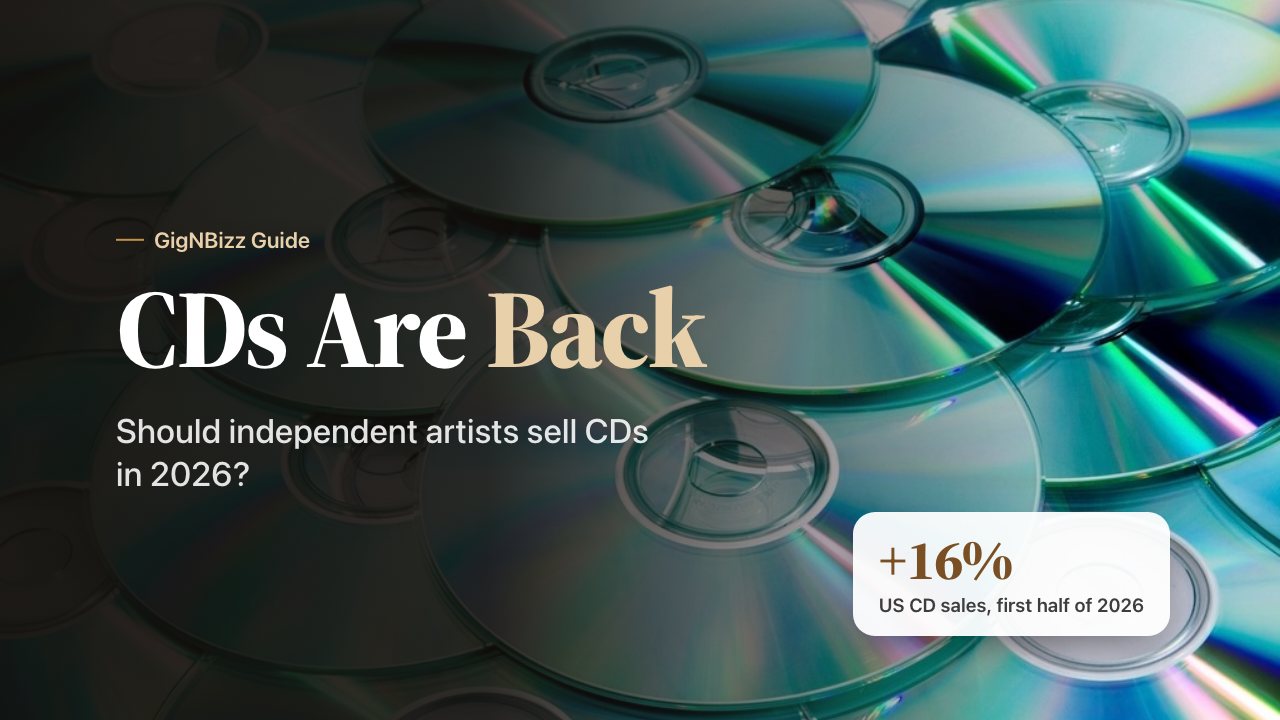
Yes, for most gigging artists. US CD sales grew 16% in the first half of 2026, far faster than vinyl, and a short run of CDs costs a few hundred dollars. The catch is that most people buying CDs aren't buying them to play. They're buying a souvenir. If you play live, sign them, bundle them and put a download code inside, a box of 100 discs can pay for itself in a couple of shows. If you don't play live yet, wait.
TL;DR
- CDs are growing again: US CD sales rose 16% to 16.3 million units in the first half of 2026, while vinyl grew 2.4% (Luminate). CD revenue rose 58.6% (RIAA).
- Much of the jump is K-pop collectors, but CD sales still grew 6.7% without K-pop.
- Many buyers don't own a CD player, so treat a CD as merch: something to hold, sign and keep. Always include a download code.
- A first run of 100 CDs usually costs about $1 to $2 per disc, depending on packaging. Sold at $10, you break even after about 20.
- Selling cover songs on CD needs a mechanical license: 13.1 cents per song, per copy, in 2026.
Table of contents
- What the 2026 numbers say
- Why this matters for a small artist
- What CDs cost to make
- Worked example: your first 100 CDs
- How to sell CDs at your shows
- Selling CDs online
- When CDs are not worth it
- FAQ
What the 2026 numbers say
For about twenty years, the CD was the format everyone agreed was dead. In 2025 it still looked that way: CD units fell 11.6% for the year, according to the RIAA. Then 2026 turned it around.
- Units: Luminate's 2026 Midyear Report, released in July, counted 16.3 million CDs sold in the US in the first half of the year, up 16%. Vinyl grew 2.4% over the same months.
- Revenue: the RIAA's mid-year report, released in September, put CD revenue up 58.6%, vinyl revenue up 17.7%, and all physical music up 25.9%.
- Who's buying: collectible K-pop releases drove a large share of the growth, and mass-market stores like Target and Walmart now take nearly 30% of physical sales. But Luminate says CD sales would still be up 6.7% without K-pop.
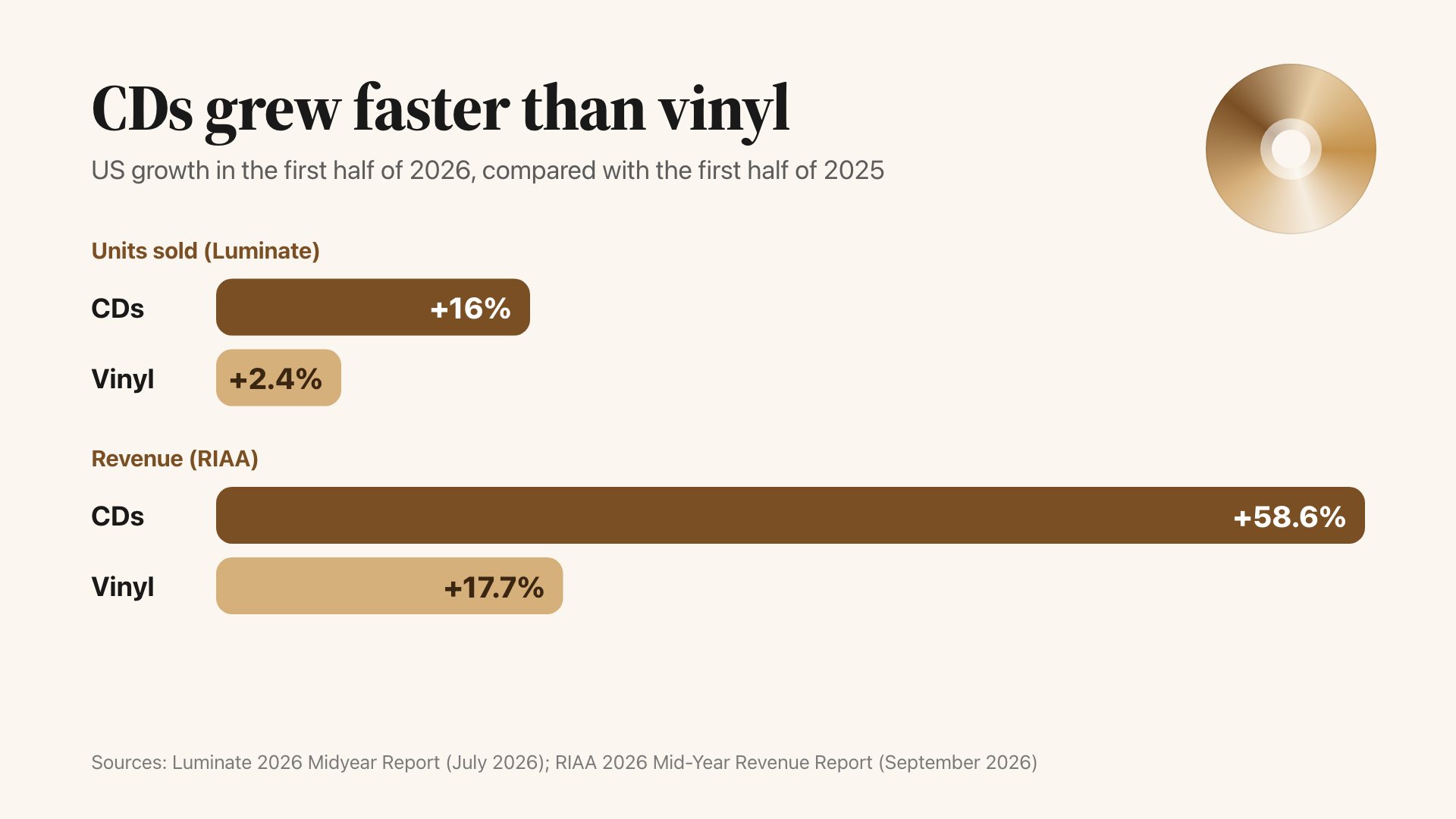
The two reports measure different things, so the numbers don't match exactly: Luminate tracks what fans buy, while the RIAA tracks what labels ship and earn. They point the same way, though. People are buying CDs again, and they're paying more for them.
Why this matters for a small artist
Here's the detail that matters most: reporting on Luminate's research found that about half of Gen Z and millennial CD buyers don't own a CD player. They buy the disc anyway, because it's a thing to keep. A photo card, a signed booklet, a reminder of a night out.
That's good news if you play live. Nobody at a bar show needs your album to hear it; they can stream it on the way home. What they want after a great set is a way to take the night with them and support you directly. A CD does that better than almost anything else on a merch table:
- It's cheap. A disc in a sleeve costs a dollar or two to make. Vinyl usually costs far more, and takes months to press.
- It's light. A box of 100 CDs fits in a car with the gear. A box of 100 records doesn't, comfortably.
- It's an easy yes. At $10, a CD is an impulse buy. At $30, a record is a decision.
- It's personal. You can sign it, number it, or write the fan's name on it while you talk.
Streaming still matters most for being found. The RIAA puts streaming at about 82% of US recorded music revenue. But streams pay fractions of a cent, and a CD sold at a show puts most of $10 straight in your pocket.
What CDs cost to make
There are two ways to make CDs, and the size of your order decides which one you'll get.
Duplication or replication?
Duplication burns your music onto blank discs, like a fast CD burner. It's the norm for small runs, from about 50 to a few hundred. Replication presses discs from a glass master in a factory, the way store CDs are made. It needs a bigger order, usually 500 or more, but each disc costs less. Both play in any CD player.
| Order | Usual method | Typical price per disc |
|---|---|---|
| 50 CDs | Duplication | About $2 to $3 |
| 100 CDs | Duplication | About $0.90 to $2 |
| 250 to 300 CDs | Duplication (some makers press from 250) | About $0.95 to $1.50 |
| 500 CDs | Replication | About $0.60 to $0.80 |
| 1,000 CDs | Replication | About $0.55 to $0.90 |
These ranges come from published price lists at Disc Makers, CD-LAB and Atlanta Disc. Disc Makers, for example, lists 100 full-color duplicated CDs from $0.92 each and 500 replicated CDs from $0.60 each. Prices change and packaging is often extra, so get a full quote with shipping before you order.
Packaging
Packaging is where the price per disc moves the most.
- Cardboard sleeve: the cheapest and lightest option. Good for EPs, demos and giveaways.
- Jewel case with an insert: the classic album look, with room for a booklet. Heavier, and the cases crack.
- Digipak or wallet: a fold-out card case. It costs more but feels like a gift, which suits fans who buy CDs to keep.
Cover songs need a license
If your CD includes songs you didn't write, you need a mechanical license for each one before you sell copies, even a handful at shows. In 2026 the US statutory rate is 13.1 cents per song for each copy (or 2.52 cents per minute for songs over five minutes). For 100 CDs with three covers, that's $39.30. Licensing services handle the paperwork for a small fee. Your own songs need no license.
Worked example: your first 100 CDs
Say you order 100 duplicated CDs in jewel cases, and with shipping it comes to about $2 per disc, or $200 in all. You sell them for $10 each at your shows.
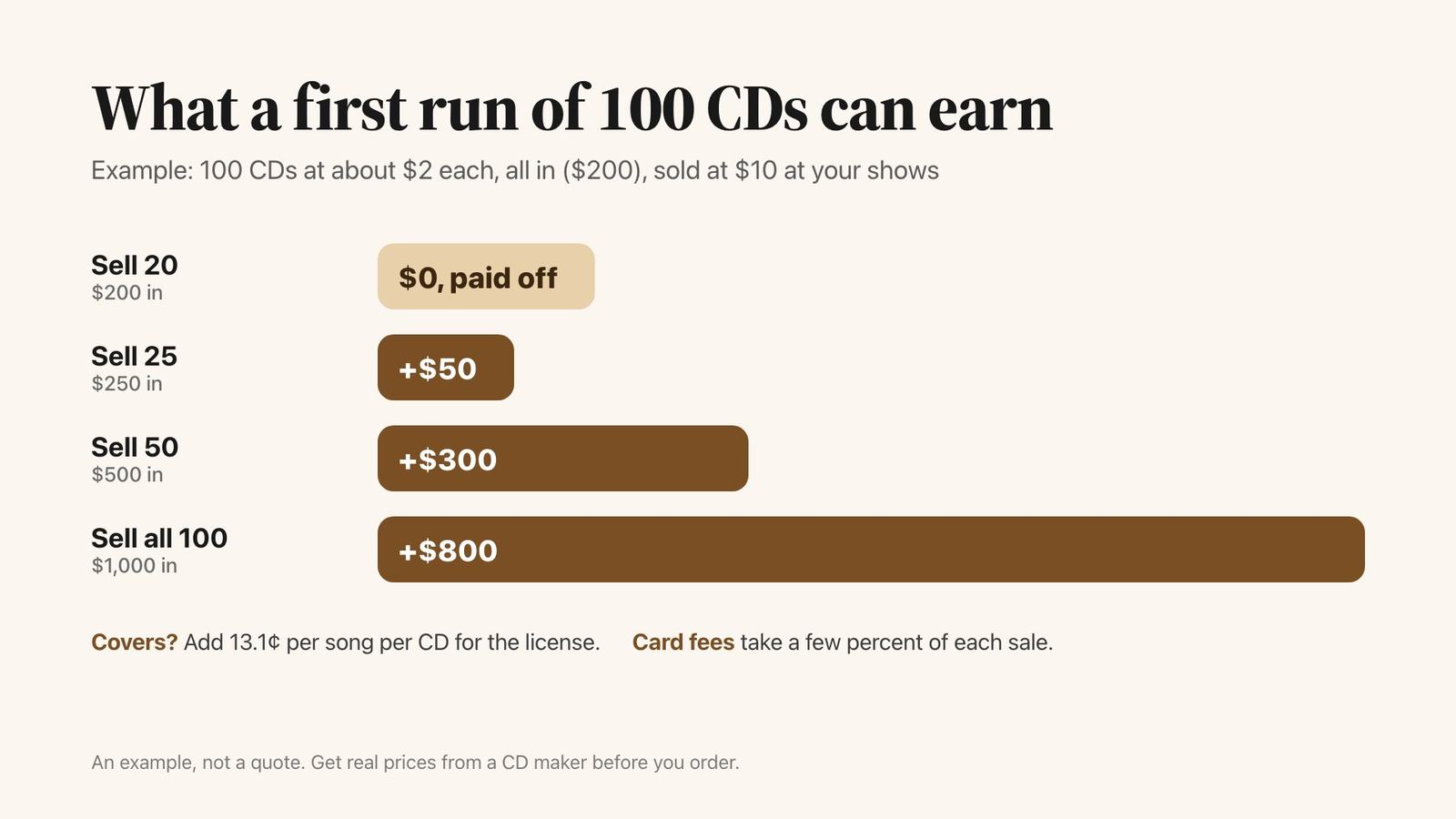
| CDs sold at $10 | Money in | After the $200 run |
|---|---|---|
| 20 | $200 | $0, the run is paid off |
| 25 | $250 | $50 |
| 50 | $500 | $300 |
| 100 | $1,000 | $800 |
Two things shave a little off: card fees, usually a few percent per sale, and the license if you recorded covers. Even so, CDs are one of the few things a small artist can sell at a show and keep most of the money.
How fast you sell depends on your shows. A packed room after a strong set might buy ten. A quiet weeknight might buy one. That's why 100 is a sensible first order: enough to bring the price down, small enough that you won't be storing boxes for years. If they sell out, reorder 300 or 500 at a lower price per disc.
How to sell CDs at your shows
The merch table is where CDs sell, and small habits make a big difference.
- Mention it from the stage. Once, near the end, simply: "We've got CDs at the back, and we'll sign them." Most people won't notice the table unless you tell them.
- Take cards. Plenty of fans don't carry cash. A phone card reader or a payment app QR code on a stand catches those sales.
- Put a download code inside. Since many buyers can't play a CD, include a card with a code or QR link to download the album. It answers "but I don't have a CD player" before anyone says it.
- Sign them. Signing turns a $10 disc into a keepsake, and it gives you a reason to talk to every buyer.
- Bundle. CD plus a T-shirt or a poster for a small discount moves both. A "CD and a sticker for $12" sign works better than two separate prices.
- Make it collectible. Borrow from K-pop: number a limited first run, add a photo card or a lyric booklet, or print two covers. Collectors buy the version they don't have.
- Collect emails or follows. Have a sign-up sheet or QR code next to the CDs. A buyer tonight is a ticket sale next time.
Selling CDs online
The table at your shows will sell most of your CDs, but an online store catches fans from out of town. Bandcamp is the usual choice: its share on physical items is 10%, plus payment processing of about 4 to 6%. On Bandcamp Fridays it waives its share, and the last one of 2026 is December 4, a good day to launch or restock. Remember to charge for shipping: a CD in a padded mailer costs a few dollars to send.
When CDs are not worth it
- You don't play live yet. Without a merch table, a box of CDs mostly sits in a closet. Play your first shows first.
- The recording isn't finished. A CD is permanent. If you're still changing the mix, wait.
- Your fans are all online and far away. Then shipping costs eat the margin. Digital sales and streaming may fit better.
- Your music changes every month. If you release a single every few weeks, a small batch of 50 or a cheap sleeve run keeps you from being stuck with old material.
Our perspective
The CD comeback is mostly a collectors' story, and that's exactly why it's useful to independent artists. You can't compete with big K-pop box sets, and you don't need to. What a small artist can offer is something no big release can: the person who made the music, standing at the table, signing the disc and saying thanks.
That only works if you're playing shows. At GigNBizz, we think about this every day: live music works best when local musicians and local businesses find each other directly. Get the gigs, and the CDs sell themselves.
Play more shows with GigNBizz
GigNBizz is a free community for independent musicians. On it, you can:
- Build a profile with your songs, so venues and fans can hear you before they book.
- Ask the Booking Agent on Discover to find you gigs, or answer local businesses looking for an act.
- Post your upcoming shows under Shows on Home, so nearby fans can tap "Going".
Read more about finding local gigs as a musician, or see how businesses book local musicians.
FAQ
Are CDs making a comeback?
Yes. In the first half of 2026, US CD sales grew 16% to 16.3 million units, according to Luminate, and CD revenue grew 58.6%, according to the RIAA. A big share came from K-pop collectors, but CD sales still grew without them.
How much does it cost to make 100 CDs?
Usually about $100 to $200, or $1 to $2 per disc, depending on packaging and the maker. Jewel cases and booklets cost more than cardboard sleeves. Shipping is often extra.
How much should I charge for a CD at a show?
$10 is a common price for an album at a show, and $5 to $8 for an EP. Round numbers make cash sales quick. A signed or limited edition can sell for more.
Do I need a license to sell CDs with cover songs?
Yes. You need a mechanical license for every cover song before you sell copies. In 2026 the US rate is 13.1 cents per song for each copy (2.52 cents per minute for songs over five minutes). Songs you wrote need no license.
Do people still have CD players?
Fewer than you'd think. Reporting on Luminate's research found that about half of Gen Z and millennial CD buyers don't own one. That's why a download code inside the case matters: the fan keeps the CD and still gets to play the music.
Sources
- Luminate 2026 Midyear Report: Trends in Music, Television & Film
- RIAA: $6 Billion in Mid-Year Recorded Music Revenue, With Growth Across Every Major Category
- ecoustics: U.S. CD Sales Surge 16% in 2026 as Vinyl Growth Slows to 2.4%
- Slashdot: Gen Z and Millennials Are Buying CDs, Though Half Don't Have CD Players
- Disc Makers: How Many CDs Should You Order?
- CD-LAB: CD Duplication in Jewel Case
- Atlanta Disc: CD Cost and Price
- Hypebot: New 2026 US Mechanical Royalty Rates Set
- Bandcamp Help: What are Bandcamp's fees?
- RouteNote: Eight Bandcamp Fridays Confirmed for 2026
Photos: rawpixel (public domain). Charts: GigNBizz.