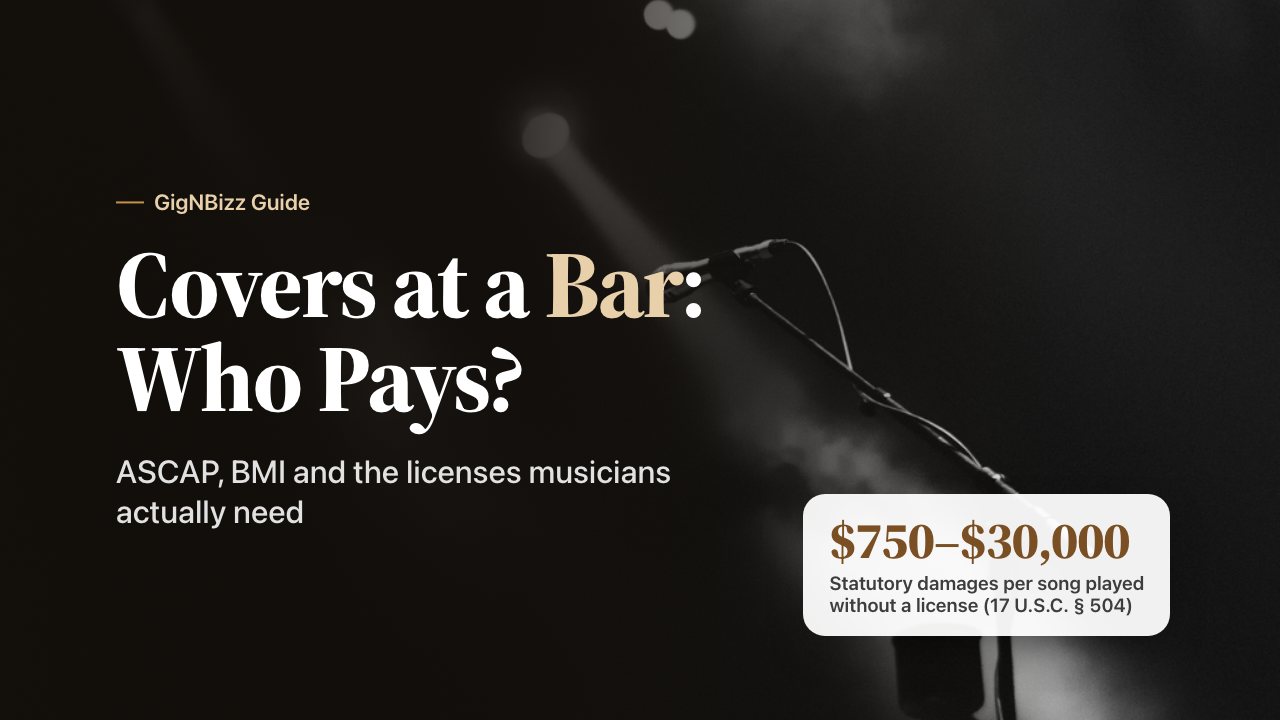
Yes, you can play cover songs at a bar, and in most cases you don't need a license of your own to do it. In the US, the business that hosts the music is responsible for the public performance licenses from ASCAP, BMI, SESAC and GMR, even when the band is an independent contractor. Your own license questions start when you record a cover, sell it, or post it online. Here's how it works for musicians and for the bars, cafés and breweries that book them, with links to the actual rules. This is general information, not legal advice.
TL;DR
- Playing a song at a bar is a "public performance" under US copyright law, and the songwriters' permission is needed.
- The bar gets that permission, through blanket licenses from ASCAP, BMI, SESAC and GMR. ASCAP, BMI and SESAC all say the business can't push this onto the musicians.
- Unlicensed music can cost a business $750 to $30,000 per song in statutory damages, and up to $150,000 if willful (17 U.S.C. § 504).
- The small-business exemption covers radio and TV only. It never covers a live band.
- A free charity show is exempt only if nobody is paid, including the performers.
- Selling a cover on CD needs a mechanical license: 13.1 cents per song, per copy, in 2026. Posting a cover video needs the publisher's permission.
- If you write songs, ASCAP OnStage and BMI Live can pay you when you play them live at licensed venues.
Table of contents
- What the law says about playing songs in public
- Who pays: the venue, not the band
- What a venue license costs
- Private parties, free shows and charity gigs
- When musicians do need a license
- Get paid for your own songs
- Checklist before a cover gig
- FAQ
What the law says about playing songs in public
Every song has a songwriter, and US copyright law gives the owner of a song the exclusive right "to perform the copyrighted work publicly," and to authorize others to do it (17 U.S.C. § 106(4)). Two definitions in 17 U.S.C. § 101 decide when that applies:
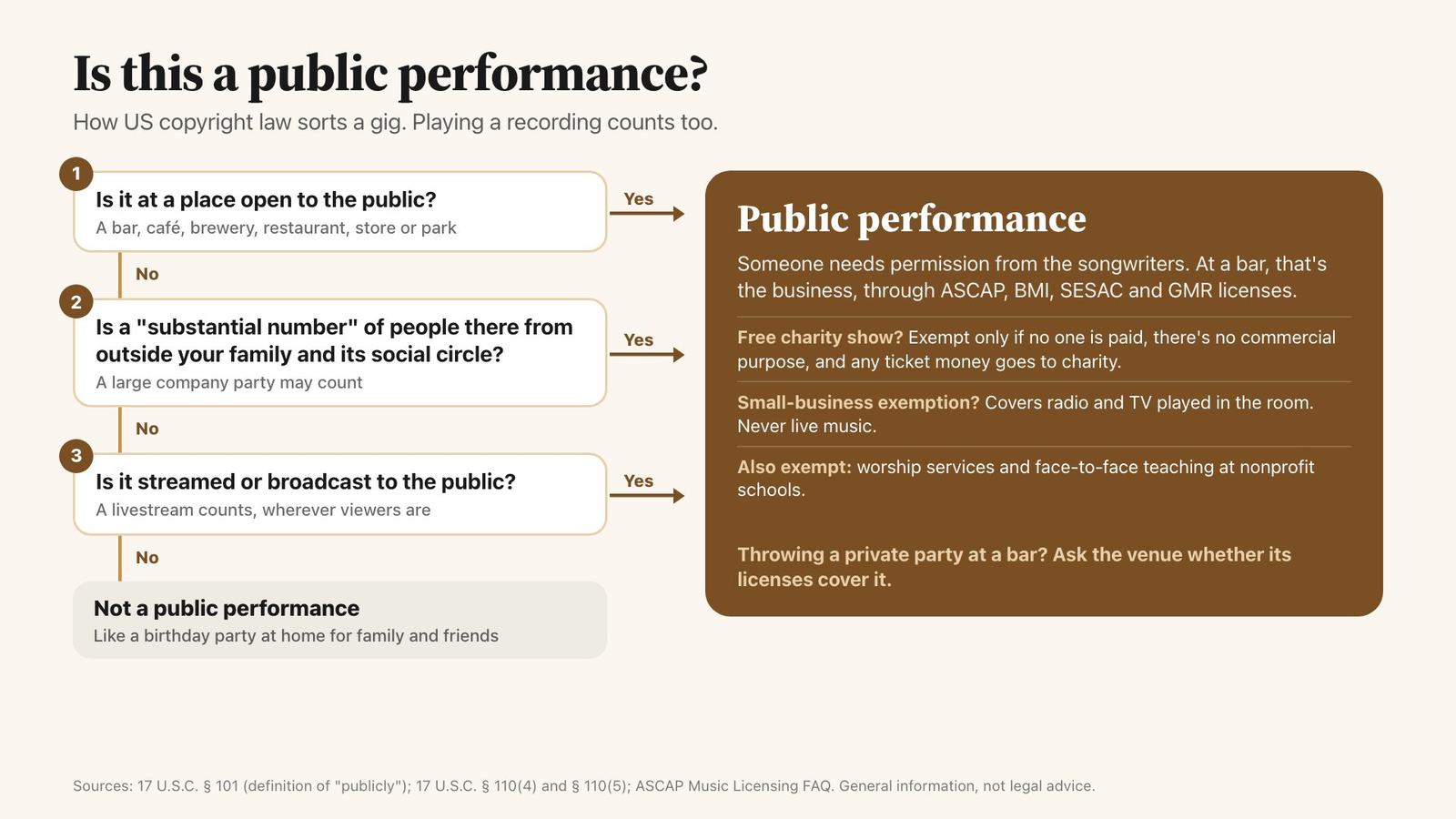
- "Perform" means to "recite, render, play, dance, or act" a work, "either directly or by means of any device or process." So a band playing a song counts, and so does a speaker playing a recording of it.
- "Publicly" means at "a place open to the public," or anywhere "a substantial number of persons outside of a normal circle of a family and its social acquaintances is gathered," or sending the performance out to the public, for example by stream or broadcast.
A bar, café, brewery or restaurant is open to the public. So a cover song played there is a public performance, whether it's a five-piece band, a solo guitarist or a DJ.
Who pays: the venue, not the band
The songwriters' permission usually comes as a "blanket license" from a performing rights organization (PRO). The four in the US are ASCAP, BMI, SESAC and GMR (Global Music Rights). A blanket license lets a business play any song in that organization's catalog for a yearly fee. All of them put the job on the business:
- ASCAP: "Since the business owner ultimately benefits from the performance, the business owner is legally responsible to obtain the license." It adds that this holds even if the business doesn't pay the musicians (ASCAP Music Licensing FAQ).
- BMI: asked whether musicians, DJs and entertainers are responsible, BMI answers "No," because "it's the business or organization that is authorizing the performance of music" (BMI Music Licensing FAQs).
- SESAC: "a business cannot shift its responsibility to musicians or entertainers" (SESAC).
- GMR: a license from Global Music Rights is required to play the works it represents, which it puts at more than 136,000 titles (GMR Licensing).
Why one license isn't enough
Each PRO licenses only its own members' songs, and many songs have co-writers in different PROs. ASCAP says that to comply with the law, "you need a license with each PRO that represents the creators of the music that you play," and BMI says the same. A cover band's setlist almost always crosses catalogs. Songview, a free database with song data from all four, shows who represents a given song.
What if a band plays only originals?
ASCAP says that if a musician performs a song they wrote alone and licenses it directly to the venue, no extra license is needed for that song. But it points out that few artists play only songs they wrote by themselves, and that co-writes, requests and covers all need licensing. BMI says much the same.
What happens without a license
Playing music without permission is copyright infringement. ASCAP says "anyone involved in enabling an unlicensed public performance may be held liable," naming corporate officers, business owners and managers, and that the damages, plus attorneys' fees and costs, usually add up to more than the license would have cost. The law sets statutory damages at $750 to $30,000 per song, up to $150,000 per song if the infringement was willful, and as low as $200 if it was innocent (17 U.S.C. § 504(c)). A night of 15 unlicensed songs is 15 possible claims. BMI says it takes legal action "only as a last resort" and tries to work with owners first.
For musicians, the practical takeaway: if a venue asks you to sign something saying licensing is your job, push back. The PROs themselves say it's the business's job.
What a venue license costs
There's no single price, and we couldn't find a published 2026 rate sheet for bars and restaurants on ASCAP's rate schedules page when we checked on November 9, 2026. It lists PDFs for many other business types. Here's how each organization says it sets fees:
| Organization | What sets the fee | Get a quote |
|---|---|---|
| ASCAP | Annual fee by business type, how music is performed (live, recorded or audio-visual) and the size of the place or audience. Over 100 rate schedules, the same terms for similar businesses. | ascap.com/music-users or 1-800-505-4052 |
| BMI | For restaurants, bars and nightclubs: live or recorded, audio only or audio-visual, nights per week with music, and other factors. Each market is different. | (888) 689-5264 or Licensing@bmi.com |
| SESAC | Fees take the kind of business into account. A family restaurant is priced differently from a festival. | sesac.com |
| GMR | Blanket license for its catalog of more than 136,000 titles. | globalmusicrights.com |
If you own a bar, call each one, describe your music honestly (how many nights, live or recorded, cover charge or not, room size) and compare. ASCAP says it is legally barred from discriminating between "similarly situated" licensees, so similar bars should be offered the same kind of agreement and rate schedule.
The small-business exemption doesn't cover live music
Many owners have heard that small bars don't need a license. That rule, 17 U.S.C. § 110(5)(B), is narrow. It covers only music from radio, TV, cable or satellite transmissions, in a business that meets limits like these:
- A food or drink business under 3,750 gross square feet (2,000 for other businesses), not counting customer parking.
- Or a bigger space with no more than 6 speakers, no more than 4 in one room, and no more than 4 TVs, one per room, none over 55 inches.
- No admission charge to see or hear it, and the broadcast itself must be licensed.
A band or DJ isn't a radio or TV transmission, so the exemption never applies to live music. ASCAP's FAQ says the exemption is "by means of radio and TV transmissions only." It doesn't cover a personal Spotify, Apple Music or YouTube account played in the bar either. Both ASCAP and BMI say a personal streaming subscription doesn't give the right to play music in a business.
Private parties, free shows and charity gigs
Private parties
ASCAP says licensing "is not necessary for purely private events," like weddings and birthday parties for family and friends. That follows the § 101 definition: no public place, no crowd of strangers, no public stream. A big company party is less clear, since a "substantial number" of people from outside a family's circle may be there. And a private party held inside a bar isn't automatically private. Ask the venue whether its licenses cover events it hosts.
Free and charity shows
Free doesn't mean exempt. The exemption for nonprofit performances in 17 U.S.C. § 110(4) applies only when all of this is true:
- There's no purpose of "direct or indirect commercial advantage."
- No fee or other pay goes to the performers, promoters or organizers.
- Either there's no admission charge, or the money left after reasonable costs goes only to educational, religious or charitable purposes. In that case the song's owner can still object with written notice at least seven days before the show.
So a fundraiser where the band gets paid doesn't qualify. Neither does a "free" show a bar puts on to sell drinks, since that's a commercial advantage. ASCAP also notes the law "does not exempt most performances by non-profit entities." Worship services and face-to-face teaching at nonprofit schools have their own narrow exemptions.
Your own ticketed show
If you rent a room and sell tickets yourself, you're closer to being the promoter. ASCAP lists concert promoters among the businesses it licenses. Before you book a hall, ask whether it holds PRO licenses that cover outside events, and get the answer in writing.
When musicians do need a license
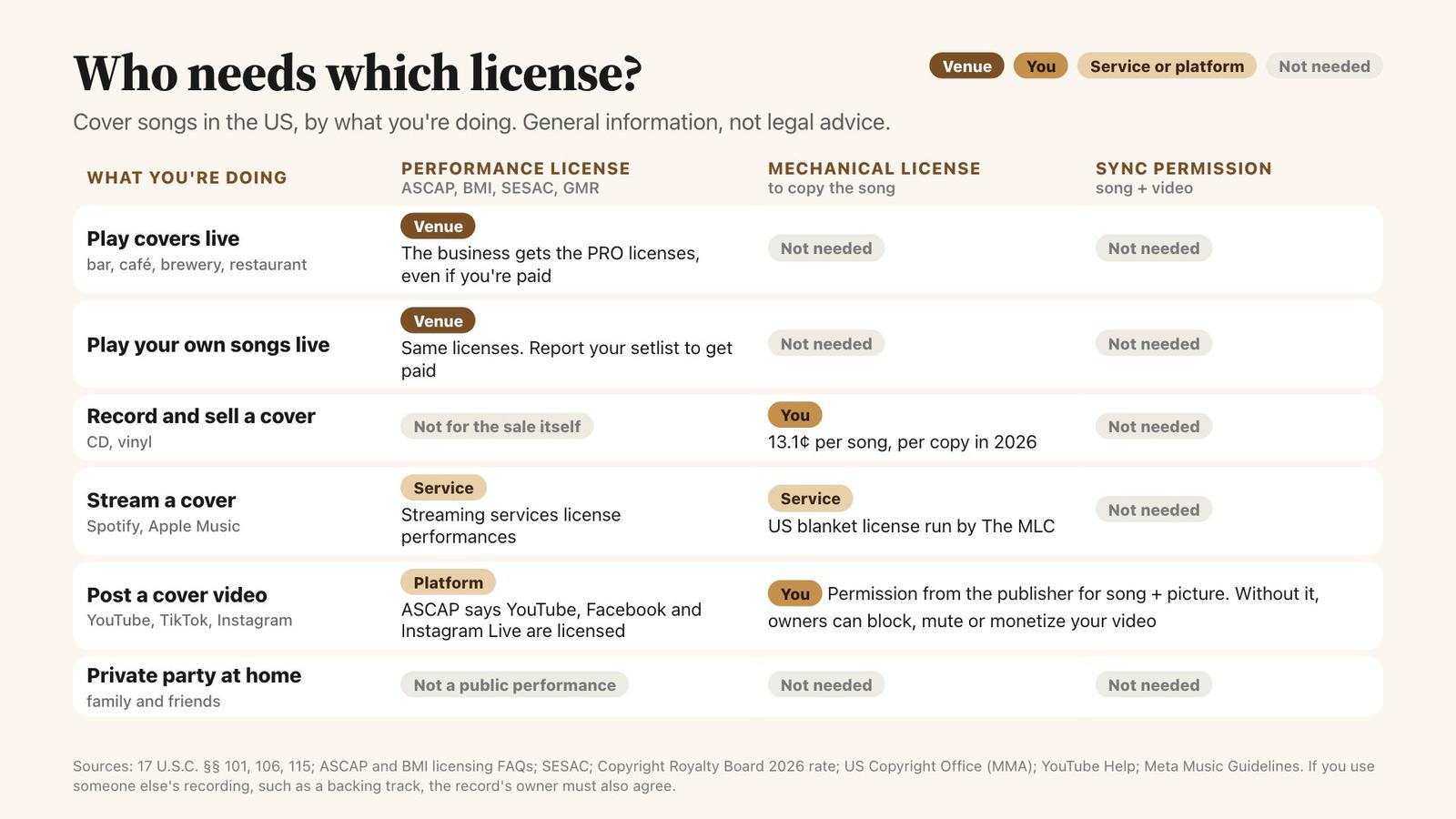
Performance licenses cover playing a song in public. They don't cover copying it. ASCAP and BMI both say they don't license "mechanical" rights (copying a song onto a recording) or "sync" rights (putting it in a video). Those come from the song's publisher or its agents.
Recording and selling a cover
Once a song has been released to the public in the US, anyone can record their own version under the compulsory license in 17 U.S.C. § 115, as long as they follow the rules and pay. Your arrangement can't "change the basic melody or fundamental character of the work," and the notice to the owner has to go out before, or within 30 days after, you make the recording, and before you distribute it. ASCAP points musicians to the Harry Fox Agency's Songfile service as one way to clear songs.
The Copyright Royalty Board's 2026 rate for CDs, vinyl and permanent downloads is 13.1 cents per song for each copy, or 2.52 cents per minute of playing time "or fraction thereof," whichever is larger. Here's a worked example for 300 CDs with two covers:
| Cover | Length | Rate per copy | For 300 CDs |
|---|---|---|---|
| Song A | 3:30 | 13.1¢ (the flat rate is larger) | $39.30 |
| Song B | 6:10, counted as 7 minutes | 7 × 2.52¢ = 17.64¢ | $52.92 |
| Total | $92.22 |
Your own songs need no mechanical license. Our guide to selling CDs in 2026 covers the rest of the math.
Streaming a cover
For on-demand streaming in the US, the streaming services get a blanket mechanical license administered by The MLC, available since January 1, 2021, under the Music Modernization Act (US Copyright Office). Distributors have their own rules for covers, and some also send releases to download stores, so read your distributor's cover-song policy before you upload. And if your track uses someone else's recording, such as a karaoke backing track, ASCAP notes you'd also need permission from the record's owner, usually a label.
Posting a cover video
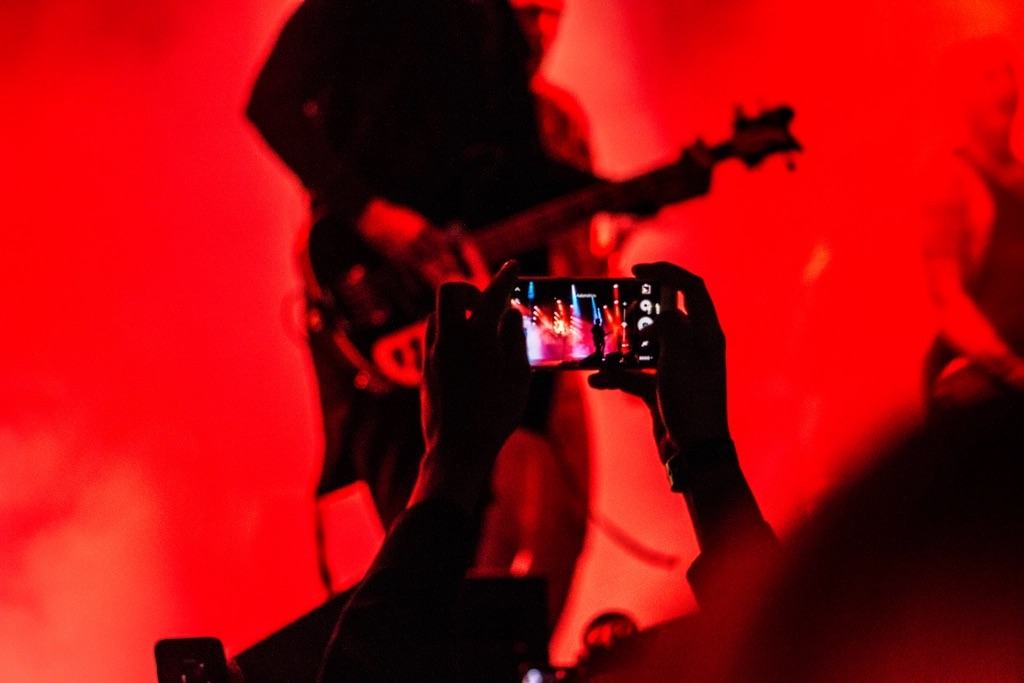
Putting a song in a video is a sync use, and ASCAP says those rights are "licensed by writers and publishers or their agents." Here's what the platforms say themselves:
- YouTube: every upload is scanned by Content ID. If it matches, the copyright owner's settings decide whether the video is blocked, monetized or tracked, and monetizing sometimes means "sharing revenue with the uploader" (How Content ID works). YouTube's claimed music page adds that you'll "generally need to seek permission" before using copyrighted material.
- Facebook and Instagram: Meta's Music Guidelines say using music for commercial or non-personal purposes "is prohibited unless you have obtained appropriate licenses," and videos with more music are more likely to be limited.
- TikTok: its Intellectual Property Policy says using copyrighted work without authorization "may lead to a violation" of its policies.
A match on YouTube is the owner's choice, not a license you hold, and owners can change their minds. One line matters for bars: a promo video for your business with a cover in it is a commercial use. Use your own music, or the musician's originals with their OK.
Get paid for your own songs
Here's the upside of all those venue fees: some of that money can come back to you. If you write songs and belong to ASCAP or BMI, you can report the songs you played live and earn performance royalties.
| ASCAP OnStage | BMI Live | |
|---|---|---|
| Who submits | ASCAP writer members. One writer can report for the whole song. | Only the performing songwriter. One band member can log shows for the band. |
| Where | ASCAP-licensed venues "of any size" in the US | US performances covered by BMI licenses |
| Deadline | By the end of the following quarter: shows from Oct. 1 to Dec. 31 are due March 31 | Up to 2 quarters before the current one, generally up to 9 months after the show |
| Payment | With ASCAP's domestic distributions | Quarterly. The rate varies with the number of reports and the fees available |
| Must have | Direct deposit | Direct deposit |
Sources: ASCAP OnStage and the BMI Live FAQ, checked November 9, 2026.
A few details worth knowing. BMI Live doesn't pay for weddings, birthday parties, private house concerts, digital livestreams, or street performances without a city permit. BMI asks you to include covers in your setlist, but only covers in its database are eligible, and ASCAP says OnStage royalties go to "the writers and publishers of the songs." So listing a cover helps the person who wrote it, not you. Your money comes from your own songs. Register them with your PRO first; ASCAP says a new registration can take up to seven days to process.
That's one more reason to work original songs into a covers set. Our guide to original songs vs. song covers looks at the balance, and our copyright guide explains registering your songs.
Checklist before a cover gig
For musicians
- Ask the venue if it has PRO licenses. A simple "Are you licensed with ASCAP, BMI, SESAC and GMR?" is fair. It protects them, and it decides whether your original songs can earn OnStage or BMI Live royalties there.
- Don't sign away their job. If a contract says the performer handles music licensing, ask to strike it.
- Keep your setlist, with the date, start time and venue address. You'll need them to report.
- Charity gig? If you're being paid, the § 110(4) exemption doesn't apply, so the venue or organizer still needs licenses.
- Filming the show? A clip posted from your account still contains the songs. Covers can get Content ID claims.
- Selling a live recording? Each cover on it needs a mechanical license first.
For bars and restaurants
- Get a quote from each PRO before your first music night, not after a letter arrives.
- Tell them the truth about how you use music: live nights per week, DJs, karaoke, TVs, cover charges. Update the license when that changes.
- Don't rely on the small-business exemption for anything but radio and TV.
- Don't play a personal streaming account over the speakers.
- Keep the license paperwork where a manager can find it.
Our perspective
Music licensing can sound scary enough that a small venue skips live music altogether, or a musician worries about rules that aren't theirs to follow. Neither should happen. The rules are simpler than they look: the room pays for the right to have songs played, and the musician pays only when they copy a song onto a recording or into a video.
We also think the licensing system is a reason to write. Covers get you booked. Your own songs, reported after every gig, are what can pay you back for years.
Show your covers on GigNBizz
GigNBizz is a free community where independent musicians find local gigs and local businesses book them. Nothing here changes who handles licenses, and GigNBizz never handles gig pay. But it helps the two sides find each other:
- Song Covers on your profile. Show the covers you play next to your original songs, so a bar can hear your set before it books.
- Discover. Businesses and musicians swipe, connect and message, then settle the date, set and pay between themselves.
- Booking Agent. A business asks for an act, and nearby verified musicians answer.
- Newest Songs and Hottest Songs. Share your released originals on the charts.
Set up your musician page, see how businesses book local music, or read the GigNBizz FAQ.
FAQ
Do I need a license to play cover songs at a bar?
Usually not. In the US, the bar is responsible for public performance licenses from ASCAP, BMI, SESAC and GMR, even when the musicians are hired as independent contractors. ASCAP, BMI and SESAC all say a business can't shift that job to the performers.
Who pays ASCAP and BMI when a band plays covers?
The business that hosts the music. Fees are annual and depend on things like live or recorded music, how many nights a week there's music, and the size of the room. Each organization licenses its own songs, so a venue with live music usually needs more than one license.
Does the small-business exemption cover live music?
No. The exemption in 17 U.S.C. § 110(5)(B) covers only radio, TV, cable and satellite transmissions played in a business that meets size and equipment limits, such as a bar under 3,750 square feet. A live band isn't a transmission, so it isn't covered.
Do I need a license to sell a CD with cover songs?
Yes. You need a mechanical license for each cover before you sell copies. In 2026 the US statutory rate is 13.1 cents per song for each copy, or 2.52 cents per minute for longer songs, whichever is larger.
Can I post a video of myself playing a cover song?
A video of a song usually needs sync permission from its publisher, which ASCAP and BMI don't grant. On YouTube, Content ID scans uploads and the copyright owner decides whether to block, monetize or track a matched video. Read each platform's music rules, and never use a cover in a business ad without licenses.
Can I earn royalties for playing my own songs live?
Yes, if you belong to ASCAP or BMI. ASCAP OnStage and BMI Live pay songwriters for live performances at licensed US venues when you submit your setlist, with deadlines. Both require direct deposit.
Sources
- 17 U.S.C. § 106: Exclusive rights in copyrighted works (Cornell LII)
- 17 U.S.C. § 101: Definitions (Cornell LII)
- 17 U.S.C. § 110: Limitations on exclusive rights, exemption of certain performances (Cornell LII)
- 17 U.S.C. § 504: Remedies for infringement, damages (Cornell LII)
- 17 U.S.C. § 115: Compulsory license for making and distributing phonorecords (Cornell LII)
- Copyright Royalty Board: Cost of Living Adjustment for 2026 (Federal Register 2025-21695)
- US Copyright Office: Music Modernization Act, Title I (blanket license)
- ASCAP: Music Licensing FAQs
- ASCAP: Restaurants, Bars and Nightclubs
- ASCAP: Rate Schedules and Licenses
- ASCAP OnStage
- BMI: Music Licensing FAQs
- BMI: BMI Live FAQ
- SESAC: Who is responsible for paying music licensing fees?
- Global Music Rights: Licensing
- YouTube Help: How Content ID works
- YouTube Help: Restrictions on claimed music
- Meta: Music Guidelines
- TikTok: Intellectual Property Policy
Photos: Petr Kratochvil via Wikimedia Commons (CC0); rawpixel (CC0), including the cover. Charts: GigNBizz.