

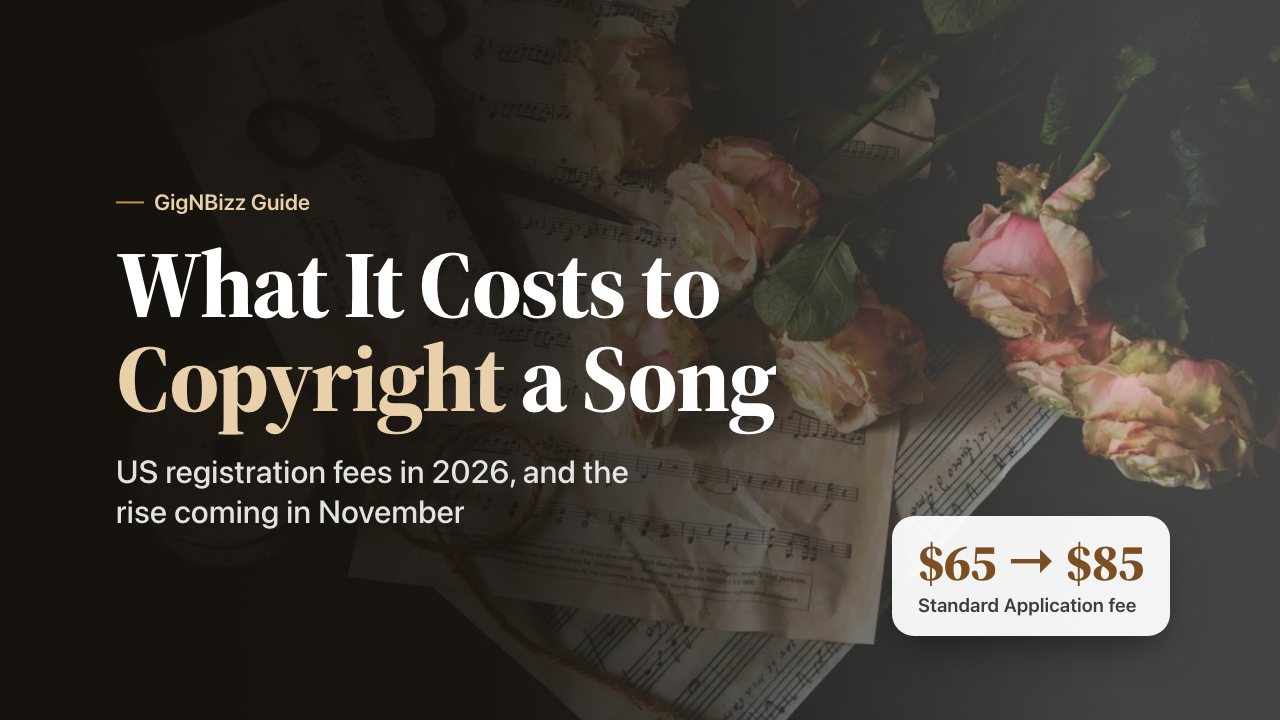
Registering a song with the US Copyright Office costs $45 or $65 when you file online today, depending on which application you qualify for. That price is about to rise. In July 2026 the Office sent Congress a new fee schedule that raises the Single Application to $55, the Standard Application to $85, and the album option for sound recordings to $130. The new fees can start in mid-November 2026. If you have finished songs waiting, filing before then saves you $10 to $65 per application.
TL;DR
- You own the copyright the moment you record or write down your song. Registering doesn't create it, but you need a registration to sue in a US court.
- Register before an infringement starts, or within three months of release, and you can ask for statutory damages ($750 to $30,000 per work) and attorney's fees.
- Fees today: $45 (Single Application), $65 (Standard Application), $65 for each album group option, $85 for a group of up to 10 unpublished works.
- Proposed fees: $55, $85, $85 for an album's songs, $130 for an album's recordings, and $130 for unpublished groups.
- If you wrote, performed and own the recording, one application can cover both the song and the recording.
- Copyright registration is separate from joining a PRO, The MLC, or uploading to a distributor. Each does a different job.
This guide explains public fees and rules for US registration. It isn't legal advice. For a contract, a dispute or anything unusual, talk to a lawyer.
Table of contents
- You already own the copyright
- Why registering still matters
- Song or recording? Know what you're registering
- The fees, now and after the increase
- Which application fits your music
- Worked examples: what you'll actually pay
- Should you register before the fees go up?
- Not the same as a PRO, The MLC or your distributor
- FAQ
You already own the copyright
Many musicians think a song isn't protected until it's "copyrighted." Not so. According to the Copyright Office's Copyright Basics circular, protection exists automatically from the moment an original work is fixed: written down, typed into a lyric sheet, or recorded, even as a voice memo.
What you pay for is registration: a public record that says who wrote what and when.
Why registering still matters
Registration is optional, but it changes what you can do if someone copies your work:
- You can sue. For US works, you need a registration (or a refusal from the Office) before you can file an infringement lawsuit.
- Statutory damages and attorney's fees. If you registered before the infringement began, or within three months of first publishing the work, you can ask the court for these. Statutory damages run from $750 to $30,000 per work, and up to $150,000 when the copying was willful. Without them, you usually have to prove the money you actually lost or the copier's profits, which is hard for a small artist.
- Evidence. A registration made before or within five years of publication counts as prima facie evidence that your copyright is valid.
The timing rule is the one to remember. Register late, after the copying started, and you lose statutory damages and fees for that infringement.
Song or recording? Know what you're registering
A released track usually holds two separate copyrights, as the Office's circular on musical compositions and sound recordings explains:
| Musical work (the song) | Sound recording (the track) | |
|---|---|---|
| What it is | Melody, harmony, rhythm and lyrics | One particular recorded performance |
| Who the authors are | Songwriters, composers, lyricists | Performers, producers, engineers |
| Office class | PA (performing arts) | SR (sound recording) |
Registering one doesn't cover the other. The money-saver: if the same person or company owns both, you can register them together on one application, choosing "Sound Recording" as the type of work. If one member wrote the song but the whole band owns the recording, you'd need two.
The fees, now and after the increase
These are the fees for the options musicians use most, from the Office's current fee page and the proposed schedule it sent Congress on July 14, 2026.
| Application | What it covers | Fee now | Proposed fee |
|---|---|---|---|
| Single Application (online) | One work, one author who is also the only owner, not made for hire | $45 | $55 |
| Standard Application (online) | Everything else, including a song and recording together | $65 | $85 |
| Paper application (Form PA or SR) | Same as Standard, mailed in | $125 | $185 |
| Album: musical works (GRAM) | 2 to 20 songs published on the same album | $65 | $85 |
| Album: sound recordings (GRAM) | 2 to 20 recordings on one album, plus its artwork, photos and liner notes | $65 | $130 |
| Group of unpublished works | Up to 10 unreleased works by the same author(s) | $85 | $130 |
| Special handling (rush) | Added on top, for urgent cases such as a lawsuit | $800 | $1,100 |
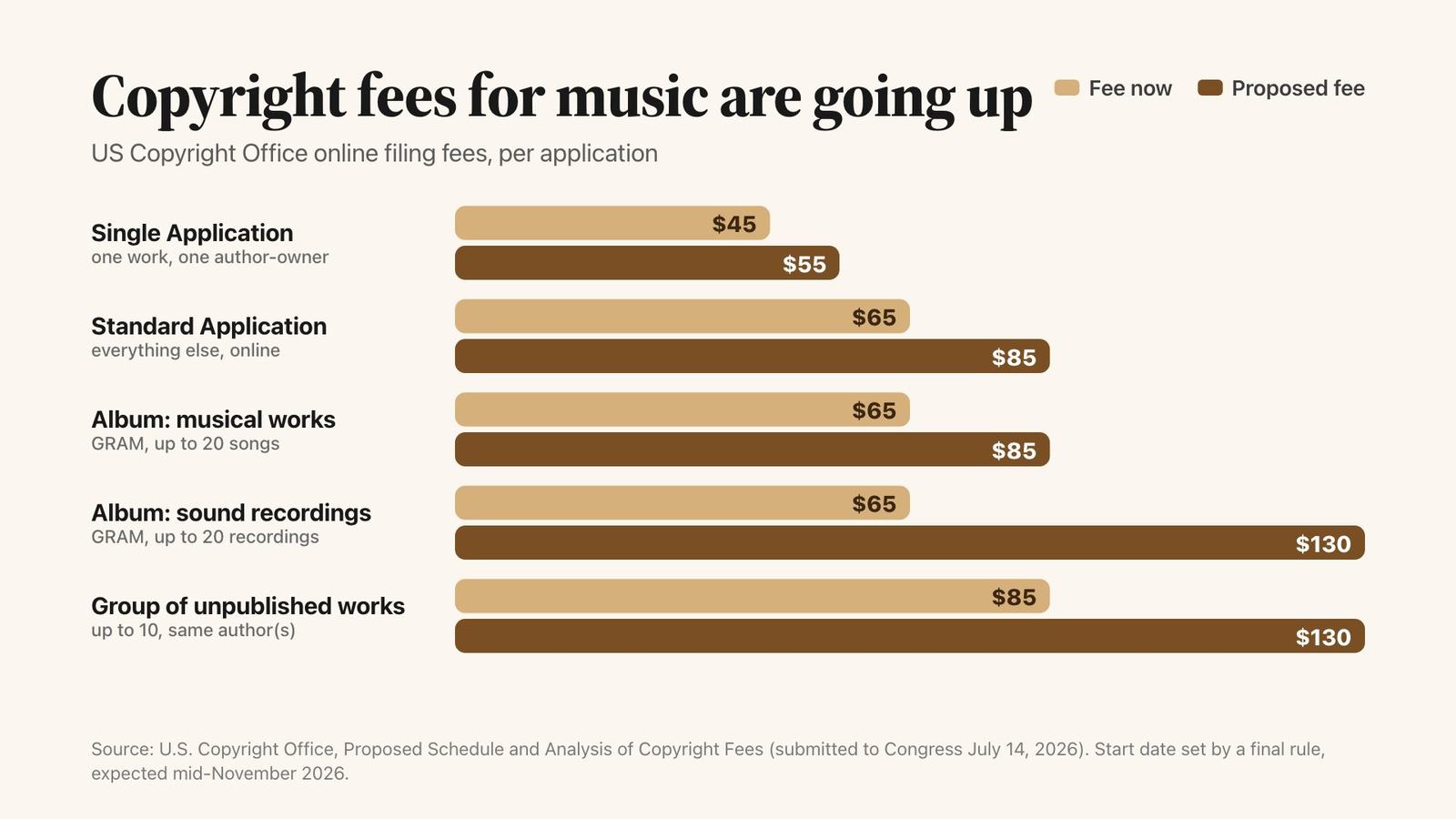
This is kinder to songwriters than the Office's March 2026 draft, which would have scrapped the Single Application and charged $130 for an album's songs. After creators objected, both were softened.
When the new fees start
By law, the Office can put the new fees in place once 120 days have passed after it sends the schedule to Congress, unless Congress passes a law blocking them. Counting from July 14, that lands in mid-November 2026. Music outlets such as Hypebot have reported November 11. The Office itself says only that it plans to start the new fees "in the fall of 2026" and will announce the exact date in a final rule in the Federal Register. As of November 8, 2026, that rule hadn't been published, so check the Office's fee page before you file.
Which application fits your music
A solo single
If you wrote the song alone, you're the only performer on the recording, and you own both, use the Single Application. The Office allows it to cover the song and the recording together in that case. It's the cheapest route: $45 now, $55 after the increase.
A band or co-written single
Two writers, a band, or a producer who shares ownership? Use the Standard Application. As long as the same person, people or company owns both the song and the recording, one Standard Application covers both: $65 now, $85 later.
An album or EP
You have three ways to register an album, and they cost different amounts:
- GRAM, the album group option. One application for up to 20 songs, and a separate one for up to 20 recordings plus artwork and liner notes. The Office won't take songs and recordings on the same GRAM application. Tracks you released earlier as singles can be included if you note the single's title and release date. Cost: $130 now for both, $215 after.
- One Standard Application for the album as a collective work. If one owner holds every song and recording and none of the tracks were released or registered before, the Office says one application can cover the album and the works on it. Cost: $65 now, $85 after. The catch, explained in the Office's circular on multiple works: a collective work may count as one work for statutory damages, so you may get one award for the album instead of one per song.
- A separate application for each track. The priciest way, but it works when every song has different writers.
A batch of demos
Unreleased songs can go in a group of unpublished works: up to 10 on one application, all by the same author or authors, who must all be named as owners. If the same people wrote and recorded them, the group can cover songs and recordings together. Cost: $85 now, $130 after, or $13 a song when you fill the group.
Worked examples: what you'll actually pay
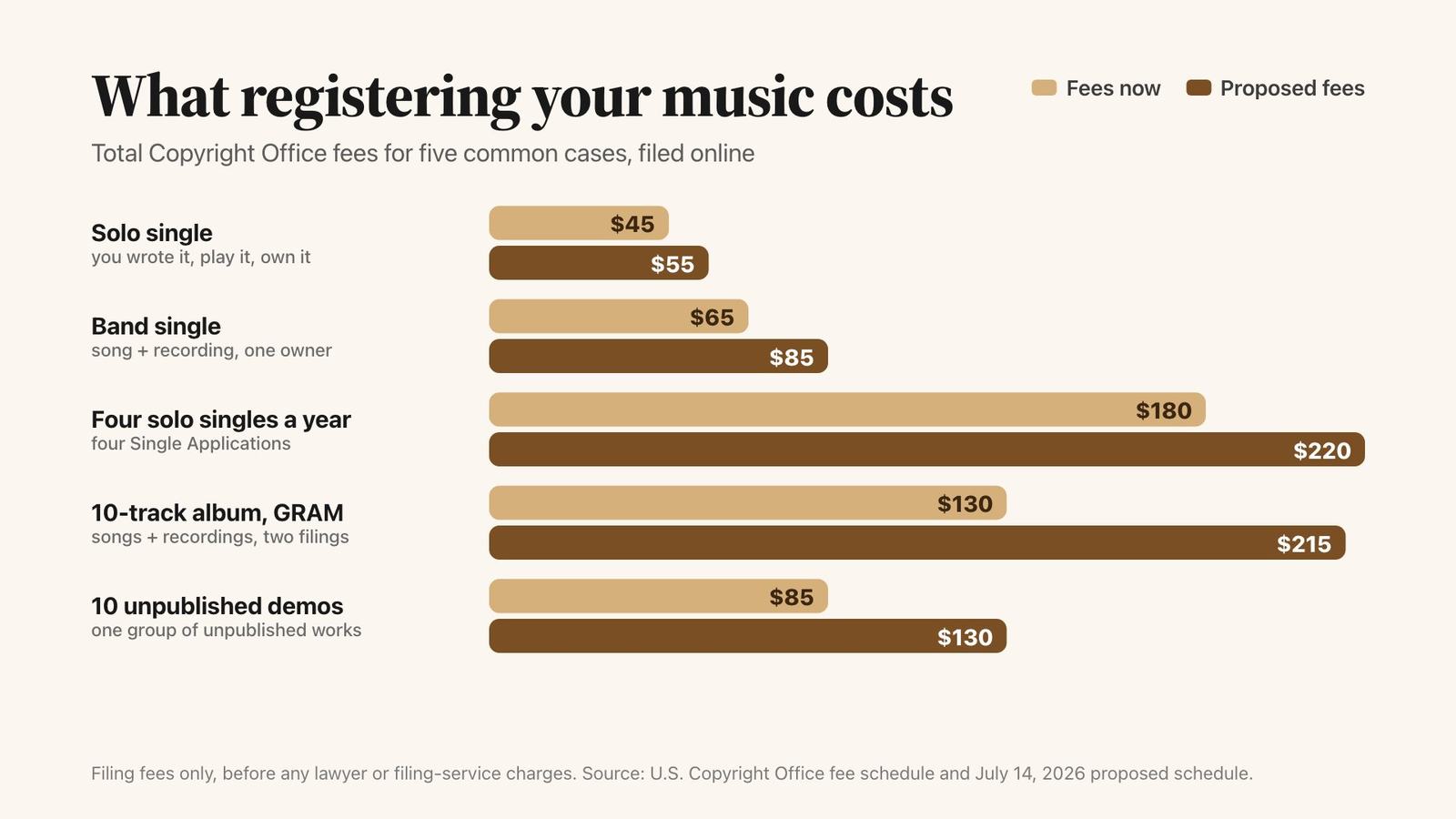
Here's what common situations cost in online filing fees, before and after the change.
| Your situation | Application(s) | Fees now | Proposed fees |
|---|---|---|---|
| Solo single you wrote, played and own | 1 Single Application | $45 | $55 |
| Band single, one owner for song and recording | 1 Standard Application | $65 | $85 |
| Four solo singles over a year | 4 Single Applications | $180 | $220 |
| 10-track album, songs and recordings | 2 GRAM applications | $130 | $215 |
| 10-track album, one owner, nothing released before | 1 Standard Application (collective work) | $65 | $85 |
| 10 unreleased demos by the same writers | 1 group of unpublished works | $85 | $130 |
If you hire a registration service, its fee comes on top. The Office offers free guides and application walk-throughs if you'd rather file yourself.
Should you register before the fees go up?
If the songs are finished, yes. The savings are small per song but add up, and an album filed through GRAM saves $85. A few tips:
- File online. Paper costs $125 now and $185 later, and it's slower.
- Have your files ready. The Office needs a complete copy of each work, usually uploaded as audio files. A release on CD or vinyl may need two physical copies mailed in instead. Have the title, year of creation and release date for each one handy.
- Released something recently? If it's been out less than three months, registering now keeps statutory damages and attorney's fees available for any copying that started after the release.
Not the same as a PRO, The MLC or your distributor
Registering with the Copyright Office proves ownership. It doesn't collect a cent of royalties. Those come from other places:
- A PRO (such as ASCAP or BMI) collects performance royalties when your songs are played in public, on radio or streamed.
- The MLC collects US mechanical royalties from streaming services for songwriters. Membership is free, and it doesn't replace a PRO.
- Your distributor delivers your recordings to Spotify, Apple Music and the rest, and pays you for the recording side.
None of these registers your copyright, and registering signs you up for none of them.
Our perspective
For most independent musicians, a copyright registration is cheap insurance you hope never to use. It costs about as much as a night out, and it's the difference between "they stole my song" and actually being able to do something about it.
But protecting songs is only half the job. Songs earn their keep when people hear them, and for most local artists that starts in a room, not a courtroom. At GigNBizz, that's the part we focus on: helping musicians and local businesses find each other so the songs get played.
Get your songs heard with GigNBizz
GigNBizz is a free community for independent musicians. On it, you can:
- Build a profile with your songs, so venues and fans can hear you before they book.
- Ask the Booking Agent on Discover to find you gigs, or answer local businesses looking for an act.
- Post your upcoming shows under Shows on Home, so nearby fans can tap "Going".
Read more about finding local gigs as a musician, see how businesses book local musicians, or check the GigNBizz FAQ.
FAQ
How much does it cost to copyright a song?
Filing online with the US Copyright Office costs $45 with the Single Application or $65 with the Standard Application today. Under the schedule the Office sent Congress in July 2026, those rise to $55 and $85, expected to start in mid-November 2026 once the Office publishes its final rule.
Is my song protected if I don't register it?
Yes. Copyright exists from the moment your song is written down or recorded. But you need a registration before you can sue over a US work, and registering early is what makes statutory damages and attorney's fees available.
Can one registration cover the song and the recording?
Yes, if the same person or company owns both. Use the Standard Application and choose "Sound Recording" as the type of work. If you wrote it alone, are the only performer and own both, the cheaper Single Application can cover both.
How much does it cost to copyright an album?
With the album group option (GRAM), you file once for the songs and once for the recordings: $65 each now, or $85 and $130 under the new schedule. If one owner holds everything and no tracks were released before, one Standard Application for the album as a collective work costs $65 now and $85 later.
When do the new copyright fees start?
The Office can start them 120 days after it sent the schedule to Congress on July 14, 2026, which is mid-November 2026. Some outlets report November 11. The Office will set the exact date in a final rule in the Federal Register, which hadn't been published as of November 8, 2026.
Sources
- U.S. Copyright Office: Fees
- U.S. Copyright Office: Proposed Schedule and Analysis of Copyright Fees to Go into Effect in Fall 2026 (July 14, 2026)
- U.S. Copyright Office NewsNet 1090: Proposed Fee Schedule Submitted to Congress
- U.S. Copyright Office: Fee Study 2026
- U.S. Copyright Office Circular 1: Copyright Basics
- U.S. Copyright Office Circular 56A: Musical Compositions and Sound Recordings
- U.S. Copyright Office Circular 34: Multiple Works
- U.S. Copyright Office: Group Registration of Works on an Album of Music (GRAM) FAQs
- Copyright Act, Chapter 5: Infringement and Remedies (17 U.S.C. § 504)
- Hypebot: US Copyright Fees Jump Nov 11
- The MLC: Membership
Photos: rawpixel (public domain). Charts: GigNBizz.