


Probably not yet. A booking agent earns a commission on the shows they book, commonly 10% to 20% of the fee according to GRAMMY GO, so agents look for acts that already draw paying crowds in more than one town. If you mostly play local cafés, bars and breweries, you can book those yourself and keep the whole fee. Here's what agents actually do, what they cost, the laws that apply in New York and California, the red flags, and how to book yourself until you're ready.
TL;DR
- A booking agent books your live shows and negotiates the deals. A manager runs your whole career. A promoter puts on the show. A talent buyer books acts for a venue.
- Agents are paid a commission on the shows they book: commonly 10% to 20% (GRAMMY GO), and often around 10% (Ditto Music).
- In New York, a business that finds engagements for musicians generally needs an employment agency license, and the state caps a theatrical agency's fee at 10% of a single engagement, or 20% for orchestras and the opera and concert fields.
- You're closer to ready when you draw paying crowds in several towns and offers come in faster than you can answer them.
- Red flags: upfront fees, "pay to play," pressure to sign today, long exclusive deals with no way out.
- Until then, book yourself: route shows, use venue databases, play your local scene and pitch local businesses that host music.
Table of contents
- What a booking agent does (and doesn't)
- How booking agents get paid
- The law in New York and California
- Signs you're ready for an agent
- How to find and approach an agent
- Red flags, and what to ask before signing
- Book yourself in the meantime
- FAQ
What a booking agent does (and doesn't)
"A music agent books live shows and in-person appearances for artists and bands," as Berklee Online puts it. For a newer act, that means club dates and opening slots. For a bigger one, it means whole tours. Berklee calls building relationships with talent buyers and promoters a core part of the job.
Four people get mixed up here, and the difference matters because only two of them work for you.
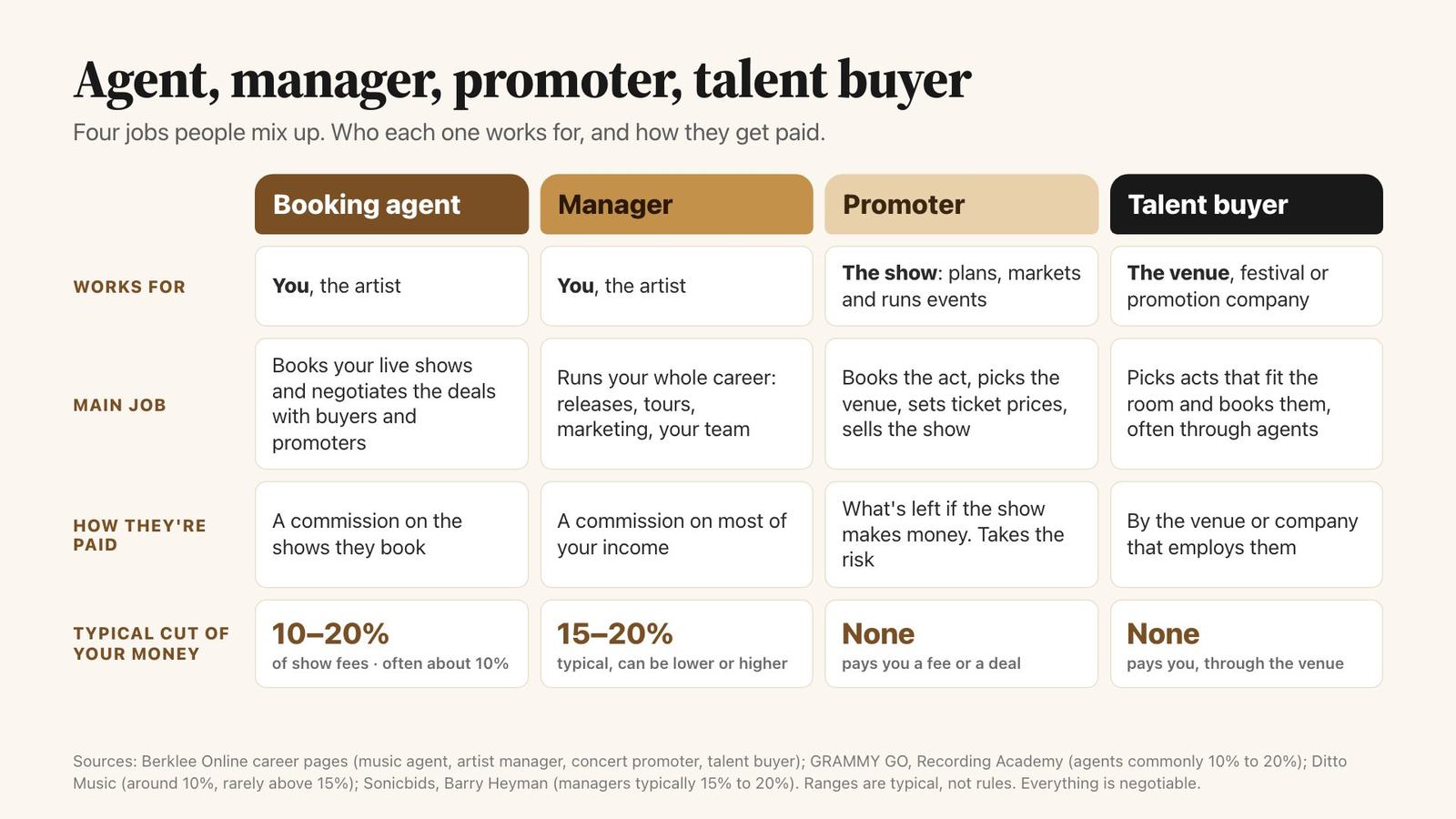
| Role | Works for | What they do | How they're paid |
|---|---|---|---|
| Booking agent | You | Books your shows and negotiates fees and terms with buyers and promoters | Commission on the shows they book, commonly 10% to 20% |
| Manager | You | Advises on your whole career: releases, tours, marketing, getting paid, your team | Commission on most of your income, typically 15% to 20% (Sonicbids) |
| Promoter | The show | Plans and markets events: books the act, picks the venue, sets ticket prices | Whatever the show earns after costs. The promoter takes the financial risk |
| Talent buyer | A venue, festival or promotion company | Picks acts that fit the room and books them, often negotiating with agents and managers | Paid by their employer, not by you |
Those descriptions come from Berklee Online's career pages for the artist manager, concert promoter and talent buyer. Berklee notes that promoters "assume all of the financial risk for the shows they put on," and that a manager's work can overlap with an agent's. Early on, one person often does both jobs, and that person is often you.
What an agent doesn't do: make people want to see you. Agents sell demand that already exists. They can get you in front of a buyer, but they can't fill the room.
How booking agents get paid
Agents take a percentage of the fees for shows they book. The published ranges:
- GRAMMY GO, the Recording Academy's learning platform, says agents get "commonly 10% to 20%" of the client's fee, and elsewhere on the same page "usually around 10-15%."
- Ditto Music says agents "will generally charge around 10% commission," and that "it's unusual for them to go higher than 15%."
- The union side. The American Federation of Musicians licenses booking agents, and its Canadian branch, the CFM, says its licensed agents work at "set rates of 15-20% - depending on type of engagement." AFM members can look for agents who've signed the AFM's Booking Agent Agreement, as Local 802's counsel explained in a 2017 column.
- New York law caps it for licensed theatrical agencies (more below): 10% of a single engagement, or 20% for orchestras and the opera and concert fields.
Two details matter as much as the rate. First, is the commission on your gross fee or on what's left after costs? Second, which shows does it cover: only the ones the agent books, or every show you play, including ones you book yourself?
What 15% costs you: an example
Here's a made-up year to show the math. Say you play 40 shows at $500 each. That's $20,000 in fees. Your costs (gas, gear, paying a drummer) come to $8,000, so without an agent you'd keep $12,000.
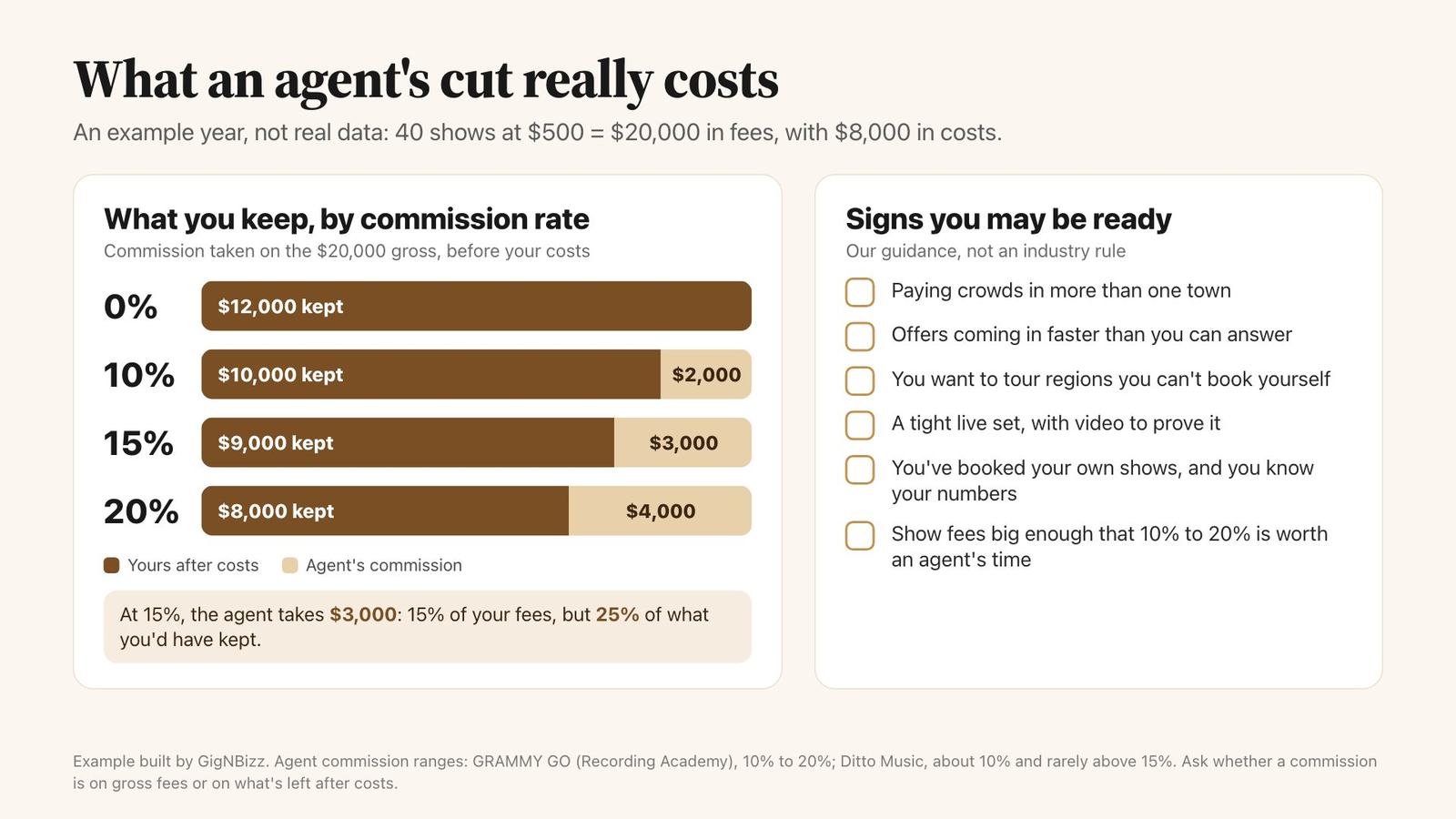
| Commission on $20,000 gross | Agent's cut | You keep after $8,000 costs | Share of your take-home |
|---|---|---|---|
| None (you book it) | $0 | $12,000 | 0% |
| 10% | $2,000 | $10,000 | About 17% |
| 15% | $3,000 | $9,000 | 25% |
| 20% | $4,000 | $8,000 | About 33% |
That doesn't mean agents are a bad deal. If an agent gets you $900 shows where you'd been getting $500, or fills dates in cities you couldn't reach, you come out ahead. The point is to do this math with your own numbers before you sign, not after.
The law in New York and California
Most musicians never think about this, but in two of the biggest music states, finding paid work for performers is a licensed business. This is general information, not legal advice. Read the actual rules linked here, and talk to an entertainment lawyer before you sign anything big.
New York
- Who counts. New York's General Business Law § 171 defines a "theatrical employment agency" as anyone who "procures or attempts to procure employment or engagements for an artist," and "artist" expressly includes "musical artists" and "musical organizations."
- The manager exception. The same section excludes "the business of managing" artists "where such business only incidentally involves the seeking of employment therefor." In plain terms, a manager who books shows only as a side part of managing you is treated differently from someone whose main business is booking.
- The license. Under § 172, no one may run an employment agency without a license: from the state labor commissioner outside New York City, and from the city inside it. NYC's Department of Consumer and Worker Protection says: "If your primary business is finding employment or engagements for artists," you are a theatrical employment agency "and need an Employment Agency license." You can look up a business with DCWP's license check.
- The fee cap. § 185 says the gross fee for a theatrical placement "shall not exceed, for a single engagement, ten per cent of the compensation," except that for "orchestras" and for "the opera and concert fields" it "shall not exceed twenty per cent."
California
- California's Talent Agencies Act defines a talent agency as anyone who procures or tries to procure "employment or engagements for an artist or artists," and its definition of artists covers musicians (Labor Code § 1700.4).
- "No person shall engage in or carry on the occupation of a talent agency without first procuring a license therefor from the Labor Commissioner" (§ 1700.5).
- "No talent agency shall collect a registration fee," and if an agency collects a fee for a job you don't get or aren't paid for, it has to repay it on demand (§ 1700.40).
Other states have their own rules, and some have none specific to music. Wherever you are, asking "Are you licensed?" is a fair first question.
Signs you're ready for an agent
There's no official threshold. Ditto Music says an agent wants you "bringing in enough ticket sales to make it worth their while," and "will only want to work with a band or artist from which they can earn enough money to live." It also points to playing live often, selling out local shows, a strong live set and a mailing list. Local 802's counsel noted in 2017 that an agent may be a wise choice for rock or pop acts, while classical and freelance players often don't need one.

Here's our checklist. It's guidance, not an industry rule:
- You draw paying crowds in more than one town, and can show the numbers: tickets sold, door counts, bar sales.
- Offers come in faster than you can answer them, and booking is eating your practice and writing time.
- You want to play regions where you have no contacts, and the fees there would cover travel.
- Your live set is tight, and you have good live video that proves it.
- You've booked yourself for a while, so you know your costs, your draw and what a fair fee looks like.
- Your fees are big enough that 10% to 20% of them is worth someone's time.
If you check most of those, start looking. If you check one or two, keep building. The work you do now, booking and promoting your own shows, is exactly what makes an agent want you later.
How to find and approach an agent
According to Ditto Music, "a booking agent will find new clients through trusted colleagues." Cold emails to agents, it says, "might have a limited success rate." So the best way in is usually through people:
- Look at who books acts like you. Check the tour posters and websites of artists one or two steps ahead of you in your genre. Many list their agent.
- Play with their roster. Opening for, or trading shows with, an agent's artists gets you seen and talked about.
- Ask for introductions. Venue bookers, promoters and other bands know agents. A warm intro beats a cold email.
- If you're in the union, start with agents who've signed the AFM's Booking Agent Agreement.
When you do reach out, keep it short: who you are, one link to your best live video, your EPK, your real numbers (cities, draw, recent fees) and what you want help with. An agent reads that note as a business case. Make it easy to say yes.
Red flags, and what to ask before signing
Red flags
- Upfront fees. In its 2025 alert on casting scams, the FTC says "Paying to get a job is always a sign of a scam," and that real talent agencies don't charge upfront and get paid after the client pays them. California bans talent agency registration fees outright.
- Pay to play. Being asked to buy tickets to resell, or pay for a "showcase" slot, is not an agent working for you.
- Pressure. The FTC warns about high-pressure pitches. A real offer will still be there tomorrow, after you've read it.
- No license, where one is required. In New York and California, ask, and check.
- Exclusivity without results. A long exclusive deal with no minimum work and no way out can lock you in with nothing coming in. Local 802's counsel listed failing to deliver the jobs promised, poor accounting of your money, and a commission "not commensurate with the services rendered" as common problems.
- Vague money handling. If the agent collects deposits or fees, you need to know when you get paid and see a statement.
Questions to ask before signing
- Term. How long does it last? Is there a trial period?
- Territory. Which regions or countries does it cover? Can you keep booking your hometown?
- Exclusivity. Are you allowed to book any shows yourself? Do you owe commission on those?
- Commission rate and base. What percentage, and is it on the gross fee or after costs? Does it apply to anything besides show fees, like merch?
- Out clause. Can you leave if the agent books fewer than a set number of shows, or earns you less than a set amount, in a period? Put the number in writing.
- After it ends. Do they keep earning on shows they booked before you left? For how long?
- Money. Who collects deposits, how fast do you get paid, and will you get a statement for each show?
- License and union. Are they licensed where they need to be? If you're an AFM member, are they an AFM signatory?
A fair agent will answer all of these without getting annoyed. Have a lawyer read anything that ties you up for more than a year.
Book yourself in the meantime
Most of what an agent does, you can start doing now on a smaller scale.
- Route your shows. Group dates by area instead of driving back and forth. Two shows an hour apart on a Friday and Saturday cost less in gas and time than two shows three hours apart.
- Use a venue database. Indie on the Move is a music venue database and booking resource with a free account. Its pricing page in October 2026 listed Premium at $13.99 a month or $119.90 a year (venue, college and festival booking details, plus emailing), and Deluxe at $39.99 a month or $335.90 a year. Check current prices before you pay.
- Play your local scene. Open mics and small shows build the draw an agent will ask about. See our guide to finding local gigs and open mics.
- Trade shows. Offer a band in another town an opening slot at your show in exchange for one at theirs. It's a simple way to build a regional circuit.
- Pitch local businesses. Cafés, restaurants, breweries, wineries and farms that host music often book directly, without agents, and they rebook acts that work.
- Track your numbers. Keep a simple sheet of every show: date, venue, fee, draw, costs. It helps you set your price now, and it's your pitch to an agent later.
- Know your price. Our guide on how much to charge for a gig walks through it.
Our perspective
An agent is a multiplier, not a starting point. They take something that's already working, a set people come back for, and get it in front of more buyers in more towns. If nothing is working yet, there's nothing to multiply, and a good agent will tell you that.
The good news: the things that get you an agent are the same things that make your music life better right now. Play often. Treat venues well. Know your numbers. Build a crowd one town at a time. Keep the whole fee while you do.
Book gigs yourself with GigNBizz
GigNBizz is a free community where independent musicians find local gigs and local businesses book them. One thing to be clear about: Discover has a feature called Booking Agent, and it is not a human agent. It's where a business or a person asks for an act, and nearby verified musicians answer. Nobody signs you, there's no contract with GigNBizz, and GigNBizz doesn't take a commission or handle gig pay. You and the business settle the date, the set and the pay directly.
As a musician, you can:
- Make a free artist page with your songs, so businesses can hear you before they book.
- Swipe local businesses on Discover, connect and message them.
- Answer open dates that businesses post, and requests that come through Booking Agent.
- List your upcoming shows under Shows on Home (members' shows are approved by our team).
See how it works for musicians, or read the GigNBizz FAQ.
FAQ
Do I need a booking agent to get gigs?
No. Most independent musicians book their own local and regional shows. Agents are most useful once you draw paying crowds in more than one town and want to tour places you can't book yourself. Until then, a percentage of small fees rarely pays for an agent's time, and agents look for acts they can earn a living from.
How much does a booking agent charge?
A commission on the shows they book. GRAMMY GO, from the Recording Academy, says agents commonly take 10% to 20% of the fee. Ditto Music puts it at around 10%, and says it's unusual to go above 15%. In New York, the state's employment agency law caps a licensed theatrical agency's fee at 10% of a single engagement, or 20% for orchestras and the opera and concert fields.
What's the difference between a booking agent and a manager?
A booking agent books your live shows and negotiates those deals. A manager runs your whole career, from releases and touring plans to marketing and your team, and usually takes a commission on most of your income, typically 15% to 20%. A promoter puts on the show and takes the financial risk, and a talent buyer books acts for a venue or festival.
Should I ever pay a booking agent upfront?
Be very careful. Legitimate agents are paid a commission after you're paid for the show. The FTC warns that paying to get a job is always a sign of a scam, and California's Talent Agencies Act bars talent agencies from charging a registration fee. If someone wants money before booking anything, walk away or check them out first.
Do booking agents need a license in New York?
Generally, yes. New York's General Business Law treats a business that finds engagements for artists, including musicians, as a theatrical employment agency that needs a license. In New York City, the Department of Consumer and Worker Protection issues it. A manager who only books shows incidentally to managing an artist is excluded. This is general information, not legal advice.
Is the GigNBizz Booking Agent a real booking agent?
No. Booking Agent on GigNBizz's Discover is a feature, not a person who represents you. A business or person asks for an act, and nearby verified musicians answer. GigNBizz doesn't sign you, doesn't take a commission and doesn't handle gig pay. You agree on the date, set and pay directly.
Sources
- GRAMMY GO (Recording Academy): The Unsung Architects of Live Music: An Introduction to Music Booking Agents
- Ditto Music: How to Find a Music Booking Agent (June 25, 2025)
- Berklee Online: Music Agent
- Berklee Online: Artist Manager
- Berklee Online: Concert Promoter
- Berklee Online: Talent Buyer
- Sonicbids, Barry Heyman: Understanding Artist Management Agreements, Part 3: How Are Managers Paid, and How Much? (2015)
- Canadian Federation of Musicians (AFM): Booking Agents
- Local 802 AFM, Harvey Mars: Can a booking agent still help you get gigs, and how do you find one? (September 2017)
- New York General Business Law § 171: Definitions
- New York General Business Law § 172: Licenses
- New York General Business Law § 185: Fees
- NYC Department of Consumer and Worker Protection: Employment Agency license
- NYC Department of Consumer and Worker Protection: Check a license
- California Labor Code § 1700.4: Talent agency and artist definitions
- California Labor Code § 1700.5: License required
- California Labor Code § 1700.40: Registration fees
- FTC Consumer Alert: Lights, camera, scam! Spot virtual casting call scams (December 8, 2025)
- Indie on the Move: Pricing (as listed October 2026)
Photos: Kai Oberhäuser via Wikimedia Commons (CC0, cover); Daniel Robert via Wikimedia Commons (CC0). Charts: GigNBizz.