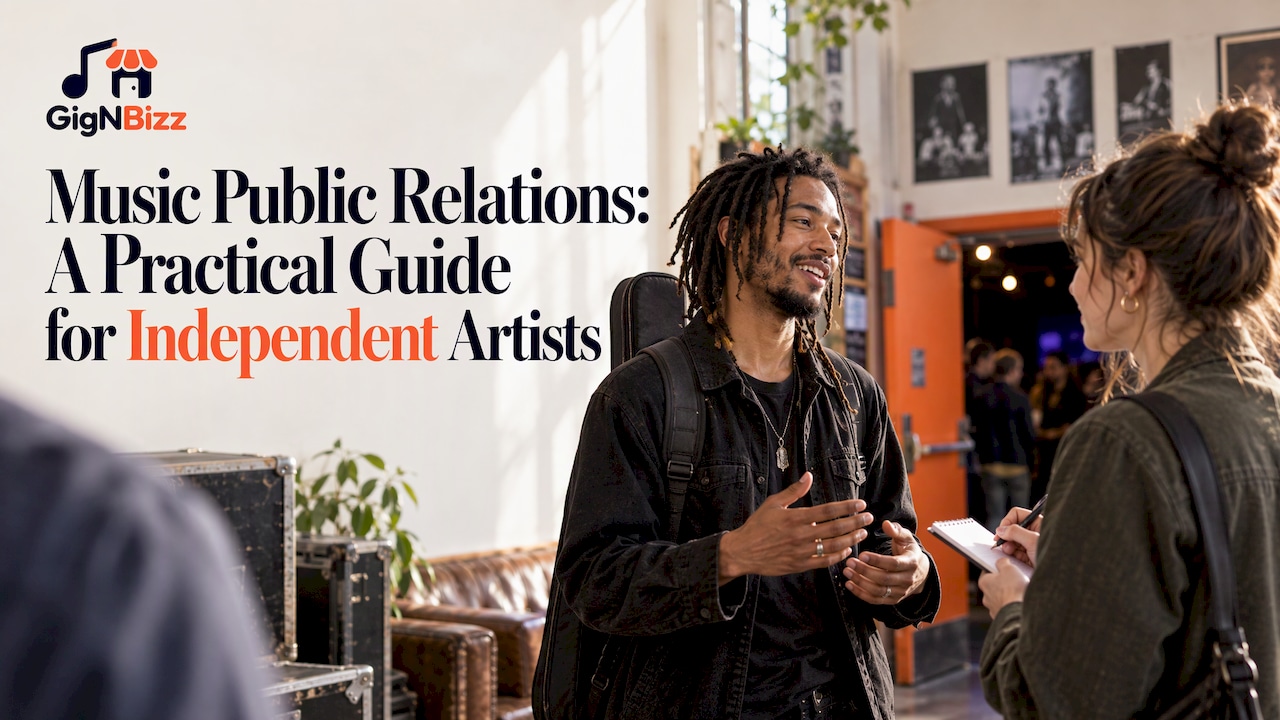
An EPK that gets you booked is one web page, at one short link, that leads with a live video and your two or three best songs, then gives a short bio, press photos, honest highlights and a booking contact. That's it. Bookers decide fast: a festival promoter writing on the Sonicbids blog says many promoters can tell "within just a couple of minutes" whether an act fits. This guide shows what to put in, what to leave out, how to format it, and the bio and email templates that carry it.
TL;DR
- An EPK (electronic press kit) is the digital version of the press packet bands used to mail out. Venues, festivals, booking agents and writers read it.
- Put a live video and your two or three strongest songs at the top. Bookers and festival reviewers often stop after the first few tracks.
- Add a short and a long bio, high-resolution photos in both orientations, real highlights, one-line press quotes, a stage plot and a booking contact.
- Leave out your whole catalog, big attachments, old photos, inflated numbers and any quote you can't link to.
- Lead with a web page that works on a phone. Keep a one-page PDF as a backup.
- Send it inside a short, specific email to the right person, follow up once, and update the page every few months.
Table of contents
- What an EPK is and who reads it
- What goes in your EPK
- Web page or PDF, and where to host it
- Venue, festival and press versions
- Writing your bio
- Stage plot and tech rider
- The pitch email that carries it
- Keeping it current
- FAQ
What an EPK is and who reads it
An EPK is a one-stop summary of your act. Bandzoogle calls it "a snapshot of your latest music or project, all summed up on one page." It's the link you send when someone asks, "Do you have something I can look at?"
Different readers open it for different reasons:
| Reader | What they're deciding | What they look at first |
|---|---|---|
| Talent buyer at a club or bar | Will this act fit the room and bring people? | Live video, local draw, genre fit |
| Restaurant, brewery or café owner | Will this sound right for my customers on a Friday? | Live video, set lengths, gear needs |
| Festival programmer | Does this act fill a gap in a lineup we're building? | Best songs, recent live video, availability |
| Writer or blogger | Is there a story here, and can I publish it today? | Bio, photos, the new release |
What bookers check first
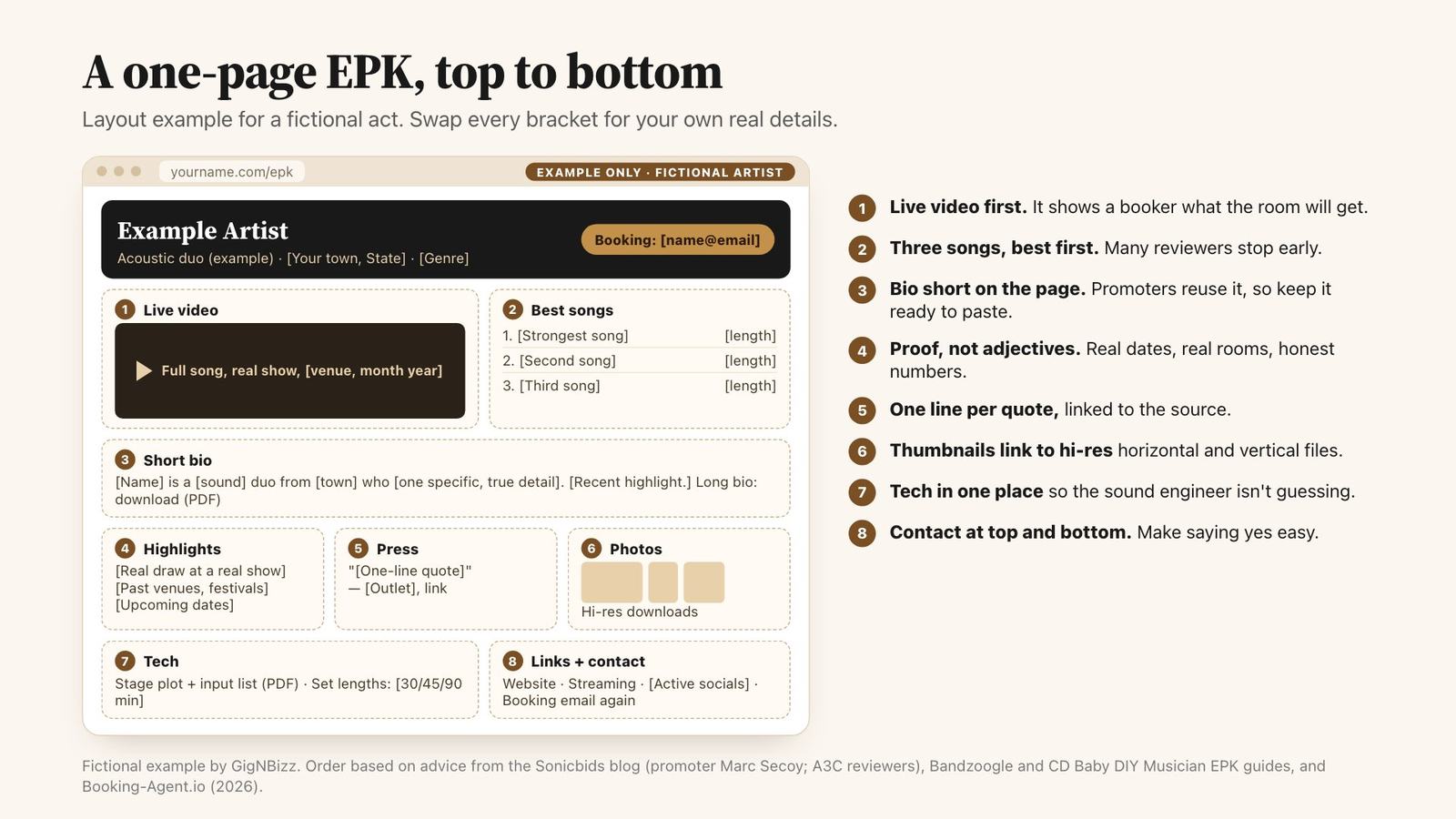
The music, then proof you can play it live. Marc Secoy, who books Paper City Music Festival and other events, wrote on Sonicbids that you should put your three best tracks first, in order, because "if two of the first three tracks are not what we expect, this usually leads to the end of the road." He also says, "I would strongly recommend putting a video of a live performance first."
Festival programmers say the same. In a Sonicbids roundup, Jeff Klingman of Brooklyn's Northside Festival said, "Nothing will get a festival programmer's interest faster than hitting play on a new band," and added that there "still needs to be a baseline level of comfort that a band will be able to show up on the night." Jeremy Weiss of LAUNCH Music Conference & Festival said many entries arrive with broken links, no music, or live recordings you can't make out.
So the first job of an EPK is simple: make your best music and a real live clip play in one click.
What goes in your EPK
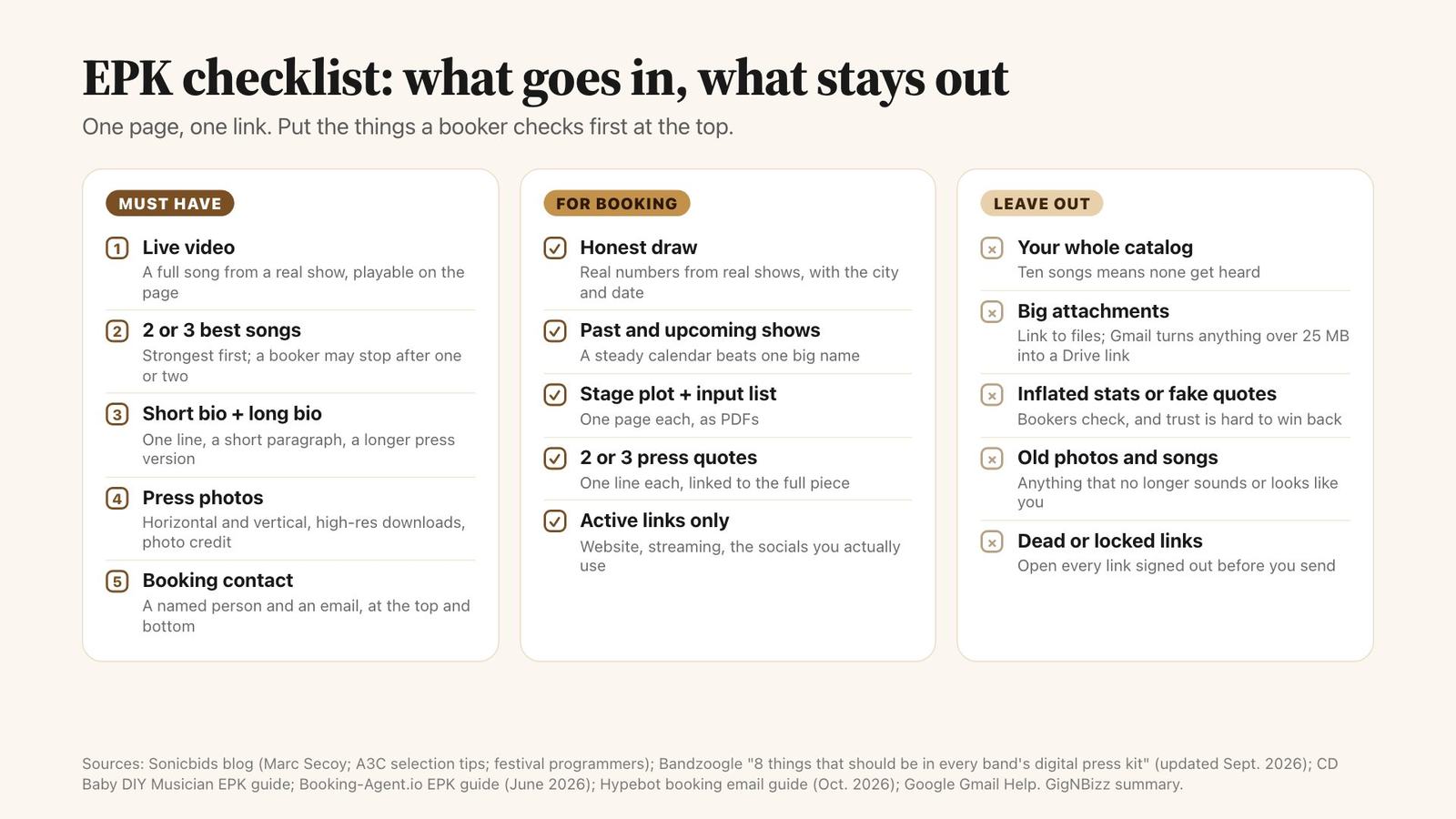
Live video
This is the piece that gets you booked. Joel Eckels of The Hotel Cafe in Los Angeles told Sonicbids, "Performance videos are the best," and warned that "the more clicks and waiting for things to load, the more impatient we get." A guide from Booking-Agent.io, a booking software company, puts it this way: "One strong live clip that proves you can perform and hold an audience beats ten polished studio videos." Use a full song from a real show, with clear sound and steady framing. If you play original music, Ditto Music's guide says a live video is more useful than a storyboarded music video.
Two or three songs
Sonicbids' own EPK guide says to put your three strongest tracks first, in ranked order. Bandzoogle notes a promoter "might only listen to the first track or two." For booking, CD Baby's DIY Musician blog suggests songs that are both well known and well received from your set. Use a player that streams the full track with one click.
Bio
Have a short one on the page and a longer one to download. Promoters often copy your bio into their own listings, according to Secoy, so the short one should be ready to paste. There's a template in Writing your bio below.
Press photos
Give people choices. Bandzoogle recommends posed and live shots, vertical and horizontal, at least one black-and-white, and a square or easily cropped portrait, shown as thumbnails that link to high-resolution downloads. Sonicbids suggests a 300 dpi version for print and a 72 dpi version for the web, at least 600 pixels wide. Booking-Agent.io suggests at least 1,500 pixels on the long edge. Credit the photographer in the file name or caption.
Highlights and draw
This is your musical résumé: past venues, festivals, opening slots, radio play, a release that did well. For venues, the most useful number is your real draw. Peter Hantzis, who has booked rooms in Boston and on Martha's Vineyard, told Sonicbids: "I appreciate it when a band tells me, flat out, we can probably only draw 10 to 15 people." If he likes the sound, he'll build a bill around you. Give the number with its context, like the city and the date. Andy Solvason, writing for Hypebot in October 2026, points out that "tickets sold at a hometown headline show do not establish what you will draw as a support act in another city."
Followers matter less than you'd think. Fred Hausman of Eastlake Music Festival told Sonicbids, "I'm not necessarily looking for likes or follows, but the quality of content you are producing and your fan engagement." Reviewers for the A3C festival said they notice when play counts don't match engagement. Ditto says plainly: don't buy fake followers or likes.
Press quotes
One line per review, with the outlet's name and a link to the full piece. That's the advice from Bandzoogle, CD Baby and Ditto alike. No press yet? That's fine. Secoy says a strong EPK can still win a booking without it. Ditto adds that acts who play private events can use quotes from past clients. Never write a quote yourself or trim one until it means something else.
Tech, links and contact
For live bookings, add a stage plot and input list (see the example below), your usual set lengths, and anything unusual you need. Link only the platforms you actually use. Then make it easy to say yes: a named person and an email, at the top and the bottom of the page. Ditto suggests listing at least two contacts if you have a band, and marking which one to use first.
What to leave out
- Your whole catalog. More songs don't help if nobody gets past the first two.
- Big attachments. Venue owner Jhoni Jackson, in a talent buyer piece on Hypebot, asks for links, plus "an MP3 or two attached" at most. Personal Gmail accounts have a 25 MB attachment limit, and anything bigger turns into a Google Drive link.
- Old material. The A3C reviewers say to remove songs, photos and videos that no longer represent you.
- Hype words. "Talent buyers are not grading your prose," says Booking-Agent.io. Real dates and real rooms beat adjectives.
- Anything you can't back up. Inflated numbers and made-up quotes break trust, and bookers talk to each other.
- Locked links. Solvason suggests opening every link while signed out, so nobody hits a "request access" screen.
Web page or PDF, and where to host it
Lead with a web page. A page can play your video and songs right there, and it opens on a phone. "Lead with the link, offer the PDF on request," Booking-Agent.io advises. CD Baby suggests hosting the EPK at one simple URL on your own site, public so promoters can open it fast, with password protection only for unreleased music.
A PDF still has a job. Some festivals and agencies ask for one, and Ditto's EPK builder help page calls PDF "the most email-friendly format." Keep yours to one page, put live links on it (a PDF can't play your songs), and keep the file small.
Where to host your EPK
You have more options than you need. Here's a neutral look at the common ones. Plans and prices were checked on November 9, 2026, and can change, so confirm on each site.
| Option | What it is | Cost (checked Nov. 9, 2026) | Good to know |
|---|---|---|---|
| Your own website | An /epk page on a site you control | Whatever your site costs | One short, permanent link. CD Baby and Bandzoogle both recommend this. |
| Bandcamp | A store page for your music and merch | Artist accounts are free. Bandcamp keeps 15% of digital and 10% of merch sales, plus payment fees. | Great for streaming full songs. It isn't built as a press kit, so link to it from your EPK. |
| Link-in-bio pages (Linktree and others) | One page of links | Linktree has a free plan with unlimited links; paid plans vary by region | Fast to set up, but it's a list of links, not a kit. Fine as a stopgap. |
| Bandzoogle EPK plan | A single-page EPK builder with templates | $6.95 a month, or $6.37 a month billed yearly; 14-day free trial | Website plans include the EPK templates too. |
| Ditto Music EPK builder | Canva templates you download as a PDF | Included for Ditto Pro and Label accounts; some templates for free users; needs a free Canva account | Makes a PDF, not a web page. |
| Sonicbids | A live-music booking platform with EPKs, long used to apply for gigs and festival slots | No prices listed on its home page | On November 9, 2026, its site said it was being rebuilt, with "Live EPKs now available" and submissions "rolling out next." |
Venue, festival and press versions
You don't need three EPKs. You need one page and a different order of emphasis depending on who you're sending it to. Bandzoogle and CD Baby both suggest tailoring the music, photos and video to the goal, and Booking-Agent.io breaks down what each kind of reader wants. Here's how that can look:
| Version | Put at the top | Add |
|---|---|---|
| Local venue, bar or restaurant | Live video, local draw, set lengths | Covers and originals mix if you play both, gear you bring, nearby shows you've played |
| Festival | Best songs, recent live video | Availability around the festival dates, stage plot, a steady show calendar |
| Press or blog | Bio and the story behind the new release | Publish-ready photos with credit, release date, streaming link, credits and lyrics |
A simple trick: keep one EPK page, and change only the first paragraph of your email to point at the part that matters to that reader. Festivals also have their own rules. Read each one's application page, because some ask for specific formats, and Hausman said missed deadlines and wrong details are common.
Writing your bio
Write it in third person, lead with your sound, and keep every sentence true and specific. Bandzoogle suggests up to four lengths, from a one- or two-sentence elevator pitch to a long bio of three or more paragraphs. Booking-Agent.io's version is a one-line hook of about 10 words, a short bio of 50 to 75 words, and a long bio of 150 to 250 words. CD Baby suggests opening with a recent press quote if you have one.
Short bio template (about 60 words)
Fill in the brackets with real details. Cut any line you can't make true.
[Name] is a [genre/sound in plain words] [solo artist/duo/band] from [town]. [One specific, true detail: where you started, what your songs are about, what you sound like live.] [Most recent highlight: a release, a festival, a residency, a notable show.] [Name] plays [set length] sets of [originals/covers/both] and is booking [season/area] now.
Long bio checklist
- Paragraph 1: the short bio, so it works alone if someone stops reading.
- Paragraph 2: the story. Where you're from, how the act came together, what you write about.
- Paragraph 3: proof. Releases, shows, festivals, press, with dates.
- Last line: what's next, and where to hear you.
Stage plot and tech rider
A stage plot is a simple diagram of who stands where. An input list tells the sound engineer what plugs into each channel. Sound engineer Aaron Staniulis, writing on Sonicbids, says festivals often request one, and you can send it whenever you confirm the details of a show. Mark vocal mics, amps, monitors and where you need power, and note whether an amp has a direct out or needs a DI box. Keep it simple: if it needs a full-color key or a poster-sized page, he says, "you've probably gone too far."
Mini example: a trio
Here's what a one-page tech sheet for a made-up acoustic trio could look like. Yours will differ.
Stage plot (audience at the bottom)
| Stage left | Center | Stage right |
|---|---|---|
| Bass player, small bass amp behind, power strip | Cajón player on a low stool, backing vocal | Lead vocal and acoustic guitar, standing |
| Monitor 1 (wedge) | Monitor 2 (wedge) | Monitor 3 (wedge) |
Input list
| Ch | Source | Mic or DI | Stand | Notes |
|---|---|---|---|---|
| 1 | Cajón | Dynamic mic | Short boom | Front port |
| 2 | Bass | DI from amp's direct out | None | We bring the amp |
| 3 | Acoustic guitar | DI box | None | Guitar has a pickup |
| 4 | Lead vocal | Dynamic vocal mic | Straight stand | Can bring our own mic |
| 5 | Backing vocal (cajón) | Dynamic vocal mic | Boom stand | Seated |
Also on the sheet: set lengths (for example, two 45-minute sets), load-in time needed, monitor notes such as "lead vocal and guitar in all wedges," and the name and phone of the band member who handles sound questions.
Staniulis says to "always err on the side of too much information rather than not enough," and to defer to the house engineer, who knows the room. If you're playing a café or restaurant, ask whether it has a sound system at all, and say clearly if you bring your own. Save the sheet as a PDF and link it from your EPK.
The pitch email that carries it
Your EPK rarely travels alone. It goes inside an email, and that email decides whether anyone clicks. Before you write, check the venue's website or social pages for booking instructions. Jhoni Jackson, who ran a venue called Club 77 when she wrote it, said that "you should always check the Facebook page or website of a venue before sending anything," and that most buyers prefer email over social messages or phone calls.
Solvason's Hypebot guide adds: name, location and the date or date window near the top; one specific reason you fit that room; plain details like lineup and set length; and any requirement that could be a problem, such as needing their sound system. Jackson's list of what to include also covers proposed dates, lineup and cover charge.
Pitch email template
Subject: [Act name], [genre], booking inquiry for [month or date window]
Hi [booker's name],
I'm [your name] from [act name], a [lineup, like "acoustic duo"] from [town]. We'd love to play [venue] on [date] or [date]. [One specific line about why you fit: a night they run, the kind of acts they book.]
We play [set length] of [originals/covers/both]. [Honest draw with context, like "We drew about [number] people to [venue] in [month]."] [Tech note, like "We bring our own small PA" or "We'd need two vocal mics and one DI."]
Live video: [link]
EPK: [link]Would either date work for your calendar?
Thanks,
[Name] · [phone] · [email]
Keep it that short, and send it to a named person if you can find one. Ask someone to proofread it, and your bio, first.
Following up
If the venue lists a reply timeline, follow it. If not, Solvason suggests waiting about seven to ten business days before one brief follow-up in the same thread. Jackson is blunt: "One follow-up email is okay; more than that is excessive." No answer after that usually means no for now. Note it and move on.
And when you get the gig, act like someone they'd want back. Eric Iocca of Audio Vault Entertainment told Sonicbids he'd "rather book a band that draws 20 people and is super cool and easy to work with" than a bigger act that's difficult.
Keeping it current
An EPK goes stale quietly. A video from three years ago, a lineup that changed, a "new single" from 2024. Booking-Agent.io suggests updating everything at least once a quarter. A simple routine:
- After every notable show: add it to your highlights, and note the real crowd size while you remember it.
- When you get a better live clip: swap it in at the top.
- With every release: update the songs, the bio's last line and the press section.
- Every few months: open every link signed out, on your phone, and fix anything broken. Remove old photos and songs.
Secoy says promoters value a steady performance calendar over a few one-off big shows, so keep your upcoming dates up to date too.
Our perspective
A lot of EPK advice reads like it was written for acts chasing big festivals. Most of the gigs our members play are closer to home: a brewery on a Saturday, a restaurant's Friday night, a farm market in the fall. Those bookers are often owners doing ten other jobs. They don't need a polished kit. They need to hear you, see you live, and know you'll show up on time with the right gear.
So start small and honest. One good live video, three songs, a true bio and a real email address will get you further than a beautiful page full of numbers you hope nobody checks.
Your EPK and GigNBizz
GigNBizz is a free community where independent musicians find local gigs and the businesses that host live music book them. A free GigNBizz artist page isn't a full EPK. It won't hold your stage plot or a press bio download. But it is a useful link to send a local venue next to your EPK, or while you're still building one. It can hold:
- Your songs, so a business can listen right on the page.
- Your town, your links, and the upcoming and past gigs you've played.
- Song covers, if you play covers at restaurants and bars.
On Discover, businesses and musicians connect and message each other, and work out the date, the set and the pay directly between themselves. GigNBizz doesn't handle gig pay. See how GigNBizz works for musicians or read the FAQ.
FAQ
What is an EPK for musicians?
An EPK, or electronic press kit, is a single page or file that shows a booker, festival or writer who you are: your music, a live video, a bio, photos, highlights and how to reach you. It replaces the paper press kits bands used to mail out.
What should be in a musician's EPK?
A live performance video, your two or three strongest songs with the best first, a short and a long bio, high-resolution press photos, a few honest highlights such as past shows, one-line press quotes if you have them, a stage plot for live bookings, and a clear booking contact.
Should my EPK be a PDF or a web page?
Lead with a web page at one short link, because it can play your video and songs and opens on a phone. Keep a one-page PDF as a backup for anyone who asks. Don't attach big files to emails; personal Gmail turns attachments over 25 MB into a Drive link.
How long should a band bio be in an EPK?
Have more than one length. A common setup is a one-line hook, a short bio of about 50 to 75 words, and a long bio of about 150 to 250 words for press. Promoters often copy your bio straight into their listings, so keep the short one ready to paste.
Do I need a stage plot in my EPK?
For live bookings, it helps. Festivals often ask for one, and a simple one-page stage plot and input list tells the sound engineer where everyone stands and what needs a mic or a DI box. Keep it simple and save it as a PDF.
Where can I host my EPK for free?
A page on your own website is best if you have one. Free options include a Bandcamp artist page, where artist accounts are free, a free link-in-bio page, or a public folder for downloads. Paid EPK builders also exist. Whatever you use, open the link signed out before you send it.
Sources
- Sonicbids blog: Here's What Sonicbids Promoters Actually Care About in Your EPK (Marc Secoy, 2014)
- Sonicbids blog: 4 Crucial Things Festival Programmers Want You to Know Before Submitting to Perform (2016)
- Sonicbids blog: Why Your EPK Matters: 6 Insights from the A3C Selection Process (2018)
- Sonicbids blog: 9 Ways to Impress a Venue Talent Buyer, Even if You Can't Pack the House (2016)
- Sonicbids blog: How to Create an EPK and Exactly What to Put in It (2016)
- Sonicbids blog: How to Create a Stage Plot and Input List That Sound Techs Will Love (Aaron Staniulis, 2015)
- Bandzoogle: The 8 things that should be in every band's digital press kit (updated Sept. 25, 2026)
- CD Baby DIY Musician: The Indie Musician's Guide to Electronic Press Kits (EPKs)
- Ditto Music: How to Create an EPK for Musicians (2025)
- Ditto Music Help: How does the EPK Builder work? (updated Aug. 25, 2026)
- Booking-Agent.io: What is an EPK and how to build one in 2026 for booking shows (June 30, 2026)
- Hypebot: How to write a booking email that makes your show easy to assess (Andy Solvason, Oct. 27, 2026)
- Hypebot: 7 Things That Annoy All Talent Buyers (Jhoni Jackson, 2016)
- Gmail Help: Attach files to messages
- Bandcamp: For Artists
- Linktree: Pricing
- Bandzoogle: Pricing
- Sonicbids home page (checked Nov. 9, 2026)
Photos: freestocks.org via Flickr (CC0). Charts: GigNBizz.