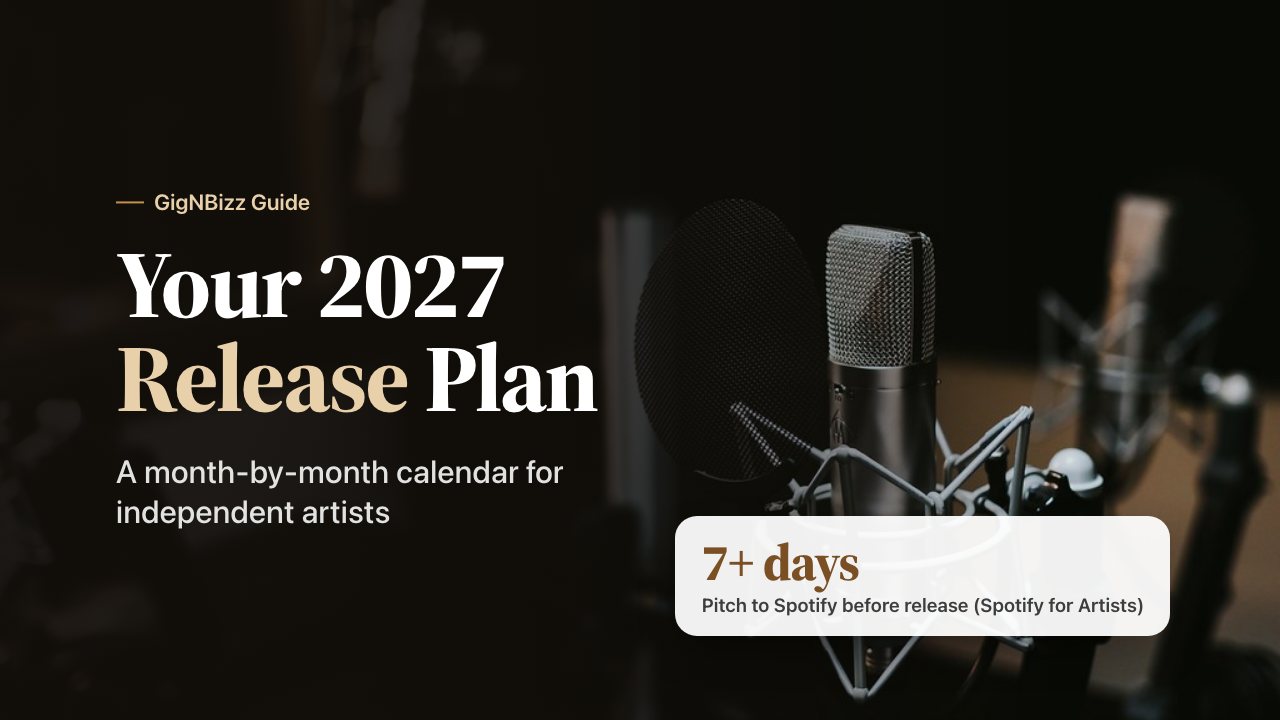
A good 2027 plan for most independent artists is four singles and an EP, about eight weeks apart, each released on a Friday. Upload each song to your distributor about four weeks early and pitch it to Spotify at least seven days before release day. That's our suggestion, not an industry rule, but the lead times behind it come straight from DistroKid, CD Baby, TuneCore and Spotify for Artists. Below is a month-by-month calendar, a countdown checklist for each release, and the 2027 dates worth putting on your wall now.
TL;DR
- Plan four singles and an EP for 2027, about eight weeks apart. Release on Fridays, the industry's global release day since July 2015.
- Upload about four weeks before release. DistroKid says about four weeks, TuneCore three to four, CD Baby at least three (four to six is ideal).
- Pitch Spotify at least seven days before release to reach your followers' Release Radar. Apple Music's pitch deadline is ten days for full consideration. Amazon takes pitches up to 14 days after release.
- Register each song with your PRO (ASCAP or BMI) and The MLC, and file the copyright. Registering within three months of release keeps statutory damages on the table.
- Dates to know: SXSW 2027 showcase applications close November 20, 2026. Grammy rules for 2028 aren't out yet. Bandcamp hasn't announced its 2027 Bandcamp Fridays.
- Book a local release show for the same week as your biggest release.
Table of contents
- How many releases to plan
- The release countdown
- Codes and registrations
- Friday release day, pre-saves and Bandcamp
- Key 2027 dates
- What changed on Spotify in 2026
- Plan a local release show
- FAQ
How many releases to plan
No platform tells you how often to release. What the numbers do show is that steady, long-term releasing pays off. In Spotify's Loud & Clear 2026 report, more than 90% of DIY royalties in 2025 went to artists who had been releasing music for more than a year.
Spotify also only pays recorded royalties on tracks with at least 1,000 streams in the previous 12 months, plus a minimum number of unique listeners it doesn't publish (Spotify for Artists). Ten songs that each get 300 streams earn nothing. Four songs your fans actually play can.
So our suggestion is a rhythm you can keep: a single about every eight weeks, then an EP that gathers them. Eight weeks gives each song a month of build-up and a month of life before the next one, and it leaves time for gigs. If you write fast, go to six weeks. If you're recording with a full band, three singles and an EP is fine. Pick a pace you can hold for the whole year.
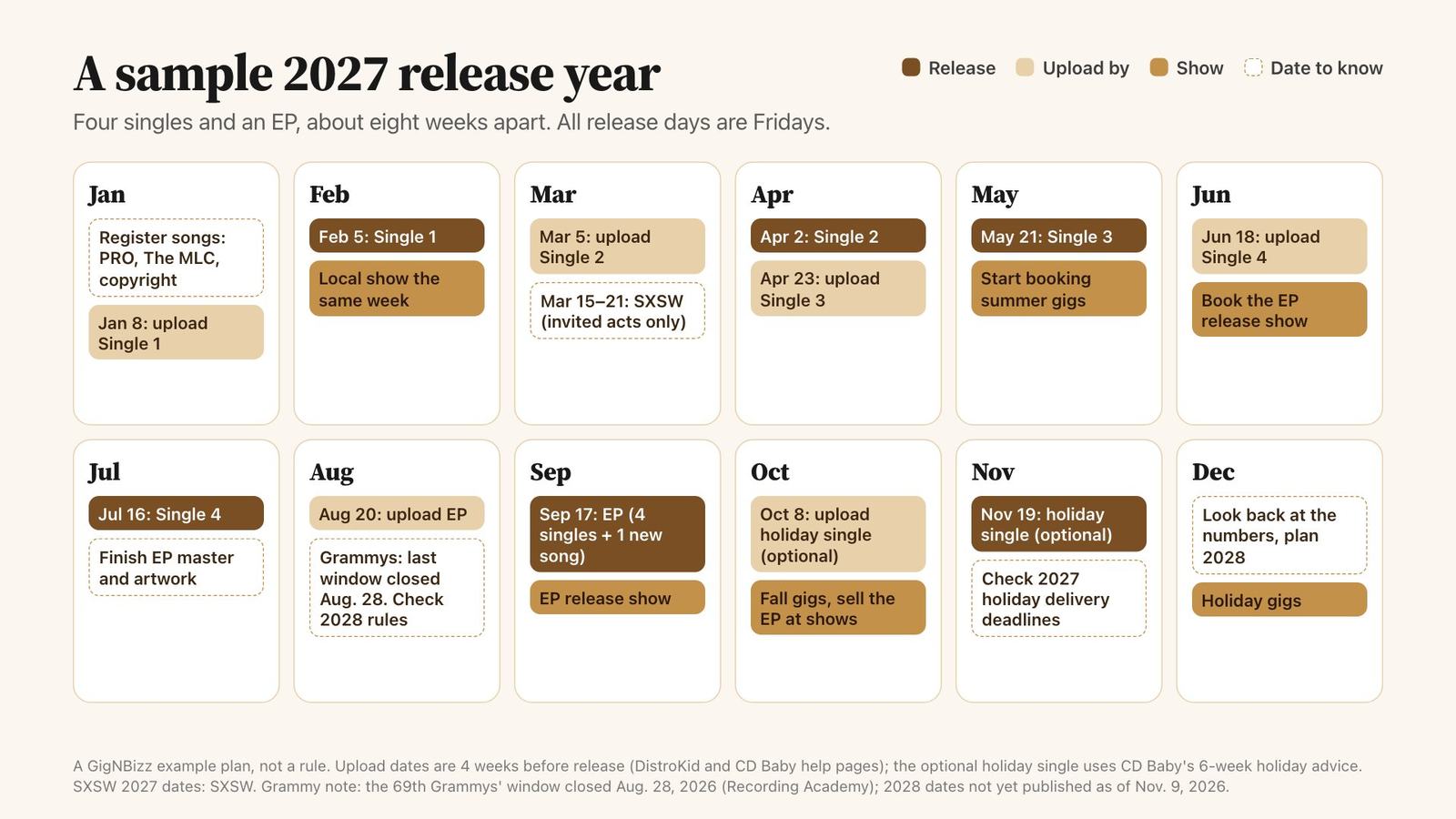
| Release | Upload by | Pitch Spotify by | Release day |
|---|---|---|---|
| Single 1 | Fri, Jan. 8 | Fri, Jan. 29 | Fri, Feb. 5 |
| Single 2 | Fri, Mar. 5 | Fri, Mar. 26 | Fri, Apr. 2 |
| Single 3 | Fri, Apr. 23 | Fri, May 14 | Fri, May 21 |
| Single 4 | Fri, Jun. 18 | Fri, Jul. 9 | Fri, Jul. 16 |
| EP (the four singles plus one new song) | Fri, Aug. 20 | Fri, Sep. 10 | Fri, Sep. 17 |
| Holiday single (optional) | Fri, Oct. 8 | Fri, Nov. 12 | Fri, Nov. 19 |
The "pitch by" date is the last safe day, not the goal. Pitch as soon as the song shows up in Spotify for Artists. We kept releases out of late December on purpose: TuneCore says stores take longer to take in new releases in November and December, and DistroKid has reduced staffing around the holidays. For the EP, pitch its one new song: once a single is out, it can't be pitched again.
The release countdown
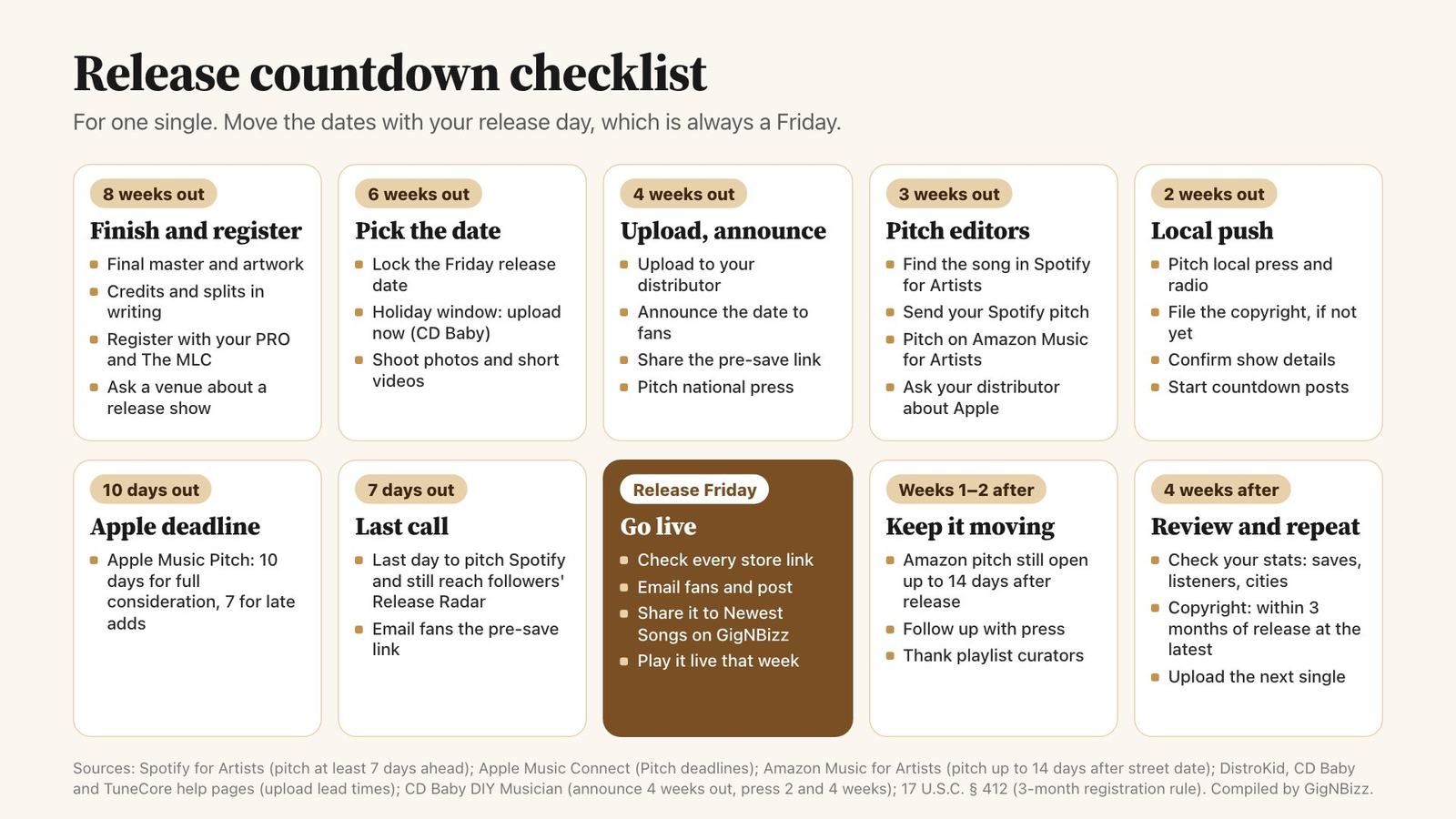
Every release follows the same countdown. Here's how far ahead each step needs to happen, and where those numbers come from.
Distributor lead times
| Distributor | What it advises | Good to know |
|---|---|---|
| DistroKid | Upload about four weeks ahead if you want the release live everywhere on the same day | Picking a future date needs the Musician Plus or Ultimate plan. Cover songs need a license, which can take up to 14 business days. |
| CD Baby | Sign up at least three weeks ahead; four to six weeks is ideal | Inspection takes one to two business days with Fast Forward, or seven to 14 without it. |
| TuneCore | Upload three to four weeks ahead | For playlist consideration, the release must be approved and processed in stores at least two weeks before release day. |
Sources: DistroKid's upload guide, CD Baby's release date help page and TuneCore's live-times page. Four weeks satisfies all three, which is why our calendar uses it.
Pitching to editors
| Service | Deadline | Rules |
|---|---|---|
| Spotify | At least 7 days before release | Pitch in Spotify for Artists. One unreleased song at a time. On-time pitches go to your followers' Release Radar. No guaranteed placement. |
| Apple Music | 10 days for full consideration; 7 days for late adds | Pitching happens in Apple Music Connect, launched in February 2026 for labels, distributors and partners. Ask your distributor if it pitches for you. |
| Amazon Music | Up to 14 days after street date | Pitch in Amazon Music for Artists. New music only, one track per release, from an Owner or Admin on the team. |
Sources: Spotify for Artists, Apple Music Pitch, MacRumors and Amazon Music for Artists. Spotify also says to deliver your music at least seven days before release so editors have time to listen, which is one more reason not to upload late.
Press and fans
CD Baby's single release guide fills in the rest. Tell fans the release date at least four weeks ahead. Pitch national media four weeks out and local media two weeks out. Start a countdown one to two weeks before release, not earlier, so fans don't tire of it. Send one email with the pre-save link a few weeks ahead and one on release day with the streaming links.
A worked example: Single 1 on Feb. 5
- Mon, Nov. 9 to mid-December: finish the master and the artwork. DistroKid recommends 3000 × 3000 pixel square cover art. Write down who wrote what and the splits.
- Before the holidays: register the song with your PRO and The MLC, and file the copyright. Ask two local venues about a show the week of Feb. 5.
- Fri, Jan. 8: upload. Announce the date to fans the same week and share the pre-save link.
- Week of Jan. 11: when the song appears in Spotify for Artists, pitch it. Pitch Amazon too, and ask your distributor about Apple Music.
- Fri, Jan. 22: pitch local press and radio. Confirm the show.
- Fri, Jan. 29: last safe day for the Spotify pitch. Countdown posts begin.
- Fri, Feb. 5: release day. Check every store link, email fans, and share it to Newest Songs on GigNBizz.
- Through Feb. 19: Amazon pitches are still open if you missed it. Follow up with press.
- Early March: look at your saves and listener cities, then upload Single 2 by Mar. 5.
Codes and registrations
Three codes and three registrations follow every song. They're boring, and they're how you get paid.
| Code | What it identifies | How you usually get it |
|---|---|---|
| ISRC | One sound recording or music video, in 12 characters. Not the song itself. | Your distributor. DistroKid creates them free during upload. |
| UPC | The release as a product: the single, EP or album | Your distributor. DistroKid creates these free too. |
| ISWC | The composition: the song, its writers and publishers | Most collecting societies assign one when you register the song. |
One song can have many ISRCs. A live version, an acoustic version and a demo are separate recordings, each with its own code, all tied to one ISWC (Songtrust; IFPI's ISRC site). That matters for the 1,000-stream rule above: streams of the acoustic version don't count toward the original.
Register every song
- Your PRO (ASCAP or BMI). They collect performance royalties for songwriters. ASCAP says you can register a song as soon as you've written it, then add the performer once it's been performed. If a co-writer belongs to a different PRO, you each register with your own.
- The MLC. It collects US digital audio mechanical royalties from streaming and download services and pays members monthly. The MLC says membership is free, and that joining doesn't replace your PRO. If you have no publisher, you're likely a self-administered songwriter and need to join yourself.
- The US Copyright Office. Registering online costs $45 with the Single Application or $65 with the Standard Application on the Copyright Office's fee page today. The Office told Congress in July it plans new fees this fall. Our copyright cost guide covers the proposed $55 and $85 and which application fits a single or an EP.
Why the rush on copyright? Under 17 U.S.C. § 412, if someone copies a published song before you register it, statutory damages and attorney's fees are off the table unless you registered within three months after first publication. Filing before release day is simplest. This is general information, not legal advice.
Friday release day, pre-saves and Bandcamp
Why Friday
Since July 10, 2015, Friday has been the music industry's global release day. The record industry group IFPI coordinated the switch across 45 countries (Wikipedia's summary, citing Billboard and Pitchfork). Release on a Friday and your song comes out on the same day as the rest of the week's new music. On DistroKid's paid plans you can even choose the hour it goes live on Spotify (DistroKid).
Pre-saves
A pre-save lets a fan add your song before it's out, so it's waiting in their library on release day. You can share one as soon as the release is uploaded:
- DistroKid builds a free HyperFollow page for every release that collects Spotify pre-saves.
- Spotify's own Countdown Pages let fans pre-save, preview the tracklist and watch countdown videos, if your profile is eligible.
- TuneCore's release planning guide puts the pre-save link at three weeks out and the full pre-save push at one week out.
Bandcamp Fridays
On Bandcamp Fridays, Bandcamp waives its revenue share, so artists keep all of their sales that day. In 2026 there were eight: Feb. 6, Mar. 6, May 1, Aug. 7, Sep. 4, Oct. 2, Nov. 6 and Dec. 4, each the first Friday of its month (Hypebot). As of November 9, 2026, Bandcamp hasn't announced its 2027 dates. The 2026 list was out by January 1, 2026, so watch for 2027's around the new year. If you sell on Bandcamp, a release or a merch drop on one of those days is worth lining up.
Key 2027 dates
Last checked: November 9, 2026. Confirm each one on the organizer's site before you plan around it.
| Date | What | What to do |
|---|---|---|
| Fri, Nov. 20, 2026 | SXSW 2027 showcase applications close | Apply now if you want to play Austin. The application fee shown is $80. |
| By Fri, Dec. 18, 2026 | SXSW tells applicants if they're invited | Hold the March dates until you hear. |
| Mar. 15 to 21, 2027 | SXSW 2027 in Austin | Invited acts get one official showcase, typically 40 minutes. |
| Late summer 2027 (unconfirmed) | Grammy eligibility cutoff for the 2028 Grammys | The Recording Academy hasn't published 2028 rules yet. The last window ran Aug. 31, 2025, to Aug. 28, 2026. |
| Not yet announced | Bandcamp Fridays 2027 | Watch for the list around the new year. |
| Late Nov. 2027 onward | Holiday delivery slowdown | Upload holiday releases early; check each distributor's 2027 table in the fall. |
SXSW 2027
Showcase applications opened June 23, 2026, the fee went up on September 1, and the final deadline is Friday, November 20, 2026 (Hypebot). SXSW's application page lists the Music Festival Showcase fee at $80 and says applicants will hear back on or before December 18, 2026. It's open to all genres, signed or unsigned. If you're accepted, a single in early March gives you something new to play.
The Grammys
The 69th Grammys, held in 2027, covered recordings released from Aug. 31, 2025, to Aug. 28, 2026 (Recording Academy). The Academy hasn't posted the window for the 70th Grammys in 2028. If it follows the same pattern, music you release in 2027 before late August would count. If entering matters to you, check the 2028 rulebook before you set the EP date.
Holiday cutoffs
Distributors publish their holiday tables in the fall, so 2027's aren't out yet. This year's give you a feel for it. For a Christmas Day release, DistroKid wanted delivery by Dec. 18, 2026, and said uploading three to four weeks early guarantees the date. TuneCore wanted it uploaded and paid for by Dec. 11, 2026. CD Baby recommends submitting at least six weeks ahead for anything from Nov. 27, 2026, to Jan. 1, 2027. That's why our optional holiday single uploads in early October.
Festival applications
Each festival sets its own application window, and many close months before the event. Make a list of the ones near you in January and check each one's site. If you're around the Hudson Valley, start with our 2027 Hudson Valley music festivals guide.
What changed on Spotify in 2026
Most of Spotify's 2026 changes target spam and fake artists, and a few help real ones. Our guide to Spotify's 2026 changes has the details. For a release plan, three matter:
- The 1,000-stream rule still stands. Fewer, stronger releases beat a flood of songs that each fall short.
- Credits count more. Since November 2025, Spotify's Song Credits list everyone behind a song, including engineers and producers, and those credits come directly from labels and distributors. Send full credits with every upload.
- Your profile is part of the release. The Verified by Spotify badge, new in April, looks for a real artist presence on and off Spotify, like concert dates, merch and linked social accounts. Every release show you list helps.
Plan a local release show
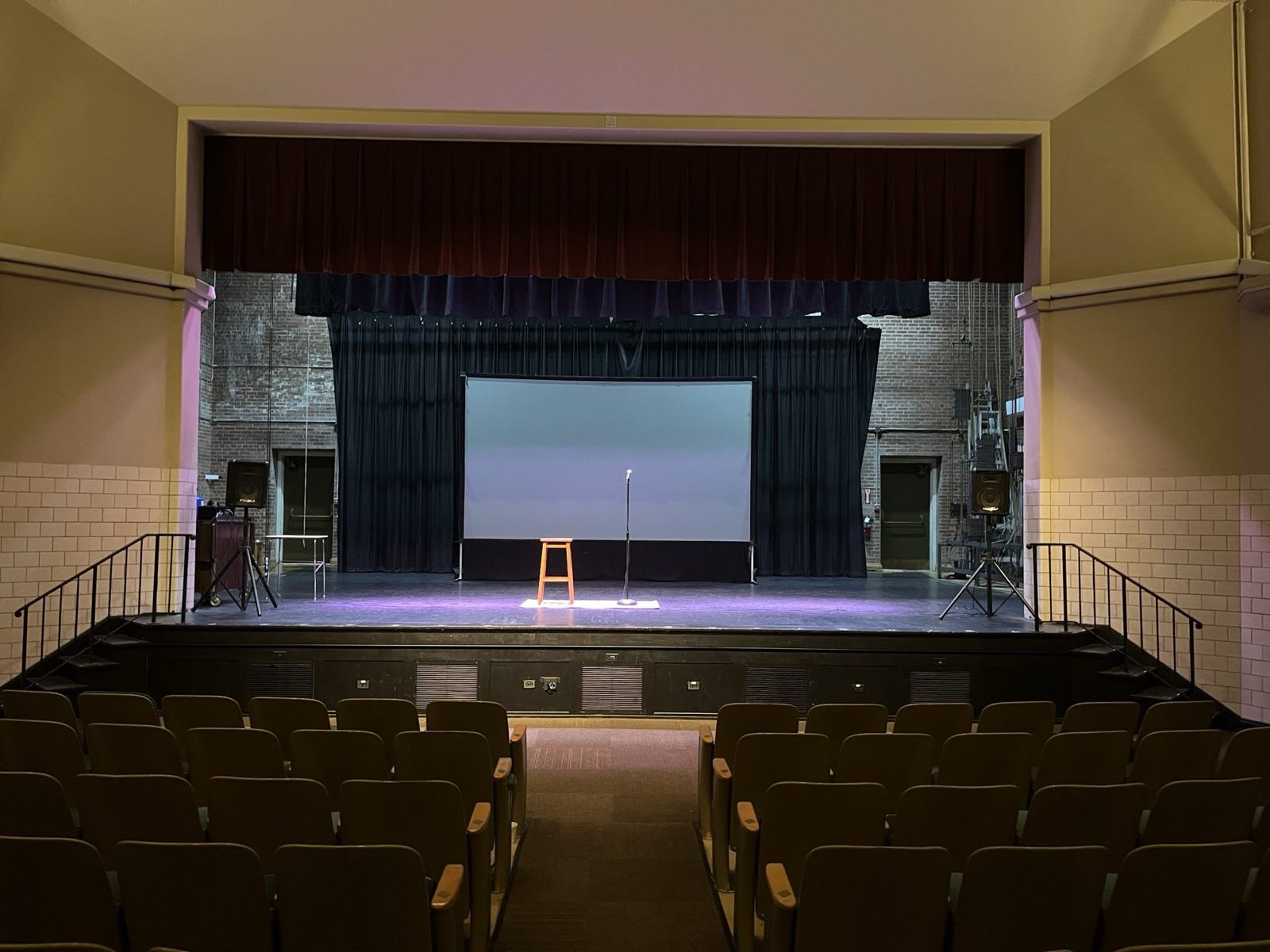
Streams come from strangers. Shows come from people who'll still be there next year. Pairing your biggest release with a local show turns a release date into an event. Here's a simple plan:
- Pick the night first. Aim for release week or the weekend after, and ask the venue eight weeks out. Small rooms book up.
- Ask what the venue needs. Sound system, set length, load-in time, and how you'll be paid. Get it in writing.
- Put it everywhere. Add the show to your socials, your website and your release emails. A release email with a show date gives fans two things to do.
- Bring something to take home. A CD, a shirt or a card with a code to the song. Our guide to selling CDs covers whether it's worth it.
- Play the new song twice. Once mid-set, once near the end. People remember what they hear twice.
- Thank the venue in public. Tag them and post a photo. It makes the next booking easier.
If you've never played your town before, our guides on finding local gigs and open mics and making an EPK are good places to start.
Our perspective
A calendar won't write your songs, but it does take the panic out of releasing them. The artists we see grow aren't the ones with the biggest launch. They're the ones who put out a good song, play it for people in their town, and do it again eight weeks later.
That's why we built the plan around local shows and not just streams. A fan who heard you live at a brewery on a Saturday is the one who saves the next single on Friday.
Share your releases on GigNBizz
GigNBizz is a free community where independent musicians find local gigs and local businesses book them. For your 2027 releases, you can:
- Share each new song from Spotify, Apple Music or SoundCloud to the Newest Songs chart, where other members can hear it.
- Post your release show so it can appear under Shows on Home. Members' shows are approved by our team before they appear.
- Find a venue for that show on Discover: swipe local businesses, connect and settle the date, set and pay directly between yourselves. GigNBizz never handles gig pay.
- Answer open dates that local businesses post, and keep your songs on your profile so bookers can hear you first.
See how GigNBizz works for musicians, read the FAQ, or sign up free.
FAQ
How often should independent artists release music in 2027?
There's no official rule. Our suggestion for most independent artists is a new single about every eight weeks, then an EP that collects them: four singles and an EP in a year. That's enough to keep fans hearing from you without rushing the work.
How far in advance should I upload my song to a distributor?
About four weeks. DistroKid recommends about four weeks if you want your music live everywhere on the same day, TuneCore recommends three to four weeks, and CD Baby says at least three weeks, with four to six ideal. Leave more time around the holidays.
When should I pitch my song to Spotify playlists?
At least seven days before release, in Spotify for Artists. If you do, Spotify adds the song to your followers' Release Radar playlists. You can pitch one unreleased song at a time, and a pitch doesn't guarantee a playlist.
Do I need to register my songs with ASCAP or BMI and The MLC?
If you write songs and want the royalties they earn, yes. A performing rights organization like ASCAP or BMI collects performance royalties, and The MLC collects US digital audio mechanical royalties from streaming services. MLC membership is free, and joining it doesn't replace your PRO.
Why do new songs come out on Fridays?
Since July 10, 2015, the music industry has used Friday as its global release day, a change coordinated by the record industry group IFPI. A Friday release comes out on the same day as the rest of the week's new music.
When is the SXSW 2027 showcase application deadline?
The final deadline is Friday, November 20, 2026. SXSW says applicants will hear back on or before December 18, 2026, and the festival runs March 15 to 21, 2027, in Austin.
Sources
- Spotify for Artists: Pitching music and videos to Spotify playlist editors
- Spotify for Artists: Track monetization eligibility
- Spotify for Artists: Countdown Pages
- Spotify Newsroom: Loud & Clear 2026 (March 11, 2026)
- Spotify Newsroom: Verified by Spotify (April 30, 2026)
- Spotify for Artists: Spotlighting the People, Connections, and Stories Behind Your Music
- Apple Music Connect: Apple Music Pitch
- MacRumors: Apple Music Connect launches for labels and distributors (Feb. 18, 2026)
- Amazon Music for Artists: Pitch
- DistroKid: How to Release Music on DistroKid (updated Nov. 1, 2026)
- DistroKid: If I Specify a Custom Release Date, When Will My Album Appear?
- DistroKid: Setting a Future Release Date
- DistroKid: Holiday Deliveries and Support (updated Nov. 2, 2026)
- CD Baby: When should I set my release date and how long does distribution take?
- CD Baby DIY Musician: How to release a single in 2026
- CD Baby DIY Musician: Music distribution deadlines for 2026
- TuneCore: How long does it take for my music to go live in stores?
- TuneCore: Holiday Season Release Scheduling
- TuneCore: Release Planning 101
- IFPI: International Standard Recording Code (ISRC)
- Songtrust: ISRC vs ISWC
- ASCAP: Registering Your Music FAQ
- The MLC: Self-Administered Songwriters
- U.S. Copyright Office: Fees
- U.S. Copyright Office NewsNet 1090: Proposed Fee Schedule Submitted to Congress (July 14, 2026)
- 17 U.S.C. § 412: Registration as prerequisite to certain remedies
- Wikipedia: Global Release Day
- Hypebot: Bandcamp Friday dates for all of 2026 (Jan. 1, 2026)
- Hypebot: SXSW 2027 music showcase applications open (June 23, 2026)
- SXSW: 2027 Music Festival Showcase application
- Recording Academy: Grammy 101 FAQ
Photos: mitcolab via Flickr (CC0); Abigail Keenan via Wikimedia Commons (CC0); Topher via the WordPress Photo Directory (CC0). Charts: GigNBizz.